
Paniscia Novarese, our family recipe
The traditional Novara dish the way we make it at home in Lumellogno, with the rice we grow in our own paddies.
Our family’s paniscia novarese: Arborio rice from Acqua e Sole in Lumellogno, crumbled salam d’la duja, soaked black-eyed beans, blanched pork rind, finely shredded Savoy cabbage, a generous soffritto of onion, carrot, celery and leek, deglazed with Colline Novaresi DOC. A slow hour-long broth, rice cooked for 16 minutes for the Arborio or 18 for the Carnaroli Classico, mantecatura all’onda with the pirlatura alone, no butter and no Parmesan. Served in warm deep plates, with a turn of freshly milled black pepper.
We who work the paddies in Novara know it well: at home in Lumellogno we make paniscia the way our grandparents always made it. It is a historic dish of the Novara plain, which arrived here together with the rice, the salam d’la duja and a glass of wine from the hills.
For our paniscia we use our own Arborio rice: it is the variety that made the everyday paniscia in Novara, the grain of the plain that holds a soft cook and gives that all’onda consistency we look for. We dry it at low temperature in our Lumellogno drier, and this is why the surface starch stays intact: in the mantecatura you can feel it, it makes the creaminess without needing to add anything.
A small family choice: we make the pulses in our paniscia with black-eyed beans. They cook quickly, stay whole and do not turn the broth bitter. It is the version we cook here at home, and when it comes to the table on a winter Sunday it is the paniscia that truly warms us.
Ingredients for 4 people
Ingredients
- 320 g Arborio rice from Acqua e Sole (or Carnaroli Classico)
- 200 g dried black-eyed beans (soaked 6-8 h)
- 100 g pork rind, blanched
- 40 g aged lardo, finely hand-chopped
- 120 g salam d’la duja, crumbled
- 250 g Savoy cabbage, finely shredded
- 1 medium onion, finely chopped
- 1 carrot, in small cubes
- 1 celery stalk, in small cubes
- 1 small leek, in thin rounds
- 120 ml Colline Novaresi DOC red wine
- 2,5 L cold water for the broth
- 2 bay leaves
- 2 cloves (optional)
- to taste freshly milled black pepper
- to taste salt (only at the end of cooking)
Notes from home
- Parmesan and butter are deliberately left out of the mantecatura: paniscia novarese is served without cheese
- Salam d’la duja is not browned for long: it is a soft salami kept under lard, it only needs warming through
- The broth goes in boiling, never cold, two ladles at a time
- The cabbage goes in halfway through cooking: any earlier and it turns to mush and bitter
- Cooking time for Arborio rice 16 minutes, Carnaroli Classico 18 minutes
- No bicarbonate of soda, no salt while soaking the black-eyed beans
Method
Soaking the black-eyed beans
The night before (or early in the morning) we put the 200 g of black-eyed beans in 1 L of cold water, in a covered bowl at room temperature. No bicarbonate of soda, no salt. Black-eyed beans are more tender than the classic risotto pulses: six to eight hours of soaking is enough, there is no need for the whole night.
Blanching the pork rind
We bring a pan of water to the boil, plunge in the pork rind for 5 minutes, drain, rinse under cold water, pat dry and cut into 5 mm cubes. It is the step that keeps the broth clean from the start, the one the grandmothers did without thinking.
Slow broth
In a large pan we put the blanched pork rind, the drained black-eyed beans, a third of the cabbage, half a carrot, half a celery stalk, half a leek, half an onion, the bay leaves and the cloves. We cover with 2,5 L of cold water. We bring to the boil, skim, lower to a gentle simmer for about an hour, an hour and a quarter at most. We do not salt now: the pork rind and the salam d’la duja will season the dish later. We check the beans halfway through cooking so they do not fall apart.
Separating
At the end of cooking we drain, setting aside the broth (strained if we prefer it visually cleaner), the beans and pork rind on one side, the cooking vegetables discarded. We keep the broth boiling and covered: it will go into the risotto hot, never cold. It is the rule that makes the difference between a paniscia that sings and one that catches.
Lardo base
In a heavy-based pan (tinned copper or triple-bottom steel) we melt the chopped lardo over a low heat for 5-7 minutes, until it releases its fat and the little pieces turn golden. It is the first crumb of good fat that opens the base.
Soffritto vegetables
We add the finely chopped onion, carrot, celery and leek. We stir, salt very lightly, sweat over a medium-low heat for 8-10 minutes until the vegetables are soft and translucent, not coloured. Generous as Novara likes it: the soffritto of paniscia is abundant.
Salam d’la duja
We add the crumbled salami, stir, and let it take on flavour for two minutes. We do not brown it for long: it is a soft salami kept under lard, it only needs warming to release its aroma and its fat.
Tostatura
We raise the heat to medium-high, pour our Arborio over the soffritto, and toast it stirring for two minutes, until the grains are warm to the touch and slightly glossy. The tostatura gives the rice the right hold.
Deglazing
We pour in the 120 ml of Colline Novaresi DOC all at once, and let the alcohol evaporate over a lively heat. Never with a white: paniscia calls for the red of our hills, the same one we drink at the table.
Cooking with broth
We add two ladles of boiling broth. We lower to a medium heat, stir little (every 30-40 seconds), and add broth as the liquid is absorbed. The rice needs to work by itself, not to be pushed.
Adding the cabbage
At the eighth or tenth minute of the risotto we add the finely shredded cabbage, stir, and carry on cooking. Not before: cabbage put in too soon turns to mush and bitter.
Adding the beans and pork rind
At the twelfth or thirteenth minute we add, very gently, the cooked black-eyed beans and the cubes of pork rind. We stir slowly: black-eyed beans are fragile and must be handled calmly so as not to break them.
Final adjustment
At the sixteenth minute for Arborio (eighteenth for Carnaroli) we check the cook: the grain soft on the outside with a slight resistance at the core. We adjust the salt (tasting first) and the freshly milled black pepper. The consistency is all’onda: when you move the pan, the rice forms a slow wave.
Covered rest
We take it off the heat, cover with a lid, and let it rest for a minute or two. It is the moment when the starch settles and the dish finds its balance.
Serving
A vigorous pirlatura with the wooden spoon to bring back the wave, no butter and no cheese: only movement. We serve in warm deep plates, with a turn of freshly milled black pepper. No other garnish: paniscia is, by definition, a humble dish.
Paniscia of Novara, Panissa of Vercelli
Paniscia asks for time, not virtuosity. A good hour of slow broth with the pork rind, the black-eyed beans soaked in the morning, the cabbage finely cut. The rest is rhythm: tostatura, deglazing, broth by the ladle, and a pan that sings quietly. With us, here in Lumellogno, the western hamlet of Novara, it is the dish of winter Sundays, when the cold of the plain comes in through the kitchen door and the paniscia comes out of the pan with its scent of salam d’la duja and of wine from the hills. The Sesia divides two kitchens that are close but different: east of the river, in the province of Novara, the paniscia with cabbage, soft salami and the red wine of Ghemme. West of it, in the province of Vercelli, the panissa, drier, with the beans of Saluggia. The same plain, two different river basins, two different dishes. At home we make paniscia, and we make it with the rice we grow here.
Lumellogno · Novara · Novara Plain
Arborio for every day, Carnaroli for the big occasions
On the rice, here with us there is a small choice to make. For the everyday paniscia our Arborio is the variety of always: large grain, generous surface starch, an accessible price, exactly the country plainness of the dish. We grow it in Lumellogno, the western hamlet of Novara, across our 350 hectares of paddies in a closed supply chain with ISO 9001 certified production, and we dry it at low temperature in our own drier. This is why in the mantecatura it releases its creaminess well without your needing to add butter or cheese. For the great Sundays, our Carnaroli Classico gives a more structured grain, a superior hold, a higher mantecatura: the same supply chain, the same plain, two different characters.
«Paniscia asks for time, not virtuosity. An hour of slow broth, a pan that sings quietly, and the final pirlatura that brings back the wave. No cheese on top: lardo, pork rind and salam d’la duja already give all that is needed. The tradition of our home is clear on this.» From the kitchen of Acqua e Sole, Lumellogno
One last thing: no cheese on top. The tradition of our home is clear on this. The fat of the dish is already enough, lardo, pork rind, salam d’la duja, and adding Parmesan would cover the difference between these three ingredients, it would be a shame. The creaminess does not come from a mantecatura with butter and cheese, it comes from the starch of the rice and the final pirlatura.
Questions about paniscia novarese
What is the difference between Paniscia and Panissa?
Can I use Carnaroli instead of Arborio?
Does Parmesan go on paniscia?
Suggested pairing
For an everyday Sunday a Colline Novaresi DOC, based on Nebbiolo, Vespolina and Croatina: it is the same wine that goes into the pan to deglaze the rice, and it dialogues with the salam d’la duja and with the lardo base. For the great Sundays, a Ghemme DOCG, a local Nebbiolo that here we call Spanna, structured and austere as the dish wants.
For the big occasions, a Gattinara DOCG, long to age, historically prescribed for paniscia. No whites, no Barbera: Barbera is the wine of the Vercelli Panissa, not of ours.
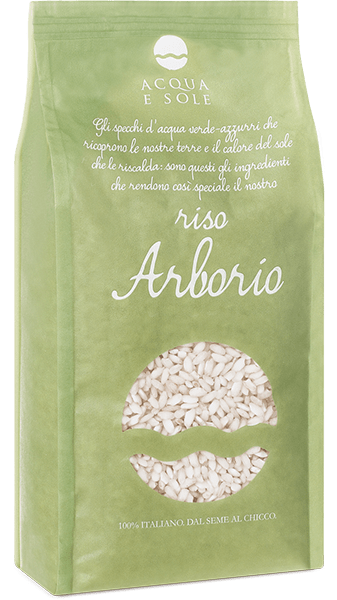
Arborio rice from Acqua e Sole
Our Arborio, grown in Lumellogno and milled in our own rice mill. Large grain, generous surface starch, a soft all’onda consistency, sixteen minutes of cooking. The democratic variety of the everyday paniscia: a closed supply chain with ISO 9001 certified production, low-temperature drying to preserve the surface starch, exactly the country plainness the dish asks for.
Take Arborio homeAn Acqua e Sole family recipe, from our kitchen in Lumellogno.