
Risotto alla Milanese Classico
The codified version of the Lombard tradition: Carnaroli, beef marrow, saffron threads and an all’onda finish (creamy and wave-like) with Grana Padano DOP.
Risotto alla milanese in its classic, codified Lombard version: Carnaroli rice, a soffritto (slowly sweated aromatic base) of onion and beef marrow, meat broth brought to doneness one ladleful at a time, saffron threads dissolved halfway through cooking and a final mantecatura (off-heat creamy stir) all’onda (wave-like) with butter and Grana Padano DOP. No white wine, no raw onion in the dish: the dry version that the Lombard plain has handed down to us.
Here at home, in Lumellogno, risotto alla milanese is one of those dishes you learn within the family before you even know its name. We cook it on Sundays, when the meat broth keeps us company for hours over a low flame and the kitchen slowly fills with its scent. It is the Lombard recipe par excellence, codified in the manuals of regional cookery and handed down from generation to generation, and we of the Novara plain feel it as part of our own land: the Lomellina and the Milanese are neighbouring territories, rice and broth have been on speaking terms for centuries.
The classic version asks for few ingredients and no shortcuts. For our home kitchen we have chosen the Carnaroli Classico from the closed supply chain of Lumellogno: the grain holds up to a long mantecatura, releases its starch at just the right moment and keeps its structure even when the dish cools at the table. We grow it here, we mill it in our own riseria, and it leaves our ISO 9001 certified production with the same care that we put, grain after grain, into the work in the paddy.
Every step carries its own weight: the very slowly stewed soffritto, the dry tostatura (toasting) to set the grain, the boiling broth poured in by the ladle, the saffron threads that give up gold and scent halfway through cooking, and finally the mantecatura all’onda. That old technique whereby the risotto, when you tilt the plate, moves like a slow wave and the grains stay distinct within the golden cream that binds them. You never beat it with a whisk, you stir it with your wrist, just as we were taught here at home.
Ingredients for 4 People
Ingredients
- 500 g Carnaroli Classico Acqua e Sole rice
- 30 g beef marrow
- ½ small onion
- 1 small bunch saffron threads
- 60 g butter
- to taste grated Grana Padano DOP
- to taste meat broth
- to taste salt
Notes from Home
- Carnaroli can be replaced with Arborio or Vialone Nano, but for us here it remains the reference variety for the all’onda mantecatura
- Arborio has large, pearly grains, ideal for softer, creamier risottos
- Vialone Nano gives an excellent yield and holds up well in cooking, a sound Veneto alternative
- As an alternative to the threads, you can use 2 sachets of good quality powdered saffron, added only at the end of cooking
- The risotto should come out all’onda, with the grains distinct but held together by the creamy, golden binding
Method
Prepare the Soffritto
We start from the base, which here at home is never skipped. We peel the onion and chop it finely, then we take the bone and draw out the marrow, gathering it to one side in a small bowl. In a wide saucepan we combine 50 g of butter, the freshly extracted marrow and the onion. We keep the flame very gentle and let it go calmly, until the onion turns translucent and almost dissolves entirely: it must lose all its sharpness and grow soft under the spoon.
Toast the Rice
At this point we pour the Carnaroli from our supply chain into the saucepan. We let it toast for a few minutes, turning it so that every grain takes on the butter and the marrow. We feel with our fingers resting on the rim of the pan: when the edges of the grain turn shiny, almost glassy, and the pan is hot to the touch, the tostatura is ready. On this point here at home we do not compromise: it is the step that decides how the rice holds up during cooking.
Cooking with the Broth
We raise the flame and begin to moisten the rice, one ladleful of boiling broth at a time, stirring unhurriedly with the wooden spoon. Cooking carries on for about 15 minutes, but the minutes are dictated by the grain, not by the clock. When the broth withdraws and is drunk up by the rice, we add another ladleful, always taking care that it stays al dente: a well-cooked risotto is a risotto stopped an instant too soon.
The Saffron
Saffron is the heart of the dish, and as we learnt within the family it must be handled with respect. If we use the threads, we first dissolve them in a little warm broth and add them halfway through cooking: they have the time to give up to the rice all their gold and their deep scent. If instead we only have the powder, we keep it aside and pour it in only at the end of cooking, so that it does not lose its aroma.
Mantecatura all’Onda
And here we come to the final gesture, the one that we of the Novara plain always await with a little pride. We take the saucepan off the heat, add the remaining butter and a good handful of grated Grana Padano DOP. We let it rest for a few minutes, stirring vigorously, then we adjust the salt. The risotto must stay soft, all’onda: when you tilt the plate it moves like a slow wave, the grains well distinct but held by the golden cream that binds them.
Keeping the Tradition
The classic version of risotto alla milanese has been codified in the manuals of regional Lombard cookery as a dry preparation of a few precise gestures: Carnaroli rice for its hold, beef marrow for depth of taste, saffron threads for colour and scent, and the mantecatura all’onda as the final technique. No white wine to deglaze the tostatura, no raw onion in the dish, no shortcuts. Our plain, from the Lomellina to the Milanese, has kept this balance for whole generations, and we here in Lumellogno prepare it in just the same way, because it is the way the land has taught us.
From the Lombard plain to our paddy fields
Why Carnaroli for the classic version
Carnaroli Classico is the variety we always keep in the pantry for our home risotto alla milanese. It has a large grain, high amylose and a resistance to cooking that Vialone Nano and Arborio do not match: it holds up to a long mantecatura without breaking down, releases its starch at just the right moment and keeps its structure even when the dish is served at the table at a leisurely pace. We grow it here in Lumellogno, the western hamlet of Novara, and we mill it in our riseria from paddy to bag: a closed supply chain with ISO 9001 certified production, which lets us know exactly what comes out of our pack.
«Risotto alla milanese is made with Carnaroli and with the wrist: the grain holds up to a long mantecatura, the wrist makes the wave. Without one or the other, it is something else.» From the kitchen of Acqua e Sole, Lumellogno
A practical word of warning: the broth must be boiling when you add it, never lukewarm. If the broth cools, cooking is interrupted, the grain loses its rhythm and the final mantecatura no longer comes out all’onda. Keep the broth pot beside the rice saucepan, always over a low flame.
Questions about Risotto alla Milanese Classico
Why does the classic version not include white wine?
Saffron threads or powder? Does it really make a difference?
How do I know when the mantecatura is “all’onda”?
Recommended Pairing
To go with the classic risotto alla milanese we gladly open a Piedmontese white with character, one that can hold up to the savouriness of the Grana and the depth of the marrow. A well-structured Gavi DOCG works, or an Erbaluce di Caluso Riserva with a few years behind it, bringing lively acidity and minerality. For those after greater complexity, a Timorasso Colli Tortonesi converses beautifully with the saffron.
On the Piedmontese reds, we stay with light wines of good acidity: a young Grignolino del Monferrato served cool, or a Vespolina Colline Novaresi from our parts. Best to avoid the great tannic reds such as Barolo and Barbaresco: the tannin closes up against the saffron and the dish loses its golden balance.
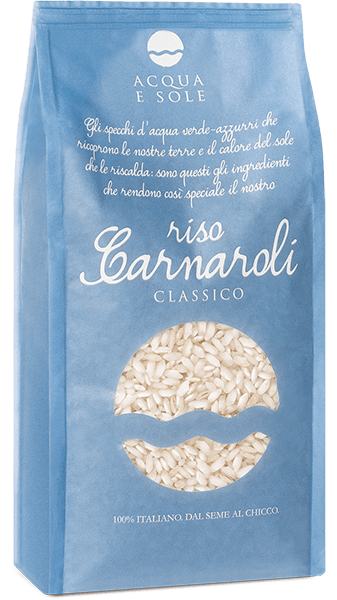
Carnaroli Classico Acqua e Sole Rice
Our Carnaroli Classico, grown in Lumellogno and milled in our riseria. A large grain, high amylose, perfect hold in a long, all’onda mantecatura. The reference variety for the classic risotto alla milanese, and for all the risottos that ask for structure and creaminess together. Closed supply chain, ISO 9001 certification, from paddy to bag always in our own hands.
Take Carnaroli homeA recipe of the Lombard tradition in its codified version, from our kitchen in Lumellogno.