
Risotto with Blueberries and Speck
A creation from the Acqua e Sole kitchen: alpine blueberries puréed, Taleggio DOP folded in during the mantecatura, speck from Alto Adige IGP baked until it turns into a crisp wafer, lemon thyme to tie it all together.
A signature risotto created in the Acqua e Sole kitchen: a meeting of Italian alpine blueberries and speck from Alto Adige IGP. Three layers of flavour built on a strained blueberry purée that stains the grain a deep violet, the creamy mantecatura with Taleggio DOP and Parmigiano, and speck baked in the oven until it becomes a crisp wafer. Lemon thyme and a handful of frozen blueberries at serving close the dish with freshness and a contrast in temperature. A medium-difficulty recipe, for late summer and early autumn, that brings to the table the dialogue between our paddy fields at Lumellogno and the mountains of the North.
Risotto with blueberries and speck is a creation born in our kitchen at Lumellogno, the western hamlet of Novara: not a traditional recipe but a signature dish that tells the story of a dialogue between two Northern Italies, that of our lowland paddy fields and that of the woods and larches of the Dolomites. We liked the idea of bringing alpine blueberries into a savoury kitchen, with no forced sweetness, and of letting them meet speck from Alto Adige IGP, which when baked in the oven turns into a fragrant, scented wafer. Lemon thyme ties it all together and lends a fresh note that lightens the creaminess of the Taleggio DOP.
The classic recipe calls for Sant’Andrea rice, a Piedmontese variety with a medium, full-bodied grain, the perfect canvas to absorb the blueberry purée without losing structure. We don’t have it in our current sacks, but the Carnaroli Classico from our closed supply chain at Lumellogno is the choice we make at home: traditionally Sant’Andrea, but our Carnaroli Classico is excellent for giving creaminess all’onda (a loose, wave-like flow) and holds up wonderfully to the mantecatura with Taleggio and Parmigiano. It is a medium-difficulty risotto, for late summer and early autumn, when blueberries are at their peak and speck starts to stir cravings for bolder flavours again.
Ingredients for 4 People
Ingredients
- 320 g Carnaroli Classico rice
- 320 g fresh blueberries
- 1 L hot vegetable broth
- 150 g Taleggio DOP
- 100 g grated Parmigiano Reggiano
- 100 g butter
- 4 slices thin speck
- 1 shallot
- ½ glass dry white wine
- 4-5 sprigs lemon thyme
- to taste extra virgin olive oil
- to taste salt and pepper
Notes from Home
- Fresh Italian alpine blueberries in July, August and September: they have sugar, scent and a deep colour
- Always keep a handful of blueberries in the freezer to add at serving: the contrast in temperature between the hot risotto and the frozen fruit is part of the dish
- Thin slices of speck from Alto Adige IGP, baked in the oven at 180 degrees until a fragrant wafer: never pan-fried, it loses structure
- Taleggio DOP in cold pieces straight from the fridge for the mantecatura: it melts more slowly and gives creaminess without stringing
- Blueberry purée always strained through a fine-mesh sieve: the cream must be smooth and silky to stain the grain without lumps
Method
Prepare the blueberry purée
We rinse the blueberries under running water. A handful, to freeze straight away, we set aside: it will be needed at the end of cooking for the finish of the dish. All the others go into a small pot with just a film of water on the bottom, medium flame, 3-4 minutes at a simmer, just enough for them to open and release their juice. We blend with a stick blender until smooth, then pass the mixture through a fine-mesh sieve, so the sauce stays velvety, with no peels or skins. We keep it ready by the side of the hob.
Bake the speck in the oven
We bring the oven to 180°C. We lay the slices of speck on a tray lined with baking paper, one beside the other but without touching. We bake for 8-10 minutes, until they turn golden and crisp like a fragrant wafer. We let them cool slightly on the tray, then break them by hand into irregular pieces.
Toast the rice
In a wide, heavy-bottomed pan, we gently soften the finely chopped shallot with a drizzle of oil and a few little leaves of lemon thyme. When the shallot is soft and translucent, we add our Carnaroli Classico and toast it for a couple of minutes over a medium flame, stirring, until the edges of the grain turn translucent. At that point we pour in the white wine and let it evaporate completely.
Cooking and blueberry purée
We carry on as we do with the risotto of our tradition: hot broth, one ladle at a time, stirring calmly. After about 8-9 minutes, when we are halfway through cooking, we fold in the blueberry purée we set aside. The grain takes on a deep, full violet: it is the moment of this recipe we love most. We keep adding broth until the degree of cooking we prefer, all’onda (a loose, wave-like flow).
Mantecatura with Taleggio and Parmigiano
We take the pan off the heat. It is the gesture we always make, here too: first you switch off, then you do the mantecatura (the off-heat creamy stir). We add the Taleggio DOP in small chunks, a good generous grating of Parmigiano Reggiano and the butter, cold, cut into regular pieces. We stir energetically for a good minute, until the risotto spreads out glossy, with an enveloping cream around every grain. We cover and let it rest for 2 minutes.
Plate up
Into each plate we pour the risotto calmly, letting it spread out on its own, without pressing it down with the spoon. On top, in an irregular way, we arrange the broken sheets of crisp speck and those blueberries we put in the freezer at the start: the sudden change in temperature between the boiling rice and the icy fruit is an integral part of the dish, a small surprise we lay claim to. We finish with a few little leaves of freshly picked lemon thyme and freshly ground pepper.
Lowland Paddy Fields and Mountain Larches
Here with us, at Lumellogno, between our paddy fields and the sky there is nothing: the Piedmontese plain opens out flat to the distant profile of the mountains. And yet every now and then we like to put two different landscapes together in the same pot: the rice from our closed supply chain and the blueberries that come down from the Italian alpine valleys at the end of July, where they grow wild among the larches. Speck from Alto Adige IGP, slowly cured in the masi of the Dolomites, closes the triangle: three Northern territories that speak the same language of patience and slow work. When August comes and the blueberries are at their best, this risotto enters our kitchen and reminds us that the Italy of rice and the Italy of the mountains are, at heart, sisters.
Lumellogno · Italian Alps · Alto Adige
Sant’Andrea of tradition, Carnaroli Classico from our home
The classic version of this risotto calls for Sant’Andrea rice: a historic Piedmontese variety, a medium, full-bodied grain, excellent for absorbing the blueberry purée deeply without losing structure. In the sacks that leave our farm at Lumellogno there is no Sant’Andrea today, but the Carnaroli Classico from our closed supply chain is the choice we make at home for this preparation: the large grain holds up to the long cooking, the surface starch gives the creaminess all’onda that is perfect for the mantecatura with Taleggio and Parmigiano, and in a deep plate the experience is the same. It is the rice we always keep in the larder for risottos with a bold character, the ones that want a grain able to carry the flavour without being overwhelmed.
«Blueberries want a grain that withstands the long cooking and holds its colour without falling apart. Our Carnaroli Classico does exactly this: creaminess all’onda, intact structure, a flavour that lets the fruit settle into it.» From the Acqua e Sole kitchen, Lumellogno
A word of caution we feel we should give: do not skip the step of the fine sieving of the blueberry purée. The cream must be glossy, smooth and silky, otherwise the lumps spoil the texture of the dish. And do not forget the handful of frozen blueberries at serving: the contrast in temperature between the hot risotto and the cold fruit is the signature of this creation of ours.
Questions about risotto with blueberries and speck
Which rice do you use for risotto with blueberries and speck?
In which season do you make this risotto?
Can I replace the Taleggio with another cheese?
Suggested Pairing
With risotto with blueberries and speck we like Italian alpine reds of good freshness, which stand up to the speck and dialogue with the tart sweetness of the fruit. We happily open a young Lagrein Alto Adige DOC, with a colour as deep as the dish itself, or a Trentino Teroldego Rotaliano DOC, fresh and with good acidic backbone.
For those who prefer a structured white, a mountain Müller-Thurgau Alto Adige DOC brings minerality and scent that counterpoint the Taleggio. A Sylvaner Valle Isarco DOC also works very well, a wine with a herbaceous note that ties in with the lemon thyme. Avoid important tannic reds such as Barolo or Amarone: at cellar temperature they clash with the sweetness of the blueberry.
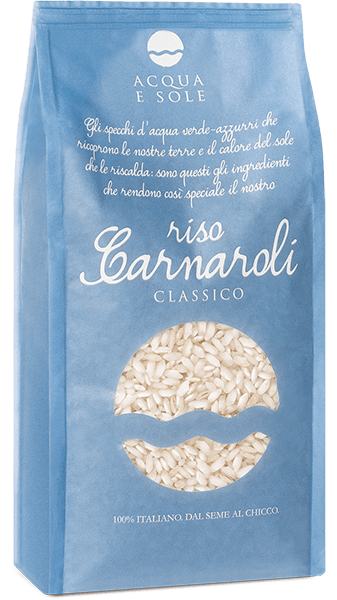
Carnaroli Classico Acqua e Sole Rice
Traditionally the recipe calls for Sant’Andrea, but our Carnaroli Classico from Lumellogno is excellent for giving creaminess all’onda to risotto with blueberries. A large grain, generous surface starch, a structure that holds up to the long cooking and the rich mantecatura with Taleggio and Parmigiano. A closed supply chain with ISO 9001 certified production, low-temperature drying in our own drying plant, a consistent flavour in every sack that leaves our warehouses.
Bring the Carnaroli homeOriginal Acqua e Sole recipe, from our kitchen at Lumellogno.