
Strawberry Risotto with Arborio
The spring risotto made with our Arborio and the local strawberries of May and June, finished without butter and without cheese, with just a thread of extra virgin olive oil.
A late-spring and early-summer risotto made with Acqua e Sole Arborio and Italian field-grown strawberries: a two-batch technique, 300 g diced and added at minute 8 of cooking for body and colour, 100 g raw in thin slices at serving for freshness. Deglazed with dry white wine, light vegetable stock added by the ladle, cider vinegar at minute 11 to balance the sweetness of the fruit. The mantecatura (off-heat creamy stir) is done off the heat with just a thread of delicate extra virgin olive oil, no butter and no cheese. Serve at once in warm deep plates, before the heat fades.
There is a prejudice about strawberry risotto that we want to clear up straight away: that it is an extravagance, a dish out of place, too sweet. It is not so. Strawberries in savoury cooking have a long tradition, and risotto is the best way to bring them to the table without forcing the nature of the fruit. The rule we use at home is simple: the strawberry should be cooked little, the rice should be worked well, and the sweetness of the fruit should be balanced with something acidic. A teaspoon of cider vinegar at the right moment makes all the difference.
For our home version we choose the Arborio from the closed supply chain of Lumellogno, the western hamlet of Novara, and it is no accidental choice. Arborio has a smaller grain than Carnaroli, a more immediate creaminess, and it blends better with the delicate fruit: in the pan it works like a pale pink cream that embraces the strawberry without covering it. It is the right variety when the dish calls for softness and velvet, and when the mantecatura (off-heat creamy stir) is kept clean, off the heat, with a thread of extra virgin olive oil and nothing else.
Ingredients for 4 People
Ingredients
- 320 g Acqua e Sole Arborio rice
- 400 g ripe but firm Italian strawberries (field-grown, May to June)
- 1 small shallot (or sweet white onion)
- 1 L light vegetable stock (carrot, celery, onion, no salt)
- 100 ml dry white wine (Erbaluce di Caluso, Trebbiano d’Abruzzo or Soave Classico)
- 2 teaspoons cider vinegar (or white wine vinegar)
- 4 tablespoons delicate extra virgin olive oil (Garda DOP or Riviera Ligure DOP)
- to taste fine salt, freshly ground black pepper
- as liked fresh mint or basil leaves (to serve)
Notes from Home
- Field-grown Italian strawberries of May and June: ripe, firm, fragrant right up to the stalk
- Out-of-season glasshouse strawberries: not recommended, they have neither sugar nor scent
- Two-batch technique: 300 g diced at minute 8 of cooking for body and colour, 100 g raw in thin slices at the end for freshness
- Mantecatura with delicate extra virgin olive oil added raw only, no butter and no cheese
- Cider vinegar at minute 11 to balance the sweetness of the fruit, without covering it
- Light unsalted vegetable stock, never meat stock: it would cover the strawberry
Method
Cleaning the strawberries and dividing them into two batches
We wash the 400 g of strawberries quickly under cold running water with the stalk still attached, never soaking them. We dry them carefully on a clean tea towel, then remove the stalk. We divide them into two batches: batch A of 300 g, cut into cubes of about 1 cm, which will go into the cooking; batch B of 100 g, in thin 3 mm slices, to keep covered in the fridge for the raw finish.
Boiling stock and a light soffritto
We bring 1 litre of light vegetable stock to a gentle boil in a small pan, then turn it down to the lowest setting and cover it, keeping it beside the risotto pan throughout the cooking, without salting it. In a heavy-bottomed pan we warm 2 tablespoons of extra virgin olive oil, add the very finely chopped shallot, and sweat it over a low heat for 3 minutes until it turns translucent without taking on colour. This is the soffritto (the slow-sweat aromatic base).
The tostatura of the Arborio
We raise the heat to medium-high and pour the 320 g of Arborio over the soffritto. We dry-toast it, stirring with a wooden spoon for 2 minutes, until the grains are hot to the touch and gleam slightly, with the white edge turning transparent. The tostatura (the dry-toast of the rice) seals the grain and prepares the structure of the risotto.
Deglazing with white wine
We pour the 100 ml of dry white wine in all at once over the well-heated rice. We let it evaporate over a high heat for about 1 minute, until the bottom of the pan is dry and there is no more smell of alcohol. The scent of the wine stays in the dish, the alcohol goes.
Cooking with stock by the ladle
We add 2 ladles of boiling stock. We lower to a medium heat. We stir gently every 30 to 40 seconds, adding more stock as the liquid is absorbed, always 1 or 2 ladles at a time. We salt just after the first 5 minutes. The rice needs to work calmly to call out its starch.
Batch A of strawberries at minute 8
At minute 8 of cooking we add batch A, the 300 g of diced strawberries. We stir gently and carry on adding stock as we go. The strawberries will partly break down, releasing their juice, and the rice will take on a natural soft pink colour. This is the moment when the dish begins to find its voice.
Cider vinegar at minute 11
At minute 11 of cooking we add the 2 teaspoons of cider vinegar. We stir and carry on cooking. This is the secret of the dish: the sweetness of the strawberry is balanced by the acidity, and the flavour gains depth without the acidic note coming to the fore.
Checking the cooking and the mantecatura off the heat
At minute 16 we check the cooking of the Arborio: the grain soft on the outside with a slight resistance at the heart, an all’onda (wave-like, loose and flowing) consistency. We adjust the salt if needed. We turn the heat off completely. With the heat off we add 2 tablespoons of delicate extra virgin olive oil raw, no butter and no cheese. A vigorous pirlatura (swirling stir) with the wooden spoon for 30 seconds, alternated with small circular shakes of the pan: the pale pink creaminess rises to the surface.
Batch B of raw strawberries and serving
We add batch B, the 100 g of thinly sliced strawberries set aside, and stir gently so as not to break the slices, which should only be caressed by the residual heat. We cover and let it rest for 1 minute. We serve immediately in warm deep plates, all’onda. A light grind of black pepper, a few decorative slices on the surface, and as liked a leaf of fresh mint or basil. To the table at once, before the heat fades.
The Strawberries of May and June
Here, in Lumellogno, spring comes late and then compresses into two months. Between the end of April and the first days of June, the field-grown Italian strawberries arrive in the markets of Novara, ripe, fragrant, red right up to the stalk, and for a few weeks strawberry risotto takes the place of herb risotto on the table at home. It is a dish we make only in those two months, never before and never after: winter glasshouse strawberries do not have the real sugar of fruit ripened in the sun, and in the pan they give up too much water. Our Arborio, grown here in a closed supply chain, holds the fruit with the right calm and in the mantecatura draws out a pale pink creaminess that makes the dish. When the strawberries are over and the peas arrive, we change the risotto.
Lumellogno · Novara · Piedmontese Spring
Why Arborio for fruit risottos
Strawberry risotto is the dish that best shows why Arborio earns its place. On meat and fish risottos Carnaroli is the prince, and on that we do not argue. But when the rice has to meet a delicate, sweet fruit of short season, the smaller grain of the Arborio and its more immediate creaminess make all the difference: it blends with the fruit, embraces it, brings it to the table without covering it. We grow it at Lumellogno, the western hamlet of Novara, on our 350 hectares of paddy fields in a closed supply chain with ISO 9001 certified production, and it is dried at a low temperature in our drying plant: that step keeps the surface starch intact, and it is the reason why in the mantecatura it gives that pale pink creaminess that makes the dish, with no need for butter and no need for cheese.
«Fruit risottos call for simplicity. Good oil, a touch of acidity to balance the sweetness, and nothing more. The creaminess comes from the starch of the Arborio, not from added fats. The season does the rest.» From the kitchen of Acqua e Sole, Lumellogno
One warning we feel we should give: no butter in the mantecatura, no Grana or Parmigiano. Strawberry risotto calls for clean flavours, and the cheese would cover the scent of the fruit. The two-batch technique, 300 g diced during cooking plus 100 g in raw slices at the end, is the key to the dish: body and freshness in the same deep plate.
Questions about strawberry risotto
Which rice should I use for strawberry risotto?
In which season is strawberry risotto made?
Can frozen strawberries be used?
Does Parmigiano go on strawberry risotto?
Why no butter in the mantecatura?
Suggested Pairing
With strawberry risotto we gladly open a fresh Piedmontese white of good acidity, which acts as a counterpoint to the sweetness of the fruit without covering the fineness of the Arborio. Here the favourite is a still Erbaluce di Caluso DOCG, a wine of the Canavese with marked minerality, perfect for the territorial bond with Lumellogno.
For those who prefer a slightly lively note, a Moscato d’Asti DOCG in its dry version gives sparkle and scent without intrusive sweetness. For the more important occasions, an Alta Langa DOCG Brut Pas Dosé from Pinot Nero and Chardonnay grapes accompanies with elegance. Best avoided are structured reds and aromatic whites such as Gewurztraminer and sweet Moscato.
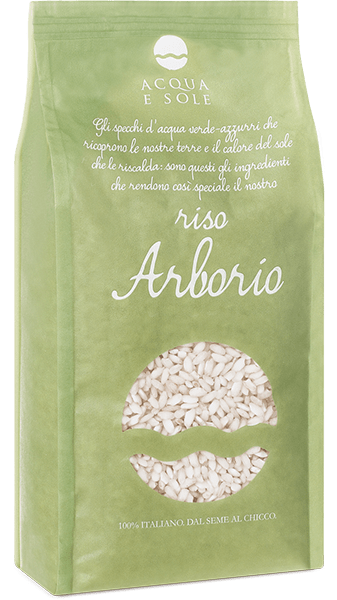
Acqua e Sole Arborio Rice
Our Arborio, grown at Lumellogno and processed in our rice mill. A small grain, generous surface starch, an immediate creaminess that embraces the delicate fruit. The right variety for risottos of fruit and delicate vegetables, where you need soft velvet and a clean mantecatura with no added fats. Closed supply chain with ISO 9001 certified production, drying at a low temperature to preserve the surface starch.
Take Arborio homeOriginal Acqua e Sole recipe, from our kitchen at Lumellogno.