
Risotto alla Parmigiana with Asparagus and Taleggio
A spring risotto from the Po valley: green asparagus, Taleggio DOP in soft clouds, a double mantecatura on our Carnaroli.
A spring risotto from the Po valley tradition: Carnaroli Classico Acqua e Sole, green asparagus split between a green broth and blanched tips, a double mantecatura (the off-heat creamy stir) first with Parmigiano Reggiano DOP aged 24 months and then with Taleggio DOP off the heat. Vegetarian, ready in 45 minutes in total. It is served all’onda (in a flowing wave) in a warm soup plate, with the asparagus tips arranged like rays and a grinding of white pepper at the last moment.
Risotto alla parmigiana with asparagus and Taleggio is the dish of April and May in the homes of the Po valley, when the green asparagus begins to push up from the sandy soils of the Lomellina. It is the first course of the big Sunday lunch, the one that spring brings to the table without asking too much.
For our own version at home we use the Carnaroli Classico from our closed supply chain in Lumellogno: a large grain, rich in amylose, which holds up to the double mantecatura without falling apart. Carnaroli is the variety that Lombard tradition has chosen for the parmigiana, and across our 350 hectares around the village it finds the right water and the right soil. The real technique is just one: the asparagus must be split in two, the stems into the broth for the green colour, the tips blanched separately for the garnish.
Ingredients for 4 People
Ingredients
- 320 g Carnaroli Classico Acqua e Sole rice
- 500 g fresh green asparagus
- 150 g Taleggio DOP (at room temperature, rind removed)
- 80 g grated Parmigiano Reggiano DOP aged 24 months
- 30 g cold butter, cubed
- 100 ml dry white wine (Erbaluce, Timorasso or Soave)
- 1 medium shallot
- 3 tablespoons extra virgin olive oil
- 1 carrot (for the broth)
- 1 celery stick (for the broth)
- 1 small onion (for the broth)
- 1 bay leaf
- 1,5 L cold water (for the broth)
- q.b. fine salt, white pepper freshly ground
Notes from Our Kitchen
- Asparagus split in two: tips blanched separately, stems half into the broth for the green and half into the risotto at minute 8
- Always bring the Taleggio out of the fridge 30 minutes beforehand and add it off the heat: over a live flame it splits and melts too much
- Broth no longer than 25 minutes of boiling: the green turns to grey
- Double mantecatura in two stages: first Parmigiano and butter on the residual heat, then Taleggio after thirty seconds off the heat
- Always remove the Taleggio rind: the ivory paste inside is what creams, the washed rind gives a bitter note
- White pepper at serving, not black: black pepper covers the delicacy of the Taleggio and the asparagus
Method
Cleaning and splitting the asparagus (5 min)
We wash the asparagus under cold water. Cut away the woody base, usually the last 2-3 cm where the stem is hard to the knife. Separate the tips, the final 4-5 cm, from the stems with one clean cut of the knife. Cut the stems into rounds half a centimetre thick, keeping the whole tips to one side. Keep the discarded woody pieces too: they go into the broth.
Green asparagus broth (20 min)
In a 3 litre pan we put the discarded woody pieces of asparagus, half the stem rounds (keep the other half for the risotto), the carrot and celery cut into large chunks, the onion in quarters, the bay leaf. Cover with 1,5 L of cold water. Salt very lightly, just a pinch. Bring to the boil, lower the heat, simmer for 20 minutes covered. Strain through a fine sieve. Keep the broth boiling, covered, over very low heat.
Blanching the tips (3 min)
In a small pan we bring 1 litre of salted water to the boil, ten grams of salt per litre. Drop in the asparagus tips and cook for exactly 2 minutes. Drain and plunge immediately into a bowl of iced water to stop the cooking. After 1 minute drain and pat dry on kitchen paper. Keep to one side: they will go raw onto the plate as a garnish.
Soffritto and dry-toasting the Carnaroli (5 min)
In a heavy-based saucepan we warm the 3 tablespoons of extra virgin olive oil. Add the finely chopped shallot and sweat it gently over low heat for 3 minutes, until translucent, never browned: this is the soffritto, the slow-sweat aromatic base. Raise the heat to medium-high and pour the 320 g of Carnaroli onto the soffritto. Toast it, stirring, for 2 minutes until the grains are warm to the touch and slightly shiny: this is the tostatura, the dry-toast of the rice, and you can hear it, the grains tick under the spoon.
Deglazing with white wine (1 min)
We pour in the 100 ml of white wine all at once. Let it evaporate over a live flame until the base is dry and the alcohol has gone completely. The rice at this point is warm, glossy, and has taken on the aroma of the wine without the alcohol.
Cooking with the green broth and rounds (10 min)
We add 2 ladles of boiling green broth. Lower to medium heat. Stir every 30-40 seconds, adding broth as the liquid is absorbed. Salt sparingly, the Taleggio and the Parmigiano are already savoury. At minute 8 of cooking we add the raw asparagus stem rounds set aside: they need the final ten minutes to come tender but with a base of bite.
Checking the cooking and turning off the heat (1 min)
At minute 18 of the risotto we taste: the grain should be soft on the outside with the slightest resistance at its heart, the all’onda consistency (a flowing wave). Turn off the heat. The risotto should be a little looser than the finish you want, because in the mantecatura it tightens and dries.
Double mantecatura: Parmigiano and Taleggio (2 min)
We add the 30 g of cold cubed butter and the 80 g of grated Parmigiano Reggiano. An energetic pirlatura (the swirling shake) with the wooden spoon: move the pan with small circular jolts for 30 seconds, alternating with firm stirs from the bottom upwards. Off the heat, add the 150 g of Taleggio at room temperature, cut into 1 cm cubes and without rind. Cream quickly for 30 seconds without swirling too much: the Taleggio should stay in clouds, not melt into a uniform mass.
Resting and serving all’onda (2 min)
We cover with a lid and let it rest for 1 minute off the heat, so the starch settles and the Taleggio finishes warming through. Serve in warm soup plates: spoon out the risotto and tap the plate lightly on the board to spread the wave. Garnish with 4-5 blanched asparagus tips per plate, arranged like rays, a grinding of white pepper at the last moment, a drizzle of raw extra virgin olive oil to taste. Serve immediately.
Lumellogno, Lomellina, Val Brembana
In our home, risotto alla parmigiana with asparagus and Taleggio is the first course of an April Sunday, when the green asparagus from the local markets reaches us from the sandy soils of the Lomellina and the paddies of Lumellogno begin to flood for the new season. Our Carnaroli, the asparagus of the Po valley, the Taleggio DOP that comes down from the Bergamo valleys and that in Novara has always been found of good quality: three local treasures of the plain that have always spoken to one another, and that in the pot meet in a single dish. The Lombard parmigiana with its double mantecatura, the asparagus from next door, the cheese of the Val Brembana. Three different voices, one single season.
Lumellogno · Lomellina · Val Brembana
Carnaroli for the mantecature of soft-paste cheeses
Carnaroli Classico is the variety we always keep in the pantry for risottos creamed with soft-paste cheeses, and in this dish it does what it does best. The large grain holds up to the double mantecatura without falling apart: first the Parmigiano Reggiano and the cold butter that draw the starch to the surface, then the Taleggio off the heat that stays in clouds over the creamy bed. We grow it in the 350 hectares around Lumellogno, dry it at low temperature in our own drying plant and process it on site: a closed supply chain that lets us deliver to the pot a Carnaroli with its surface starch still intact.
«For risottos creamed with soft-paste cheeses, Carnaroli is the right grain: it holds up to the double mantecatura, it releases its starch at the right moment, and it keeps the wave right up to the fork. For the asparagus and Taleggio parmigiana it is made just so.» From the kitchen of Acqua e Sole, Lumellogno
One word of warning we feel we should give: the Taleggio must never be added over a live flame. Take it out of the fridge half an hour beforehand, remove the rind, cut it into small cubes and keep it ready next to the pan. The second mantecatura must always be done off the heat, in thirty seconds, leaving the creamy clouds visible on the surface. That gesture is what separates an asparagus parmigiana from a cheese fondue.
Questions about risotto alla parmigiana with asparagus and Taleggio
Which rice should you use for risotto alla parmigiana with asparagus and Taleggio?
How do you get the green colour of asparagus risotto?
Which wine should you pair with risotto alla parmigiana with asparagus and Taleggio?
Recommended Pairing
To accompany this spring parmigiana we like Piedmontese whites with good structure and minerality, which hold up to the double mantecatura and converse with the delicate note of the asparagus. We gladly open an Erbaluce di Caluso DOCG dry with a few years in the bottle, or a young Roero Arneis DOCG for those who prefer a fresher white.
For festive tables, a Piedmont sparkler such as Alta Langa DOCG brut or pas dosé works beautifully: the bubble cleans the richness of the Taleggio and keeps the dish fresh right to the last mouthful.
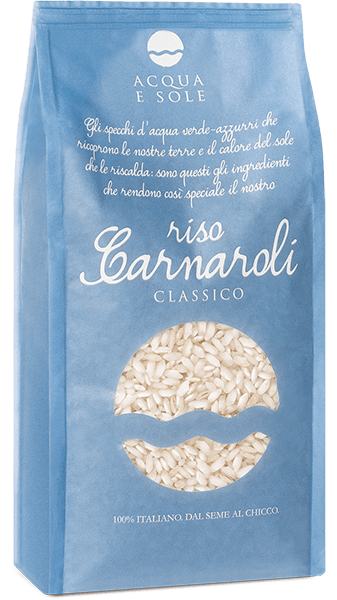
Carnaroli Classico Acqua e Sole rice
Our Carnaroli Classico, grown in the 350 hectares around Lumellogno and dried at low temperature in our own drying plant. A large grain, an internal structure rich in amylose, surface starch intact: it holds up to the double mantecatura of the parmigiana without falling apart and keeps the wave right up to the fork. It is the right variety for risottos creamed with soft-paste cheeses, where the quality of the rice tells most.
Bring the Carnaroli homeOriginal Acqua e Sole recipe, from our kitchen in Lumellogno.