
Artichoke Heart Risotto with Cinta Senese Guanciale
The late-winter dish, where the guanciale di Cinta warms the artichoke hearts and our Carnaroli Classico gives the rich mantecatura we look for.
A late-winter risotto with Carnaroli Classico Acqua e Sole, artichoke hearts cut into thin wedges, guanciale di Cinta Senese cut into strips and browned from cold. The fat of the guanciale becomes the base of the tostatura, and in the mantecatura it works together with the butter and the Grana for a rich, rounded creaminess. The right technique: one third of the guanciale kept crisp for the finish, cautious salting during cooking, vegetable broth two ladles at a time for eighteen minutes. Serve at once in warm deep bowls.
This is the version we make when the late-winter day is still cold and the table needs a dish that warms you. The guanciale di Cinta Senese, cut into thin strips and browned from cold in the pan, releases a savoury fat that becomes the base of the tostatura: the artichokes dive into it, take on character, lose a little of their sharper bitterness and marry with our Carnaroli Classico in a rich mantecatura, where the butter works together with the fat of the guanciale.
The artichoke hearts come from the lands where the crop is at home: the romaneschi of southern Lazio, the violetti of Sant’Erasmo in the Venice lagoon, the spinosi of Albenga in Liguria. Three different families, three different characters, and not one of them invented near us. We grow the rice here in Lumellogno, the western frazione of Novara, but the artichokes are an ingredient that comes to us from afar, and we treat them with the respect they deserve.
The guanciale di Cinta Senese comes from a native pig breed of central Tuscany, raised semi-wild in the woods of the Siena and Grosseto areas. The guanciale is cured for at least three months, the fat has the lightly smoky sweetness we look for to support the artichoke without covering it. When we serve it, the crisp strips set aside go on top at the last moment, and everyone finds their bite of crunch in the deep bowl.
Ingredients for 4 People
Ingredients
- 320 g Carnaroli Classico Acqua e Sole rice
- 8 artichoke hearts (4 medium artichokes)
- 100 g guanciale di Cinta Senese
- 1 medium shallot (about 60 g)
- 1 lemon (juice, for soaking)
- 100 ml dry white wine
- 1 L hot vegetable broth
- 20 g butter
- 50 g grated Grana Padano or Parmigiano
- 1 sprig fresh parsley
- to taste freshly ground black pepper
- to taste fine salt (a little, the guanciale is already savoury)
Notes from Home
- The guanciale di Cinta Senese has the smoky sweetness the artichoke calls for
- A good-quality cured guanciale also works, never pancetta
- Spineless romaneschi artichokes are the easiest to trim
- Lemon-acidulated water is essential: the artichokes blacken in a few minutes
- The guanciale goes into the pan from cold, never over high heat from the start
- Cautious salting during cooking, the guanciale has already done its part
Method
Acidulated water and trimming the artichokes
Fill a large bowl with cold water and the juice of the lemon. Pull off the tough outer leaves of each artichoke down to the tender yellow-green heart, cut off the top by 2-3 cm, peel the stalk removing the outer fibrous layer. Halve them, remove the hairy choke in the centre with a small knife, cut into thin wedges and drop them at once into the lemon water. Allow 15 minutes for four artichokes.
Guanciale from cold
Cut the guanciale di Cinta Senese into thin strips 2-3 mm wide. Put it in a heavy-bottomed pan from cold, turn the heat to low, let the fat melt slowly for 5-6 minutes until the strips are golden and crisp. Take out a third and set it aside on kitchen paper: you will need it for the finish. The recipe carries on in the fat left in the pan.
Shallot in the guanciale base
Add the finely chopped shallot to the guanciale base left in the pan, sweat it for 2 minutes over medium-low heat until it turns translucent. There is no need to add more fat: the fat released by the guanciale is the base of the tostatura.
Artichokes in the soffritto
Drain the artichokes from the acidulated water, pat them dry with a tea towel. Add them to the guanciale and shallot base, raise the heat to medium-high, sauté for 5 minutes, stirring, until they turn tender at the heart and slightly golden at the edges. Salt with caution.
Toasting the rice
Pour the 320 g of Carnaroli Classico straight into the artichokes dry, with no other fat. Toast it, stirring, over a brisk heat for 2 minutes, until the grains are hot to the touch, glossy and slightly translucent at the edges. Deglaze with the 100 ml of dry white wine, let the alcohol evaporate over a brisk heat.
Boiling broth, two ladles at a time
Lower to medium heat. Add the boiling vegetable broth two ladles at a time, stir little (every 30-40 seconds), wait until it has almost dried out before topping up. Carry on like this for 16-17 minutes in total. The rice needs to work itself, not to be pushed.
Taste and adjust
At the eighteenth minute taste it: the grain should be soft on the outside with a slight resistance at the heart. Adjust the salt with caution (the guanciale has already done its part) and the black pepper. The texture is all’onda: when you move the pan, the rice forms a slow wave across the surface.
Rich mantecatura
Take it off the heat, add the 20 g of cold butter in cubes and the 50 g of grated Grana. Cover, let it rest for a minute, then stir it vigorously with a wooden spoon: it is the movement that incorporates air and melts butter and cheese together with the fat of the guanciale, giving a creaminess rounder than the basic version.
Serving with crisp guanciale
Serve at once in warm deep bowls. Scatter the crisp guanciale set aside over each portion, a grinding of black pepper at the moment, the finely chopped fresh parsley. No over-the-top garnishes: the golden strips stay distinct to the last bite and do their job on their own.
The Pig of an Ancient Breed
The Cinta Senese is a native pig breed of central Tuscany, recognisable by the white band that crosses its shoulders over the dark coat. It is raised semi-wild in the woods of the Siena and Grosseto areas, where the animals feed on acorns, roots and wild grasses. It is an ancient breed, worked by generations of Tuscan norcini, and from its fat comes a guanciale with a lightly smoky sweetness, a note of the woods that industrial guanciale cannot reproduce. When we bring it into the kitchen, its fat becomes the base of the dish, not a final detail: it melts from cold, supports the artichokes, accompanies our Carnaroli in the mantecatura. It is the way we have found to bring central Tuscany to the table together with the Piedmontese rice of Lumellogno.
Tuscany · Lumellogno · Closed Supply Chain
The Carnaroli Classico for rich mantecature
Our Carnaroli Classico works here for two precise reasons. First: the surface starch is generous, it comes out in the mantecatura and makes the creaminess with no need to add cream or excessive amounts of butter, leaving room for the fat of the Cinta guanciale that is already working in the dish. Second: it holds its cooking well, a full eighteen minutes with the grain al dente at the heart, and that counts when the dressing is rich and needs supporting. We dry it at low temperature in the drying plant of Lumellogno, the western frazione of Novara where we have our 350 hectares of paddy fields, and this post-harvest care is the reason why in the mantecatura the grain behaves as it should. A closed supply chain with ISO 9001 certified production, from seed to packet: the rice that arrives in your kitchen is the same one we work at home.
«On a rich mantecatura the Carnaroli Classico makes the difference: the surface starch is generous, the cooking hold lets it support the fat of the guanciale, and the grain stays al dente when the dish reaches the table. For risottos that warm late winter it is the right variety.» From the kitchen of Acqua e Sole, Lumellogno
One word of warning we feel we should give: set aside a third of the guanciale already made crisp before you carry on with the recipe. That final bite, the golden strips scattered over the deep bowl at the last moment, is what makes the difference between a good risotto and a memorable one. And in the mantecatura don’t skimp on the stirring: that is where butter, Grana and the fat of the guanciale bind into a rounded cream.
Questions about artichoke and guanciale risotto
What is guanciale di Cinta Senese and why use it here?
Why does the guanciale go into the pan from cold?
Can I replace the Carnaroli Classico with another variety?
Suggested Pairing
For a risotto with a rich mantecatura, fatty guanciale and artichoke, we like a Piedmontese red of medium structure, with gentle tannins and good acidity, that supports the dish without covering it. We are happy to open a Barbera d’Asti DOCG of the year, medium-bodied and ready in its freshness, perfect to cut through the fat of the guanciale and to dialogue with the smoky sweetness of the Cinta.
Alternatively, a young Dolcetto d’Alba DOC offers clean fruit and a soft tannin, a nimble choice for the weekend lunch. Avoid important tannic reds such as Barolo or Barbaresco: at cellar temperature they close up and cover the finesse of the artichoke, leaving the dish out of balance.
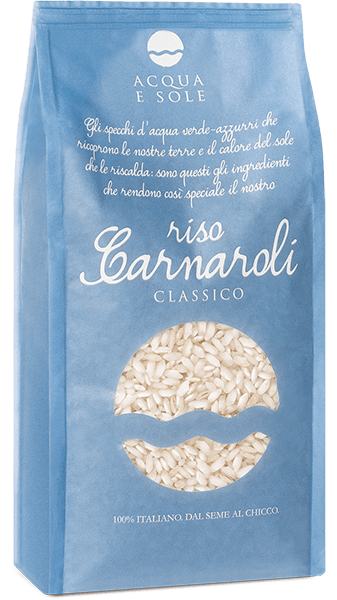
Riso Carnaroli Classico Acqua e Sole
Our Carnaroli Classico, grown in Lumellogno and processed in our rice mill. A long, firm grain, generous surface starch, a high cooking hold of a full eighteen minutes al dente. The right variety for risottos with a rich mantecatura, where the grain has to support a savoury dressing without falling apart and the creaminess must build on the rice’s own natural starch. A closed supply chain with ISO 9001 certified production, dried at low temperature to preserve the surface starch.
Bring the Carnaroli homeOriginal Acqua e Sole recipe, from our kitchen in Lumellogno.