
Creamy Seafood Risotto with Red Prawn Bisque
A true bisque from the shells, Carnaroli Classico from Lumellogno, a clean mantecatura with no butter.
A deep pink seafood risotto with a true bisque of red Mazara prawns and Carnaroli Classico Acqua e Sole from Lumellogno. The bisque is built by toasting the shells, heads and coral at length, deglazing with Cognac and cooking for 35 minutes with tomato and cold water, then blending and passing through a fine sieve twice. The rice cooks for 18 minutes with the boiling bisque, with mussels and clams added all’onda (loose and wavy) at minute 13 and the raw prawn flesh at minute 15. A clean mantecatura (off-heat creamy stir) off the heat with extra virgin olive oil and a few drops of lemon, never butter and never cheese.
When we want a seafood risotto to become a dish for a big Sunday, we reach for the red prawns and make a true bisque, the kind from the old days. It is the difference between a fish stock and a proper sauce of the sea: the shells and heads are toasted until they turn dark, deglazed with Cognac, cooked down hard with tomato, then blended and passed through a fine sieve twice.
The risotto that comes from it is deep pink, dense, with that sweet and faintly bitter base note that only the red crustaceans of the Mediterranean can give. Our Carnaroli Classico from Lumellogno holds up to this sauce without being overwhelmed, because the large grain keeps its structure even inside a liquid this full. We grow it across the 350 hectares around our hamlet, to the west of Novara, and we dry it at low temperature in our own drying plant: this step leaves the surface starch intact, and it is the reason the rice works so well in the pan even with the most structured bisque.
The key technique here is not the rice, it is the bisque. The crustaceans need long toasting, crushing the heads so the coral is released and colours the base. The Cognac cuts the fat and adds aroma, the tomato rounds off the sweetness, the cold water extracts slowly. A mantecatura (off-heat creamy stir) with extra virgin olive oil and a touch of lemon juice to lift the flavour, no Parmesan. The seafood wants to be tasted, not covered. This is a risotto for silence at the table.
Ingredients for 4 People
Ingredients
- 320 g Carnaroli Classico Acqua e Sole rice
- 400 g red Mazara prawns, with shell and head
- 200 g pink prawns or king prawns (garnish)
- 200 g very fresh mussels
- 200 g carpet-shell clams
- 100 g good-quality tomato passata
- 30 ml Cognac or aged brandy
- 100 ml dry white wine (Vermentino or Falanghina)
- 1 shallot and 1 small golden onion
- 1 small carrot and 1 stick of celery
- 2 cloves of garlic
- 4 tablespoons extra virgin olive oil
- 1 bunch of fresh chives
- 1 unwaxed lemon (for a few drops of juice)
- to taste fine salt, freshly ground white pepper
Notes from Home
- Red Mazara prawns are the Mediterranean benchmark, but other red prawns with a sturdy shell work just as well
- The squid from the basic version is left out here: in the bisque it would be too noisy
- Chives replace parsley, the pink of the dish needs protecting, the dark green would muddy it
- Bisque means a passed sauce of crustaceans: no cheese in the mantecatura, ever
- Cooking time for the Carnaroli: exactly 18 minutes from the first addition of bisque
- Always do the mantecatura off the heat, never over the flame
Method
Cleaning the crustaceans
We shell the red prawns, keeping the shells, the heads and the inner coral (the red-orange part that colours the bisque). We set the raw flesh aside, covered, in the fridge. We also clean the pink prawns for the garnish, separating heads and shells to add to the rest of the crustaceans.
Purging the mussels and clams
We scrub the mussels well and remove the beard. We put the clams in cold salted water (35 g of salt per litre) for at least an hour, changing the water twice. The mussels and clams are opened separately, in a covered pan with a drizzle of oil and a clove of garlic: as soon as they open, off the heat. We strain the cooking liquid and set it aside. We shell most of them, keeping 8 mussels and 8 clams whole in their shells for the final plate.
Toasting the shells for the bisque
In a roomy saucepan we heat 2 tablespoons of oil. We add the shells, the heads and the carapaces of all the prawns. We toast over a lively heat for 5 minutes, crushing the heads well with a wooden spoon so the coral is released and colours the base. This is the step that gives the bisque its deep orange colour: there is no rushing it.
The soffritto for the bisque
We add the onion, carrot and celery, finely chopped, to the saucepan with the toasted shells. We do the soffritto (slow-sweat aromatic base) for another 3 minutes over a medium heat, stirring, until the vegetables begin to colour and take on the aroma of the crustaceans.
Cooking the bisque
We deglaze with the Cognac and let it evaporate for a minute over a lively heat. We add the tomato passata and 1.2 litres of cold water. We bring it to the boil, lower the heat and simmer covered for 35 minutes. We blend everything with a stick blender straight in the pan, then pass it through a fine sieve once, and a second time through a muslin or cheesecloth to get a smooth, dense, glossy sauce. We keep the bisque boiling, covered, next to the rice pan. We also add the strained liquid from the mussels and clams to the stock.
The soffritto and the tostatura of the rice
In a heavy-bottomed saucepan we heat 2 tablespoons of extra virgin olive oil. We add the finely chopped shallot and a whole clove of garlic in its skin. We do the soffritto over a low heat for 3 minutes, until the shallot is translucent. We remove the garlic. We raise to a medium-high heat, pour in the 320 g of Carnaroli dry and do the tostatura (the dry-toast of the rice), stirring for 2 minutes, until the grains are warm to the touch and slightly glossy.
Deglazing with white wine
We pour in the 100 ml of white wine all at once. We let it evaporate over a lively heat until the base is dry: the wine must go off completely, alcohol included, before we move on to the bisque.
Cooking the risotto with the bisque
We add 2 ladles of boiling bisque. We lower to a medium heat. We stir every 30 to 40 seconds, adding bisque as the liquid is absorbed. We salt only lightly: the bisque is already savoury thanks to the crustaceans. The rice takes on a deep pink-orange colour straight away, and from this moment the count of the 18 minutes of cooking the Carnaroli begins.
Adding the mussels and clams (at minute 13)
At minute 13 of cooking, we add the shelled mussels and clams (keeping aside the ones in their shells for decoration). We stir gently, just to warm them through: they are already cooked from the opening, and we do not want to cook them twice.
Adding the prawn flesh (at minute 15)
At minute 15, we add the raw flesh of the red prawns and pink prawns cut into large pieces (we keep one whole red prawn per person aside as decoration). We stir gently. It cooks in two minutes, the heat of the rice is enough: cooked any longer they would turn mealy and lose their sweetness.
Checking the cooking and switching off (at minute 18)
At minute 18 we check the cooking of the Carnaroli: the grain should be soft on the outside with a slight resistance at the core, the consistency all’onda (loose and wavy), the base creamy without being dry. We switch off the heat. The mantecatura is always done with the pan off the flame: the residual heat is enough, and it avoids overcooking the rice and the crustaceans.
A clean mantecatura
We add 2 tablespoons of raw extra virgin olive oil and a few drops of fresh lemon juice, just enough to lift the sweetness of the bisque without covering it. A vigorous pirlatura (circular swirling) with a wooden spoon: we move the pan with small circular jolts for 30 seconds, until the starch of the Carnaroli comes to the surface and makes the creaminess. No butter, no cheese.
Resting and chives
We cover and let it rest for a minute. We add the finely cut chives at the very last, and a grind of white pepper. No parsley here: the dark green would muddy the pink of the dish.
Serving all’onda
We serve in warm deep plates. We pour out the risotto and tap the plate lightly on the board to spread the wave: the rice settles on its own, deep pink, dense. On top we set the mussels and clams in their shells, a whole red prawn in the centre, a drizzle of raw extra virgin olive oil. We serve immediately.
When the rice meets the sea
A risotto with red prawn bisque is the acid test for a risotto rice. The liquid is dense, full, almost a sauce: the grain comes into the pan with a serious opponent, because the bisque tends to cover and clag up the rices that have no character of their own. Here the variety really matters, and there is no argument about it. Our Carnaroli Classico, grown across the 350 hectares around Lumellogno, to the west of Novara, and dried at low temperature in our own drying plant, comes into the pan whole with its surface starch intact: it melts into the mantecatura with no need for butter, making a clean creaminess that speaks to the density of the bisque without weighing it down. A closed supply chain, from seed to grain, with ISO 9001 certified production.
Lumellogno · Novara · Closed Supply Chain
Why Carnaroli Classico holds up to the bisque
A creamy seafood risotto with a true bisque is the variety’s test bench. On fish risottos, and even more inside a crustacean sauce this dense, Carnaroli Classico is the choice we make at home. A large grain, a structure rich in amylose: it holds up to the cooking without falling apart, keeps its shape even inside a liquid as full as the bisque, and in the mantecatura it releases the surface starch that makes a clean creaminess with no need for butter or Parmesan. We grow it at Lumellogno, the western hamlet of Novara, on our 350 hectares in a closed supply chain with ISO 9001 certified production, and it is dried at low temperature in our own drying plant: that step keeps the surface starch intact, and it is the reason the rice works so well in the pan even with the most structured bisque.
«On fish risottos no cheese, not even a grating. The Italian tradition is clear, and the flavour of the bisque wants no company. Extra virgin olive oil, a few drops of lemon, chives. That is all.» From the Acqua e Sole kitchen, Lumellogno
One word of caution we feel we should give: the mantecatura must always be done off the heat, never over the flame. The residual heat is enough, and it avoids overcooking the rice and the crustaceans. The vigorous pirlatura with a wooden spoon for 30 seconds draws out the surface starch of the Carnaroli, and that is the creaminess of the dish. Mussels and clams all’onda, never overcooked: they open separately and are warmed through in the last few minutes, inside the cooking rice.
Questions about seafood risotto with bisque
Which rice should I use for a risotto with bisque?
What is the difference between a bisque and a fish stock?
Can I use frozen red prawns for the bisque?
Recommended Pairing
On a creamy seafood risotto with bisque we want a white of good body and marked minerality, one that holds up to the density of the sauce and speaks to the sweetness of the red prawn without covering it. At home we gladly open an Erbaluce di Caluso DOCG still wine, a Canavese wine of solid structure and warm minerality, perfect for its territorial link with Lumellogno.
For those after an alternative with character, a Roero Arneis DOCG of a good vintage, with medium body and a long finish, or a white from the Colline Novaresi of our own parts. Avoid Moscato wines, sweet whites and aromatic whites such as Gewurztraminer: they would cover the aroma of the bisque and clash with the minerality of the sea. No tannic reds.
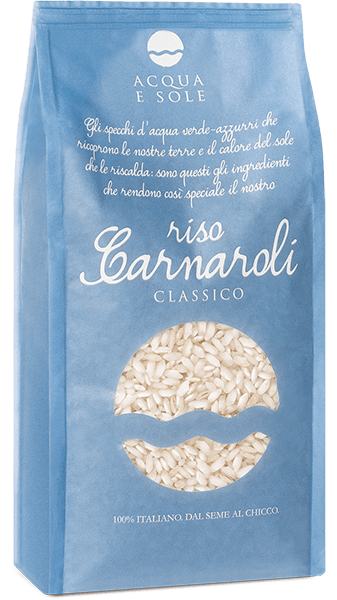
Carnaroli Classico Acqua e Sole Rice
Our Carnaroli Classico Acqua e Sole, grown at Lumellogno and milled in our own rice mill. A large grain, a structure rich in amylose, surface starch left intact that makes a clean creaminess even inside a dense crustacean bisque. The right variety for structured seafood risottos, where you need a rice with character of its own, able to hold up to a full sauce without being overwhelmed. A closed supply chain with ISO 9001 certified production, low-temperature drying.
Bring Carnaroli Classico homeAn original Acqua e Sole recipe, from our kitchen at Lumellogno.