
Risotto with Radicchio and Mild Gorgonzola
The autumn risotto with red radicchio, mild gorgonzola and toasted walnuts, finished with our Carnaroli from Lumellogno.
Risotto with red radicchio from Treviso braised in red wine, finished off the heat with mild gorgonzola DOP that melts into the starch of the Carnaroli, topped with walnuts toasted at the last moment. A vegetarian Lombard-Piedmontese first course for autumn and winter evenings: no cream, mild gorgonzola and never the sharp kind, a gorgonzola mantecatura (the off-heat creamy stir) in place of Grana. Ready in 40 minutes, with our Carnaroli Classico from Lumellogno and our closed supply chain.
Radicchio and gorgonzola are a classic match in Lombard-Piedmontese cooking: the bitterness of the first and the sweet-pungent note of the second balance each other in a rounded, rich dish that asks for cold evenings. For us, who grow rice at Lumellogno, on the Novara plain to the west of Novara, this pairing tastes of home, of the village trattoria, of a November evening after work in the fields.
The difference from the Veneto classic is clear: here we do not finish with Grana, we melt the mild gorgonzola straight into the rice off the heat. The cheese melts into the starch of the Carnaroli and becomes an enveloping cream that takes the dish into more creamy, richer, more comforting territory. For the mantecatura (the off-heat creamy stir) we use the Carnaroli Classico from our closed supply chain: it holds up to cooking without going to mush and binds the gorgonzola without letting it split. A grating of toasted walnuts over the top at serving, and a single rule: mild gorgonzola, never the sharp kind.
Ingredients for 4 People
Ingredients
- 320 g Carnaroli Classico Acqua e Sole rice
- 300 g late red radicchio from Treviso (trimmed, leaves cleaned)
- 100 g mild gorgonzola DOP, diced, at room temperature
- 30 g shelled walnut kernels
- 1 medium shallot
- 100 ml dry red wine (Bonarda, young Barbera or young Nebbiolo)
- 1 L light vegetable broth (celery, carrot, onion, bay leaf)
- 30 g butter for braising
- 20 g cold diced butter for the mantecatura
- 2 tablespoons extra virgin olive oil
- to taste fine salt, freshly ground black pepper
- to taste sprig of fresh thyme (optional)
Notes from Home
- Mild gorgonzola, never the sharp kind: the mild marries the bitterness of the radicchio, the sharp fights it
- Gorgonzola at room temperature before the mantecatura: straight from the fridge it does not melt well into the starch
- Walnuts toasted at the moment of serving, not in advance: cold they lose the crunch and the toasted note
- Braise the radicchio before the rice, always: without the initial braise it stays bitter and fibrous
- No cream in the mantecatura: the gorgonzola already brings its own fat and the creaminess comes from the starch of the Carnaroli
Method
Cleaning and cutting the radicchio
We wash the head of radicchio under cold running water, separating the tougher outer leaves (they are used as well). Dry carefully with a clean tea towel or a salad spinner. Cut away the hard core at the base and discard it. Cut the rest into strips about 5 mm wide. Set aside a handful of leaves cut into a fine julienne for the raw finish, if you like the contrast.
Braising the radicchio (5 min)
In a wide pan we warm the 30 g of butter together with a tablespoon of extra virgin olive oil over a medium-low heat. Add the finely chopped shallot and sweat it for two minutes until translucent. Raise the heat to medium-high and add the cut radicchio. Pour in 50 ml of red wine and let it evaporate for two minutes, stirring. The radicchio should wilt and darken. Season lightly with salt, a grind of pepper, turn off the heat and keep it aside, covered.
Toasting the rice (2 min)
In a heavy-based saucepan we warm the remaining tablespoon of extra virgin olive oil over a medium-high heat. Add the 320 g of Carnaroli dry and toast it, stirring with a wooden spoon, for two minutes, until the grains are warm to the touch and slightly glossy. The tostatura (the dry-toast of the rice) seals the outside and prepares the grain to release its starch well in the steps that follow.
Deglazing the rice with wine
Pour the remaining 50 ml of red wine over the toasted rice. Let it evaporate over a lively heat until the base is dry. The rice takes on a pinkish colour and smells of wine: wait until all the alcohol has gone before moving on to the broth.
Cooking with the broth (10 min)
Add two ladles of boiling vegetable broth. Lower the heat to medium. Stir every thirty to forty seconds, adding broth as the liquid is absorbed. Season lightly with salt, bearing in mind that the gorgonzola at the end is savoury. The rice should cook without rushing, and all we have to do is give it time and broth, a little at a time.
Meeting the braised radicchio (at minute 10)
At ten minutes of cooking we add the braised radicchio along with all the cooking juices from the pan. Stir to blend the colour: from here on the rice takes on the purple vein of the dish. Carry on cooking, adding broth as before.
Checking the cooking (at minute 18)
At eighteen minutes we taste. The grain should be soft on the outside with the very slightest resistance at the heart, and the onda (the wave the rice makes in the dish) should move slowly. Turn off the heat: the mantecatura is always done off the heat, and with gorgonzola the rule is stricter still.
Gorgonzola mantecatura and resting
Off the heat we add the 100 g of diced mild gorgonzola (at room temperature) and the 20 g of cold butter. Stir vigorously with a wooden spoon for thirty to forty seconds, until the gorgonzola has completely melted and the rice is creamy and glossy. The cheese melts into the starch of the Carnaroli and becomes a cream that wraps every grain without covering the radicchio. Cover the saucepan and let it rest for a minute.
Serving with toasted walnuts
In a small pan we dry-toast the 30 g of walnut kernels for one or two minutes over a medium heat, until they smell fragrant: stay close to the pan, they burn in seconds. Chop coarsely with a knife. Spoon the risotto into warm bowls all’onda (loose and flowing), tapping the bowl gently on the board to spread the wave. Scatter over the toasted walnuts, a grind of black pepper and, if you like, a few leaves of fresh thyme. Serve at once.
A November evening at Lumellogno
On November evenings at Lumellogno, after work in the fields, risotto with radicchio and mild gorgonzola is one of those dishes you make without thinking about it. The braised radicchio smells of red wine, the gorgonzola comes from the chilled counter of the village trattoria, the walnuts toast in the little pan while the rice rests. It is a borderland dish: it is born where the Novara plain meets the Oltrepò Pavese and the Bonarda vineyards. No cream, no frills, mild gorgonzola and a Carnaroli that holds. The creaminess comes from there, not from added fat.
Lumellogno · Novara plain
Why the Carnaroli holds the gorgonzola
Risotto with radicchio and gorgonzola is a dish that asks for a rice that holds. The mild gorgonzola brings fat, the braised radicchio brings vegetation water and wine, and the off-heat mantecatura is the moment when everything binds: if the grain does not hold, the wave turns into a shapeless cream. With our Carnaroli Classico the grain stays visible, distinct, supported, and the purple of the radicchio stays a vein in the dish, not a flood.
«The gorgonzola marries the bitterness of the radicchio, but it wants a rice that can hold it up. The Carnaroli dried at low temperature keeps its surface starch intact: in the mantecatura it melts and binds the cheese without letting it split. The creaminess comes from there, not from a spoonful of cream.» From our kitchen at Lumellogno
We grow it at Lumellogno, west of Novara, and we work it on site with low-temperature drying in our own drying plant. It is a closed supply chain with ISO 9001 certified production, from seed to grain, which lets us guarantee the same quality in every pack that leaves our farm. On risotto with radicchio and gorgonzola the difference shows at once: a whole grain even after twenty minutes in the pan, a clean creaminess that never sits heavy.
Questions about risotto with radicchio and gorgonzola
Which rice should I use for risotto with radicchio and gorgonzola?
Can I use sharp gorgonzola instead of the mild kind?
Which wine should I pair with risotto with radicchio and gorgonzola?
Suggested Pairing
To go with this risotto we like medium-bodied reds with good acidity, which hold the mild gorgonzola without fighting it. We happily open a Bonarda from the Oltrepò Pavese, just beyond our own borders, or a young Barbera d’Asti, with the acidity that cleans the fat of the cheese.
For those who prefer a white, a Sauvignon from the Collio holds the dish well with its mineral freshness. Best avoided are the big tannic reds such as Barolo, Amarone or Sagrantino: they fight the gorgonzola and take space away from the radicchio.
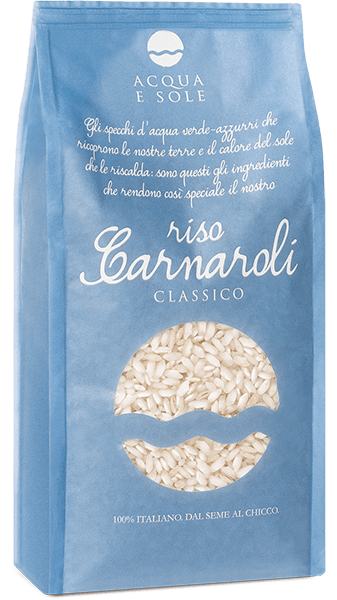
Carnaroli Classico Acqua e Sole Rice
The prince of risottos, grown at Lumellogno and worked in our own rice mill. A large grain, a structure that holds up to cooking without going to mush, surface starch left intact thanks to low-temperature drying. The right variety for risottos with important cheeses such as mild gorgonzola: it binds without falling apart and keeps its creaminess even as it rests in the bowl.
Bring the Carnaroli homeOriginal Acqua e Sole recipe, from our kitchen at Lumellogno.