
Risotto with Radicchio
Treviso red radicchio braised in wine and Carnaroli Classico from Lumellogno. Finished with Grana, no cream, all’onda.
An autumn Veneto risotto with Carnaroli Classico Acqua e Sole, late-season Treviso red radicchio braised separately with shallot, butter and dry red wine, the rice toasted and deglazed with the second half of the wine, cooked for 18 minutes with a light vegetable broth, the braised radicchio stirred in at minute 10, and a traditional mantecatura with cold butter and Grana Padano. 320 g of rice for 4 people, no cream, served all’onda with a julienne of raw radicchio over the top.
There is a misunderstanding about risotto al radicchio that we clear up straight away at home. People think the dish is bitter, and so they keep it at arm’s length as if it were difficult. It isn’t true. Freshly cut radicchio is bitter, of course, but cooking transforms that flavour: the bitterness rounds off, the fibre softens, and what is left on the plate is a faintly winey, bittersweet note that the rice takes in without smothering it. The secret lies in two steps: braising the radicchio before the rice, and finishing with a cheese that balances without dominating.
For our risotto al radicchio we use our own Carnaroli Classico. It is the variety that the Veneto-Lombard tradition of risotto al radicchio has always chosen: a large grain, an internal structure that holds up to cooking without turning to mush, and surface starch that melts during the mantecatura and creates creaminess with the Grana. We grow it across the 350 hectares around Lumellogno, the western hamlet of Novara, and we dry it at low temperature in our own drying plant: the surface starch reaches the pan intact, which is why during the mantecatura it works so well even with a dry cheese like Grana.
The key technique is not the rice, it is the radicchio. The initial braise with butter, shallot and a splash of red wine is the step that makes the dish: five minutes of patience, and the bitterness turns to sweetness. It is a seasonal dish, autumn and winter, for when the radicchio is in full harvest and the evening calls for a first course that warms.
Ingredients for 4 People
Ingredients
- 320 g Carnaroli Classico Acqua e Sole rice
- 1 head late-season Treviso red radicchio (about 300 g trimmed)
- 1 medium shallot (or half a red onion)
- 100 ml dry red wine (Cabernet Franc, Refosco, Bonarda or young Nebbiolo)
- 1 L light vegetable broth (celery, carrot, onion, bay leaf)
- 30 g butter for braising the radicchio
- 30 g cold butter, cubed, for the mantecatura
- 2 tablespoons extra virgin olive oil
- 60 g Grana Padano DOP, freshly grated
- 1/2 unwaxed lemon for the zest (optional)
- to taste fine salt, freshly ground black pepper
Notes from Home
- Late-season Treviso radicchio from November to February: long leaf, wide white rib, firm structure
- The initial 5-minute braise of the radicchio in butter is the key step of the dish, never skip it
- Set aside a handful of fine raw radicchio julienne for a fresh, raw finish, a cool contrast
- A medium-bodied dry red wine, not too tannic: no Barolo or Amarone, far too overpowering
- A light home-made vegetable broth, no stock cube, no meat broth: the bitterness of the radicchio stays in the lead
- A traditional mantecatura with Grana Padano, no cream: the creaminess comes from the starch of the Carnaroli
- Lemon zest at the end reopens the bittersweet note of the radicchio, optional but recommended
Method
Cleaning and cutting the radicchio (5 min)
We start with the radicchio. Wash the head under cold water and dry it carefully with a clean tea towel. Remove the hard core at the base. Cut the rest into strips about 5 mm wide. Set aside a handful of leaves cut into a fine julienne for the raw finish.
Braising the radicchio (5 min)
Now we make the braise, and this is where the dish becomes ours. In a large pan, warm 30 g of butter with 1 tablespoon of extra virgin olive oil over a medium-low heat. Add the finely chopped shallot and sweat it for 2 minutes until translucent. Raise the heat to medium-high, add the cut radicchio and stir. Pour in 50 ml of red wine and let it evaporate over a lively heat for 2 minutes, until the radicchio wilts and darkens slightly. Season lightly with salt and a grind of pepper. Turn off the heat and keep it aside, covered.
The dry-toast of the Carnaroli (2 min)
In a heavy-bottomed pan, warm 1 tablespoon of extra virgin olive oil over a medium-high heat. Add the 320 g of Carnaroli Classico dry and toast it, stirring with a wooden spoon for 2 minutes, until the grains are warm to the touch and slightly glossy.
Deglazing the rice (1 min)
Pour the remaining 50 ml of red wine over the toasted rice. Let it evaporate over a lively heat until the base is dry. The rice takes on a rosy colour that is already a hint of the finished dish.
Cooking with the broth, first 10 minutes
The broth goes in piping hot, two ladles at a time, and we stir little. Add 2 ladles of boiling vegetable broth. Lower to a medium heat. Stir every 30 to 40 seconds, adding broth as the liquid is absorbed. Season lightly with salt, bearing in mind that the Grana at the end is already savoury.
Meeting the braised radicchio (at minute 10)
At minute 10 of the risotto the braised radicchio goes in, along with all its cooking juices from the pan. Stir to blend the colour: from here on the rice takes on the deep purple that turns to pink in the final stages of cooking. Carry on cooking, adding broth as before.
Checking the cooking at minute 18
At minute 18, check the cooking of the Carnaroli: a grain soft on the outside with a slight resistance at the heart, an all’onda consistency, the wave on the plate should move slowly. Turn off the heat.
The Grana mantecatura (1 min)
Off the heat, in goes the cold cubed butter and the grated Grana. Add the 30 g of cold butter and the 60 g of freshly grated Grana Padano. Stir vigorously with a wooden spoon, or move the pan with small circular shakes, for 30 seconds, until the rice is glossy and creamy. The surface starch of the Carnaroli melts and creates the creaminess with no need for cream.
Resting and adjusting (1 min)
Cover the pan with a lid and let it rest for 1 minute off the heat. The rice settles and takes its final wave. Taste, adjust the salt and the freshly ground pepper. If you like, a light grating of unwaxed lemon zest (the yellow part only, not the white): it reopens the bittersweet note of the radicchio.
Serving all’onda with raw radicchio julienne
Pour the risotto into warm shallow bowls. Tap the bowl gently on the board to spread the wave. Garnish with the raw radicchio julienne set aside earlier and a grind of black pepper. Serve at once.
The dish of patience
Radicchio is a vegetable of patience: it wants the cold to give its best, and in the pan it wants time to lose its bitterness and release its sweetness. At home, risotto al radicchio is the dish of November and December evenings, when the late-season Treviso is in full harvest and our Carnaroli waits in the kitchen to be toasted. The initial braise with butter and shallot is the step that makes the dish, and from there the rest is just a matter of boiling broth, patient ladles and a Grana mantecatura. No cream, ever. The Veneto tradition is clear, and we are happy to stay within it.
Lumellogno · an autumn risotto
Why Carnaroli Classico holds its colour here
Risotto al radicchio is one of those dishes where the quality of the rice shows at once, because the dish is so intense in colour and the grain risks vanishing under the winey hue of the braised radicchio. With the wrong rice, the wave becomes a one-colour mush. With a Carnaroli that holds, every grain stays visible, distinct and firm, and the purple of the radicchio remains a vein, not a flood.
«Our Carnaroli Classico reaches the pan whole, with its surface starch intact: it melts during the mantecatura and creates the clean creaminess that the Grana reinforces without weighing it down.» From the Acqua e Sole kitchen, Lumellogno
We grow Carnaroli Classico across the 350 hectares around Lumellogno, the western hamlet of Novara, and we dry it at low temperature in our own drying plant. That low temperature is the technical reason why it works as it should during the mantecatura, even with a dry cheese like Grana. A closed, ISO 9001 certified supply chain, from seed to grain: the rice that reaches your kitchen is the same one we eat at our own table.
Questions about risotto al radicchio
Which rice should I use for risotto al radicchio?
Why does the radicchio need to be braised before adding it to the rice?
Can you make risotto al radicchio without cream?
Suggested Pairing
The rule is simple: drink the same wine you used to deglaze. At home we happily open a young Nebbiolo d’Alba, medium-bodied with a gentle tannin, which echoes the red of the braise and stands up to the elegant bitterness of the radicchio.
As an alternative, a Barbera del Monferrato with good acidity, which cuts through the rich Grana mantecatura, or, for those who prefer a white, a structured Erbaluce di Caluso whose minerality balances the winey note of the dish. Avoid very old and tannic reds such as Barolo or Amarone: far too overpowering for the delicacy of the radicchio.
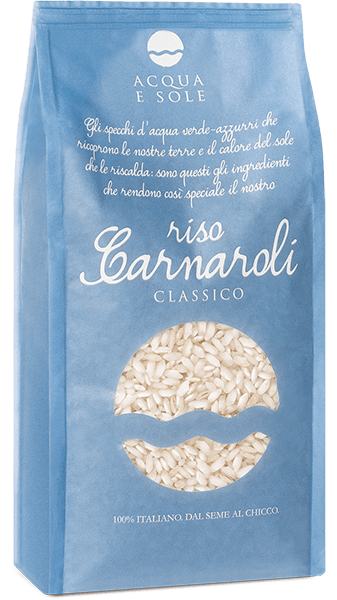
Carnaroli Classico Acqua e Sole Rice
Our Carnaroli Classico, grown in Lumellogno and dried at low temperature in our own drying plant. Generous surface starch, eighteen minutes of cooking resilience, a perfect all’onda mantecatura. The right variety for risotto al radicchio, where the grain has to carry the winey colour of the braise and bind with the traditional Grana mantecatura, no cream.
Bring Carnaroli homeAn original Acqua e Sole recipe, from our kitchen in Lumellogno.