
Porcini Mushroom Risotto
The autumn woodland dish made with our Carnaroli Classico from Lumellogno, fresh porcini and a loose, flowing mantecatura (the off-heat creamy stir).
A Piedmontese autumn risotto made with Carnaroli Classico Acqua e Sole, fresh porcini (Boletus edulis) cleaned dry and cooked two ways (cubes in the soffritto, thick slices sautéed separately), a vegetable stock enriched with the filtered soaking water of the dried porcini, and a traditional mantecatura with cold butter and Parmigiano Reggiano. 320 g of rice for 4 people, the Carnaroli cooked for a full 18 minutes, served all’onda in warm shallow bowls.
Two habits go round about porcini risotto that don’t pass muster in our house. The first is washing the mushrooms under running water: porcini are sponges, they drink it up in seconds, and in the pan they release a watery liquid that dilutes everything. You clean them dry, with a small knife and a brush, and that’s that. The second is the stock cube: with a good homemade vegetable stock, or with the well-filtered soaking water of the dried porcini, the dish becomes a different thing altogether.
For our porcini risotto we use the Carnaroli Classico from home. The mushroom sauce is earthy, deep and full of umami: it wants a large grain, rich in amylose, that holds twenty minutes of cooking without falling apart and binds without smothering. We grow it across the 350 hectares around Lumellogno, the western hamlet of Novara, and we dry it at low temperature in our own drying house: that step keeps the surface starch intact, and it’s the reason it works so well in the mantecatura even with rich sauces like this one.
The key technique of the dish is how the porcini are cut. The firm caps should be cut thick, a good two centimetres, and cooked separately from the rice: one part we sauté and add at the end for texture, the other we work into smaller pieces with the soffritto, so it melts into the risotto and gives flavour.
Ingredients for 4 People
Ingredients
- 320 g Carnaroli Classico Acqua e Sole rice
- 500 g fresh porcini (Boletus edulis), firm caps
- 20 g good-quality dried porcini (a flavour booster)
- 250 ml warm water for soaking the dried ones
- 100 ml dry white wine (Erbaluce di Caluso, Soave or Gavi)
- 1 medium shallot (or half a white onion)
- 2 garlic cloves, left in their skins
- 4 tbsp extra virgin olive oil
- 30 g cold butter, diced (for the mantecatura)
- 40 g Parmigiano Reggiano aged 24 months, grated
- 1 sprig fresh parsley
- 1.2 L light vegetable stock (carrot, celery, onion, bay leaf)
- to taste fine salt, black pepper freshly ground
Notes from Home
- Always clean fresh porcini dry: small knife on the stem, soft brush on the cap, never under running water
- Cook the fresh ones two ways: 300 g in 2 cm thick slices for the sauté, 200 g in 1 cm cubes for the soffritto
- The 20 g of dried porcini should always be added even alongside the fresh ones: the filtered soaking water is the base of the stock
- No stock cube, no rush: a light vegetable stock made in 20 minutes, or just the soaking water of the dried ones, loosened with water
- A dry, non-aromatic, unoaked white wine: avoid oaky Chardonnays, Gewürztraminer, Moscato
- Traditional mantecatura with 30 g of butter and 40 g of Parmigiano, which the Lombard-Piedmontese school allows and recommends here
Method
Soaking the dried porcini (20 min)
We start with the dried ones: put the 20 g of dried porcini in a bowl with 250 ml of warm water (not boiling). Leave them to soak for 20 minutes, because the soaking water becomes the secret of the stock. Once soaked, drain the mushrooms, squeezing them out over the bowl. Filter the water twice through a fine sieve lined with kitchen paper, to remove the grit. Chop the rehydrated dried porcini coarsely.
Cleaning the fresh porcini dry (8 min)
Fresh porcini are cleaned dry, never under water: scrape the stem with the small knife, lift off the grit with a soft brush, check the cap with a barely damp cloth. Cut the porcini into two groups: 300 g in 2 cm thick slices for the garnish sauté, 200 g in 1 cm cubes for the risotto soffritto.
Light vegetable stock (20 min, alongside)
The stock comes together in the time the porcini take: a carrot, a stick of celery, an onion, a bay leaf, and twenty minutes of gentle simmering. In a pan combine 1.2 L of cold water, the roughly chopped vegetables, the bay leaf and the parsley stalks. Bring to the boil, lower the heat, simmer uncovered for 20 minutes. Season lightly with salt. Strain. Add the filtered soaking water of the dried porcini: about 1.3 L in total. Keep it hot over the lowest heat.
Sautéing the thick-sliced fresh porcini (5 min)
The thick caps are sautéed on their own, because in the pan with the rice they would fall apart. In a wide frying pan heat 2 tbsp of extra virgin olive oil with 1 garlic clove in its skin. Add the thick porcini slices. Cook over a high heat without stirring for 2 minutes (for the golden crust), then turn and cook for another 3 minutes. Season with salt at the end. Remove the garlic. Off the heat, add the chopped parsley. Keep covered and warm.
Soffritto with porcini cubes and chopped dried ones (6 min)
In a heavy-based pan heat 2 tbsp of extra virgin olive oil. Add the finely chopped shallot and 1 garlic clove in its skin. Sweat over a low heat for 3 minutes until the shallot is translucent. Add the 200 g of cubed fresh porcini and the chopped rehydrated dried porcini. Turn the heat up to medium and brown for 3 minutes, stirring, until the porcini are hot and lightly coloured. Remove the garlic.
The dry-toast of the Carnaroli (2 min)
Our Carnaroli goes in dry over the porcini base: tip the 320 g of Carnaroli Classico onto the soffritto. Toast over a medium-high heat, stirring, for 2 minutes, until the grains are hot to the touch and faintly glossy. Don’t let them colour too much.
Deglazing with white wine (1 min)
Pour in the 100 ml of white wine all at once. Let it evaporate over a high heat until the base is dry, a good minute or so. The alcohol must disappear completely: only the acidity remains, which cleans the palate and prepares the grain for the stock.
Cooking with the stock, 18 minutes (15 min)
The stock is added boiling, two ladles at a time, and you stir little: the rice needs to work on its own. The first ladle is the one from the soaking of the dried porcini, so it starts off full of flavour. Lower to a medium heat. Stir every 30-40 seconds, adding stock as the liquid is absorbed. Adjust the salt halfway through cooking (just a little: the stock from the dried porcini is already savoury). At minute 18 check the cooking: the grain soft on the outside with a slight resistance at the heart. A flowing all’onda consistency.
Traditional mantecatura (1 min)
On mushroom risottos the traditional mantecatura calls for cold butter and Parmigiano: one of the few occasions when we don’t leave them out. Off the heat, add 30 g of cold diced butter and 40 g of grated Parmigiano. Stir vigorously with the wooden spoon or move the pan with small circular jolts for 30-40 seconds, so the surface starch of the Carnaroli is drawn out and binds everything together. Cover and let it rest for a full minute.
Serving all’onda with the sauté on top (3 min)
Add half of the porcini sauté to the risotto, stirring gently so as not to break them up. Keep the other half for the garnish. Serve in warm shallow bowls: pour in the risotto and tap the bowl lightly on the board to spread the wave. Decorate with the sauté slices set aside, a shower of freshly chopped parsley, a grinding of black pepper, a drizzle of raw extra virgin olive oil. Serve immediately.
The October dish
In our house porcini risotto is the dish of October, of when you come back with a basket from the woods and decide that supper deserves it. The firm caps come from the chestnut and beech woods of upper Piedmont, cleaned dry with the small knife and the brush, never under water. Into the pan goes our Carnaroli Classico, dry-toasted over the porcini base, and the boiling stock made in twenty minutes with the vegetables and the filtered soaking water of the dried ones. It is a dish of substance, rooted in the cooking of the Novara plain, with the traditional mantecatura that the Lombard-Piedmontese school allows here, and it is served all’onda in warm shallow bowls with the slices of sautéed porcini on top.
Lumellogno · woods and rice fields in autumn
Why Carnaroli Classico works well here
Porcini risotto is one of those dishes where the rice does half the work. The mushroom sauce is full and deep, and if the grain doesn’t hold the cooking or doesn’t bind well, the whole dish loses its way: either it turns into a soft mush with no structure, or it stays loose and the porcini keep to themselves in the stock. Carnaroli Classico is the grain that Italian tradition has chosen for situations like this, and in our house we confirm it at every autumn supper.
«Our Carnaroli reaches the pan whole, with its surface starch intact: it melts in the mantecatura, binds the mushroom sauce, and holds the eighteen minutes of cooking without falling apart.» From the kitchen of Acqua e Sole, Lumellogno
We grow Carnaroli Classico across the 350 hectares around Lumellogno, the western hamlet of Novara, and we dry it at low temperature in our own drying house. That low temperature is the technical reason it works as it should in the mantecatura. A closed supply chain certified ISO 9001, from seed to grain: the rice that reaches your kitchen is the same one we eat at the family table.
Questions about porcini risotto
Which rice should you use for porcini risotto?
Why shouldn’t you wash porcini under running water?
Butter or just oil in the mantecatura of mushroom risotto?
Suggested Pairing
To accompany our porcini risotto we like young Piedmontese reds, with measured tannins that stand up to the mushroom sauce without covering it. We happily open a young Nebbiolo d’Alba, fresh and of good structure, which ties in with the shallot base and the rich mantecatura.
As an alternative, a Barbera del Monferrato of medium acidity, which cleans the palate between one forkful and the next, or a young Barbaresco served at cellar temperature for special dinners. Avoid reds that are too structured, such as an aged Barolo, which overwhelm the mushroom.
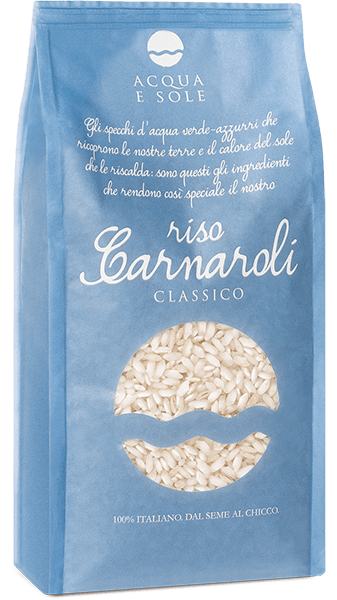
Carnaroli Classico Acqua e Sole Rice
Our Carnaroli Classico, grown in Lumellogno and dried at low temperature in our own drying house. Generous surface starch, eighteen-minute cooking hold, a perfect all’onda mantecatura. The right variety for autumn risottos with full sauces like that of porcini, where the grain must hold up without covering.
Bring Carnaroli homeOriginal Acqua e Sole recipe, from our kitchen in Lumellogno.