
Risotto with Dried Porcini and Black Truffle
Carnaroli Classico, dried porcini given a long soak, brown chestnut mushrooms and black truffle shaved over the plate at serving.
A Piedmontese winter risotto with Carnaroli Classico, 50 g of high-quality dried porcini given a long soak (an hour in warm water), brown cremini chestnut mushrooms cooked separately trifolati (sautéed with garlic and parsley), and a traditional mantecatura (the off-heat creamy stir) with cold butter and 30-month Parmigiano Reggiano. The black truffle, whether prized or summer, goes in only cold, in fine shavings on the already plated dish. White pepper, never black. It is the risotto for the important January dinners, with a glass of young Barbaresco or a structured Pinot Noir alongside.
From November onwards the fresh porcini are gone, and for us who grow rice the mushroom risotto does not disappear for six months: it changes its voice, and becomes the risotto of dried porcini plus black truffle. It is a winter dish that is not the same thing as the fresh one from October, but it stands on its own, and on certain January evenings it is the dish that comes to mind for us first.
For our home version we use the Carnaroli Classico from the closed supply chain of Lumellogno: it holds up to a heavy, dense broth, and binds without covering either the porcini or the truffle. The key technique is the long soak of the dried mushrooms, a full hour in warm water rather than twenty minutes, so that they give back all their flavour to the broth. It is a quiet risotto, of long character.
Ingredients for 4 People
Ingredients
- 320 g Carnaroli Classico Acqua e Sole rice
- 50 g high-quality dried porcini (extra or special grade, not small calibrated ones)
- 800 ml warm water for the soak (long soak, one hour)
- 250 g medium brown chestnut mushrooms (cremini), cut into large pieces
- 20 g prized black truffle (Tuber melanosporum) or summer black truffle (Tuber aestivum)
- 1 medium shallot
- 1 glass dry white wine
- 2 tablespoons extra virgin olive oil
- 1 clove of garlic, skin on (for the sauté)
- 40 g cold butter, diced
- 50 g grated 30-month Parmigiano Reggiano
- 1 tablespoon white truffle oil (optional, sparingly)
- to taste a small sprig of fresh parsley
- to taste fine salt, white pepper freshly ground
Notes from Home
- A long soak of a full hour in warm water, not twenty minutes: the dried mushrooms give everything back to the broth only with time
- Strain the water three times (fine sieve, kitchen paper, muslin): the broth must be clean, mahogany in colour
- Black truffle only cold, in fine shavings over the already plated dish: in the pan the aroma vanishes within a minute
- White pepper, not black: with truffle, black stains the aromatic profile
- Parsley in a small sprig, not in quantity: the truffle wants no company
- White truffle oil only if you like it, sparingly: it covers the truffle if you overdo it
Preparation
Mise en place of the dried porcini (2 min)
Weigh out 50 g of high-quality dried porcini, extra or special grade, not small calibrated ones. Put a small pan with 800 ml of water on the heat and bring it to a warm temperature, not boiling. The right temperature is one you can touch with your hand without discomfort.
Long soak of the dried porcini (60 min)
We put the 50 g of dried mushrooms in 800 ml of warm water (not boiling) and leave them a full hour, no less. The long soak is the step you cannot skip: the dried mushrooms give back all their flavour to the broth only with time, and twenty minutes is not enough. It is the difference between an ordinary risotto and the one we make at home.
Triple straining and chopping of the rehydrated mushrooms (5 min)
At the end of the soak, we drain the mushrooms, squeezing them over the bowl, and strain the water three times: first with a fine sieve, then a second time with kitchen paper, finally a third with muslin. We get about 700 ml of deep mahogany-coloured broth. We chop the rehydrated dried mushrooms finely with a knife.
Preparing the broth (3 min)
No vegetable broth is needed this time. The strained soaking water, topped up with 600 ml of lightly salted boiling water, does all the work. About 1.3 litres of boiling liquid in total, to keep on the heat next to the rice during cooking.
Sautéed brown chestnut mushrooms (6 min)
In a wide pan with 2 tablespoons of oil and 1 clove of garlic, skin on, we sauté the brown chestnut mushrooms cut into large pieces for 6 minutes over a lively heat, until they are golden and the water has evaporated. Salt at the end. We keep them aside, covered.
The soffritto (the slow-sweat aromatic base) with the rehydrated dried mushrooms (4 min)
In a heavy-bottomed pan, a classic soffritto of shallot in a little oil. Then the finely chopped rehydrated dried porcini go in straight away. We brown them for 4 minutes over a medium heat until they bind with the base and scent the pan.
Tostatura (the dry-toast of the rice), deglazing and cooking the Carnaroli (18 min)
The tostatura of the Carnaroli in the soffritto for 2 minutes, until the grains are glossy and warm to the touch. We deglaze with the white wine and let it evaporate. We add the porcini broth one ladleful at a time, cooking for 18 minutes in all. At minute 14 we fold in the sautéed chestnut mushrooms. We adjust with a little salt (the dried-mushroom broth is already savoury). Check the grain at the core at minute 18.
Mantecatura (the off-heat creamy stir) and covered rest (2 min)
Off the heat, 40 g of cold diced butter and 50 g of 30-month Parmigiano Reggiano, with an energetic pirlatura (the brisk stirring of the pan) for 40 seconds. A covered rest of one minute: it is the time in which the rice absorbs the fat and turns creamy without being soupy.
Serving with cold black truffle (3 min)
We serve in warm shallow bowls, and only at this point, over the already plated risotto, fine shavings of fresh black truffle grated with the mandoline (never before, never in the pan). A grinding of white pepper and, if you like, the smallest drop of white truffle oil to finish. No abundant parsley: the truffle wants respect.
The quiet risotto
Here in Lumellogno, when the fresh porcini are gone and outside there is the fog that stays all day, the mushroom risotto does not disappear from the home table. It changes its voice. The high-quality dried porcini spend an hour in a warm soak, the water turns deep mahogany, and our Carnaroli Classico drinks it slowly. The black truffle arrives in fine shavings over the already plated dish, and you sense it in the nose before the mouth. It is the quiet risotto, the one for the long January evenings, that makes you wait and stays in the memory.
Lumellogno · winter rice fields
Carnaroli Classico for the heavy broths of winter
Carnaroli Classico is the variety we always keep in the larder for risottos with character, the ones with a concentrated broth and long flavours. Compared with softer varieties it holds up to a dense base like that of dried porcini without the grain breaking down, it binds in the mantecatura with that traditional creaminess that the Piedmontese look for, and it accompanies delicate flavours like black truffle without covering them. We grow it at Lumellogno and process it on site, from the rice field to the bag: a closed supply chain with ISO 9001 certified production, which lets us guarantee the same quality in every pack that leaves our farm.
«For the risotto of dried porcini and black truffle you need a rice that holds up to a heavy broth without drawing attention to itself. Carnaroli Classico keeps the grain, binds in the mantecatura, and lets the mushrooms and the truffle speak. It is made for the quiet dishes, the ones of long character.» From the Acqua e Sole kitchen, Lumellogno
One word of warning we feel we should give: do not skimp on the quality of the dried porcini. The difference between extra or special grade and small calibrated ones shows immediately in the colour of the soaking water and in the nose of the finished dish. For this recipe it is the first ingredient, not the last.
Questions about risotto with dried porcini and black truffle
Can I use summer black truffle instead of the prized one?
Why a one-hour soak and not the usual twenty minutes?
Why must the black truffle be added only cold?
Recommended Pairing
To go with this winter risotto we like the Piedmontese reds with structure but not aggressive, which hold up to the truffle and converse with the aroma of the dried porcini. We gladly open a young Nebbiolo d’Alba, or a Barbera d’Alba aged in wood, which brings body without covering.
For the real occasions, a young Barbaresco works well too, served at cellar temperature; one of the softer Barolo wines is acceptable if autumn is already well advanced and the dish is truly important. Avoid the whites: with black truffle they lose the comparison.
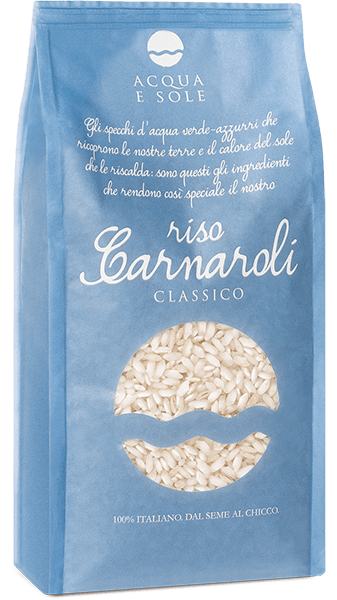
Carnaroli Classico Acqua e Sole Rice
Our classic Carnaroli, grown at Lumellogno and processed in our own rice mill. A long, firm grain with perfect hold in cooking: it stands up to heavy broths and long mantecature without breaking down. The right variety for risottos with character, the ones with a concentrated base and flavours to be left to speak, from dried porcini to black truffle.
Take the Carnaroli homeOriginal Acqua e Sole recipe, from our kitchen in Lumellogno.