
WHOLEGRAIN RICE, OUR GUIDE TO THE THREE ITALIAN WHOLEGRAIN RICES
Our three wholegrain varieties from the Novara plain.
Acqua e Sole’s Italian wholegrain rice is grown at Lumellogno on the Novara plain and comes in three closed-chain varieties: Carnaroli Classico Integrale, Il Moro (black) and Il Cardinale (red). Cook times run from 35 to 45 minutes depending on the variety. There are three ways to cook it: boiled and drained (all’inglese), as a risotto (Carnaroli Classico Integrale only), and oven-baked pilaf (for all three). All are naturally gluten-free, dried at low temperature in our drying house.
Our three Italian wholegrain rices
Wholegrain rice is the same grain as ever, with the bran we have not taken off. That brown veil holds the fibre, the B-group vitamins and the minerals that milling carries away. Here on our fields at Lumellogno, on the Novara plain, we grow three wholegrain varieties from the same closed chain: Carnaroli Classico Integrale, the most versatile and the only one you can also make a real risotto with; Il Moro, a naturally black rice with a toasted, hazelnut-like flavour; Il Cardinale, a red rice with a warm pigment, sweet and lightly spiced. Three different characters from the same plain, all dried at low temperature in our drying house so as not to damage the bran. This guide walks you through the three varieties, the three safe cooking methods and the five benefits of intact bran. Reading time, six minutes.
Wholegrain rice is the same grain as ever, with the bran intact. The bran carries fibre, B-group vitamins and minerals that milling removes. At Lumellogno we dry at low temperature so as not to damage it: it is an agronomic choice before it is a nutritional one.
The 3 wholegrain varieties compared
Carnaroli Classico Integrale
The most versatile. For rustic risottos, side dishes, traditional country first courses.
See product ›Il Moro (black)
A naturally black rice with a toasted flavour reminiscent of hazelnut. Natural pigment, nothing added.
See product ›Il Cardinale (red)
Natural red pigment, sweet and lightly spiced taste. For spices and white meats.
See product ›If you are starting now
Begin with Carnaroli Classico Integrale: the most versatile, the closest in texture to a rice you already know, the only one that holds the mantecatura (the off-heat creamy stir) of a risotto. The shortest cook time of the three.
If you are after salads
Take Il Moro: the black grain that stays firm and crunchy even after hours in the fridge, strong in colour against green, yellow and orange vegetables, white fish and citrus.
If you love spices
Take Il Cardinale: the red has a natural sweetness that binds with curry, sweet paprika, saffron and fennel seeds without taking over. Excellent for peppers and white meats.
All three are naturally gluten-free, keep the germ and the bran, and are dried at low temperature in our drying house at Lumellogno so as not to damage the micronutrients.
The 3 methods for cooking wholegrain rice
Wholegrain rice asks for more time than the refined kind and a different hydration. Three safe methods, each with its own use in the kitchen.
All’inglese, boiled and drained
The simplest. Plenty of salted water in a large pot, then drain. For cold salads or a warm side.
See method › Method 2Wholegrain risotto (Carnaroli only)
Traditional mantecatura with boiling broth. Only Carnaroli Classico Integrale holds the creaminess.
See method › Method 3Oven-baked pilaf (all three)
Absorption in a covered oven, nothing to stir. A separate, reliable result that works for every variety.
See method ›Method 1. All’inglese, boiled and drained
The simplest method, and the one we use at home for Il Moro and Il Cardinale when they end up in cold salads. Boiling in a large pot with plenty of salted water, then draining, cooling for salads or serving warm as a side.
Serves 4
- 320 gAcqua e Sole wholegrain rice (any of the three varieties)
- 3 Lplenty of water (ratio 1 to 10, as for pasta)
- 30 gcoarse salt, 10 g per litre
Bring the water to the boil
In a roomy pot, we bring the 3 litres of water to a brisk boil. Wholegrain rice needs to move freely while it cooks.
Salt and add the rice
We salt the boiling water and wait for it to return to the boil. We pour in the rice in a steady stream and stir once.
Cook to the variety’s time
We cook over a high heat, uncovered: 35-40 minutes for Carnaroli Integrale, 40-45 minutes for Il Moro and Il Cardinale. Taste a grain 5 minutes before the end. A well-cooked wholegrain kernel is soft on the outside and slightly firm at the heart, and never turns to mush.
Drain and cool
We drain in a colander. For cold salads, run straight under cold running water to stop the cooking, then dress with a thread of extra-virgin olive oil to keep the grains from sticking together.
The right result. An al dente grain, separate, lightly glossy if dressed with oil. A base for cold salads, summer one-bowl meals, a side for white meats or fish.
Method 2. Wholegrain risotto (Carnaroli Classico Integrale only)
A risotto with wholegrain rice can be done, but only with Carnaroli Classico Integrale. Il Moro and Il Cardinale do not release enough surface starch and would give a loose result. Longer than a classic risotto (35-40 minutes against 18), plenty of broth, patience.
Serves 4
- 320 gAcqua e Sole Carnaroli Classico Integrale
- 1,5 Lvegetable or meat broth, always boiling
- 1small white onion, finely chopped
- 3 tbspextra-virgin olive oil
- 100 mldry white wine
- 30 gbutter for the mantecatura
- 50 ggrated Parmigiano Reggiano DOP, optional
- to tastesalt, black pepper
Sweat the onion
We sweat the onion in the oil over a low heat until it turns translucent, without colouring it. Calmly, no rush.
Toast the rice
We add the rice and toast it for two minutes, stirring until the grains are hot and glossy. The tostatura (the dry-toast of the rice) of Carnaroli Integrale asks for a moment longer than the refined kind.
Deglaze with the wine
We deglaze with the white wine and let the alcohol evaporate completely before moving on to the broth.
Cook with boiling broth
We add boiling broth two ladles at a time, stirring every 30-40 seconds. Total cook time 35-40 minutes. Wholegrain rice absorbs more liquid than the refined kind: keep the broth always ready on the heat.
Season and mantecare
When the rice is nearly done, we adjust the salt and pepper. Take it off the heat and finish with the mantecatura, stirring in cold butter and parmesan if you like (it is not compulsory: the flavour of Carnaroli Integrale holds up on its own too). Let it rest, covered, for a minute.
Serve in a deep plate
We serve in warm deep plates, with a swirl of raw extra-virgin olive oil. A wholegrain risotto is more rustic than the classic one, a little less fluid, hearty.
The right result. A rustic risotto, al dente grains that stay well defined, a creaminess more restrained than a refined risotto but still there. A full, hearty, country flavour.
Method 3. Oven-baked pilaf (for all three varieties)
The oven-baked pilaf is the safest method for wholegrain rice, and the one we teach to anyone cooking the wholegrain kind for the first time. Cooking by absorption, nothing to stir, always a separate result.
Serves 4
- 320 gAcqua e Sole wholegrain rice (any of the three varieties)
- 640 mlboiling water (ratio 1 to 2, twice the water of refined rice)
- 6 gfine salt
- 20 gextra-virgin olive oil or butter
- optional1 bay leaf, or 1 cinnamon stick, or 1 teaspoon of curry for Il Cardinale
Preheat the oven
We heat the oven to 180 °C, conventional setting. Keep the already-salted water in a separate small pan, ready to bring to the boil when you need it.
Toast the rice
In an ovenproof casserole with a lid, we warm the oil or melt the butter. We add the rice and toast it for 2 minutes, stirring, until the grains are hot and glossy.
Add boiling salted water
We pour in the boiling salted water all at once and add any aromatics (bay, cinnamon, curry for Il Cardinale). Stir just once.
Bake covered
We cover and bake for 40 minutes for Carnaroli Integrale, 45 minutes for Il Moro or Il Cardinale, without lifting the lid again. The steam has to stay shut inside the casserole, it is what cooks the wholegrain kernel.
Rest and serve
We take it out and let it rest, covered, for 5 minutes. Fluff with a fork and serve. It keeps in the fridge, covered, for up to 24 hours and reheats well in a pan with a spoonful of water.
The right result. Dry, separate wholegrain rice, a well-defined grain, lightly glossy. It goes well with curry, white meats, baked fish, spiced vegetables, slow stews.
The 5 nutritional benefits of wholegrain rice
Our principle is a simple one: less processing, more nourishment. The outer bran we leave on the grain is where nature has put the most useful substances. Here is what changes at the table.
-
More fibre, much more
Wholegrain rice contains about four times the fibre of refined white rice. Fibre slows down the absorption of sugars, prolongs the feeling of fullness, supports the digestive transit. The difference shows on the plate: a portion of wholegrain keeps you full longer than a portion of white. Recent studies on dietary fibre confirm the role of the wholegrain cereal in the everyday Mediterranean diet.
-
B-group vitamins intact
The outer bran of the grain is where the B-group vitamins are concentrated, in particular B1 (thiamine), B3 (niacin), B6 (pyridoxine). Milling white rice removes the bran and with it nearly all of these vitamins. Wholegrain rice keeps them all: a portion covers a significant fraction of the daily thiamine requirement, a vitamin our body uses for energy metabolism.
-
Minerals from the bran: magnesium, iron, zinc, phosphorus
It is again in the outer bran that the minerals are found. Magnesium is particularly abundant: wholegrain rice contains about three or four times more than the refined kind. Magnesium is important for muscle function, iron for the transport of oxygen, zinc for the immune system, phosphorus for the bones. These are the minerals the whole grain carries within itself.
-
Natural antioxidants (specific to Moro and Cardinale)
Pigmented rices such as Il Moro (black) and Il Cardinale (red) contain natural pigments from the anthocyanin family and phenolic antioxidants. These are the same compounds found in blueberry, black grape, pomegranate. The colour of the grain is not cosmetic: it is the visible sign of a natural richness in the cereal. Italian pigmented rices have been studied for decades in the cereal research centres of northern Italy for their antioxidant profile.
-
A lower glycaemic index
Wholegrain rice has a glycaemic index that is on average lower than white rice, thanks to the presence of fibre and a less available starch. It means a slower glycaemic response after the meal, a feature useful for anyone keeping an eye on the balance of sugars. It is not a medicinal food, it is simply a complete cereal that behaves better than a refined one.
Why our wholegrain rices taste of more
One thing we do here at Lumellogno, and that few people talk about: our wholegrain rices are dried in the drying house at low temperature, with the warmth of the sun and slow ventilation. It is a choice that pays off on the refined grains and matters even more on the wholegrain ones. The outer bran, the part that on our wholegrain rices stays on the grain, is the most delicate: it holds oils, B-group vitamins, antioxidant substances that degrade easily if the rice is dried at high temperature to go fast. Slow drying preserves all of it. It is why our three wholegrain rices, Carnaroli Integrale, Il Moro and Il Cardinale, have a full flavour, a bran left intact and visible to the naked eye, and a freshness that lasts in the bag. Three varieties, three different characters, a single closed chain on the Novara plain. Try all three, one at a time: you will work out for yourself which is yours, and most likely over time you will keep them all in the cupboard, as we do at home.
The nutritional values in detail
Indicative nutrition table per 100 g of raw rice
| Parameter | Wholegrain | Refined |
|---|---|---|
| Energy (kcal) | 340-350 | 340-350 |
| Fibre | about 4 times more | baseline |
| Magnesium | about 3-4 times more | baseline |
| Thiamine (B1) | about double | baseline |
| Glycaemic index | on average lower | on average higher |
The figures are indicative and vary slightly from one variety to the next. Calories are practically equivalent between wholegrain and refined: the difference is not the quantity, it is the nutritional quality of those calories.
What changes between Carnaroli Integrale, Il Moro and Il Cardinale at the nutritional level
The three wholegrain varieties share the same base profile: high in fibre, B-group vitamins intact, minerals from the bran (magnesium, iron, zinc, phosphorus).
The specific quality of Moro and Cardinale is the natural pigment: anthocyanins and phenolic antioxidants from the class of compounds found in blueberry and black grape. The colour of the grain is not cosmetic, it is the visible sign of a natural richness in the cereal.
Carnaroli Classico Integrale has no pigments but keeps the structure of Carnaroli with the nutritional richness of the whole bran. For anyone starting out with wholegrain it is the natural first choice.
Frequently asked questions about wholegrain rice
Which wholegrain rice suits salads best?
For cold salads, Il Moro is the natural choice. The black wholegrain grain keeps a crunchy, firm texture even after hours in the fridge, and in colour it makes a beautiful contrast with green vegetables (rocket, lamb’s lettuce), yellow ones (sweetcorn, peppers), orange ones (carrots, salmon). As an alternative, Il Cardinale works very well in warm autumn salads with pumpkin, pomegranate, hard cheeses. We use Carnaroli Classico Integrale less often for salads because it tends to be softer when cold, but it suits a creamy salad with avocado or goat’s cheese.
How long should you cook wholegrain rice?
Standard times for our three varieties:
- Carnaroli Classico Integrale: 35-40 minutes, boiled or pilaf. 35-40 minutes as a risotto too, always longer than refined Carnaroli.
- Il Moro (black): 35-45 minutes, boiled or pilaf.
- Il Cardinale (red): 35-45 minutes, boiled or pilaf.
In every case the rule is one and the same: taste a grain 5 minutes before the end to fine-tune the last stretch of cooking. Wholegrain rice never turns as soft as the refined kind, and that is not a fault: it should stay slightly al dente at the heart.
Can I make a risotto with wholegrain rice?
Yes, but only with Carnaroli Classico Integrale. Il Moro and Il Cardinale do not have enough surface starch to bind the mantecatura of a risotto and would give a loose, dry result. Carnaroli Integrale, on the other hand, is the only Italian wholegrain rice that allows a real risotto, even if longer (35-40 minutes against the 18 of refined Carnaroli) and with more broth. It works very well for rustic autumn risottos: with leeks, with pumpkin, with porcini mushrooms, with late radicchio.
Does wholegrain rice contain gluten?
No, wholegrain rice is naturally gluten-free, like every variety of Oryza sativa. All our rices, refined and wholegrain, are gluten-free by nature. For anyone living with coeliac disease, wholegrain rice is an excellent everyday alternative to refined rice, with the nutritional advantage of intact bran. Take care with the preparations, though: a wholegrain pasta may contain gluten, but a grain of Italian wholegrain rice does not, ever.
Which is the best wholegrain rice for beginners?
Carnaroli Classico Integrale. It is the most versatile of the three, the closest in cooking texture to a rice you already know, the only one that lets you make a risotto too. The shortest cook time among our three wholegrain varieties (35-40 minutes against 35-45 for the pigmented ones). It is the wholegrain rice we use in our own home as the first step when we suggest to a friend they try wholegrain in place of white: the leap in the kitchen is minimal, the nutritional gain is already full.
What is the nutritional difference between wholegrain and refined?
The outer bran of the grain contains most of the fibre, the B-group vitamins, the minerals (magnesium, iron, zinc) and the antioxidant substances. Milling, which produces white rice, removes this bran and with it nearly all of these nutrients. In round numbers: wholegrain rice has about four times the fibre, three or four times the magnesium, double the thiamine (B1) compared with refined white rice. The glycaemic index is on average lower. In calorie terms they are practically equivalent (about 340-350 kcal per 100 g for both, raw): the difference is not the quantity of calories, it is the nutritional quality of those calories.
What is the difference between wholegrain rice and semi-wholegrain rice?
The wholegrain keeps the complete bran, while the semi-wholegrain removes it partly with a mild whitening. At Acqua e Sole we produce only wholegrain varieties with intact bran or refined varieties, not semi-wholegrain: it seems to us a middle road that loses the benefits of the bran without really shortening the times. The nutritional profile and cook times of the semi-wholegrain sit halfway, closer to the refined for fibre and B-vitamins.
How much water to cook wholegrain rice in the oven?
For a baked wholegrain rice pilaf the ratio is 1 to 2: for 320 g of rice you need 640 ml of water, twice the ratio of refined rice (1 to 1.5). Water already salted, brought to the boil, poured all at once over the toasted rice. Lid on, 40-45 minutes at 180 °C conventional. The wholegrain kernel absorbs more water than the refined one because the outer bran acts as a brake on hydration.
Three varieties, one single plain
One single closed chain at Lumellogno, three different wholegrain varieties: a classic structure (Carnaroli), a black pigment (Il Moro), a red pigment (Il Cardinale). All dried at low temperature in our drying house, with ISO 9001 certification, intact bran, naturally gluten-free.
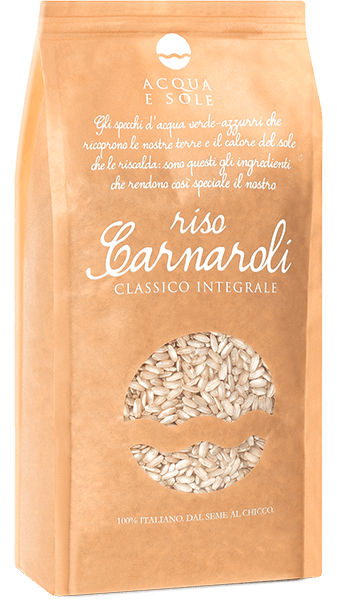
Carnaroli Classico Integrale
The most versatile of our wholegrain rices. Rustic risottos, side dishes, traditional country first courses. Cook time 35-40 minutes. The choice for anyone starting out with wholegrain.
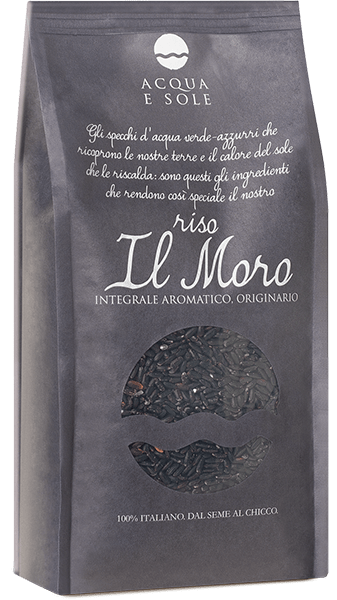
Il Moro (wholegrain black)
A naturally black rice, a toasted flavour reminiscent of hazelnut, anthocyanin pigments. The choice for cold salads, pairings with fish and shellfish, fusion. Cook time 35-45 minutes.
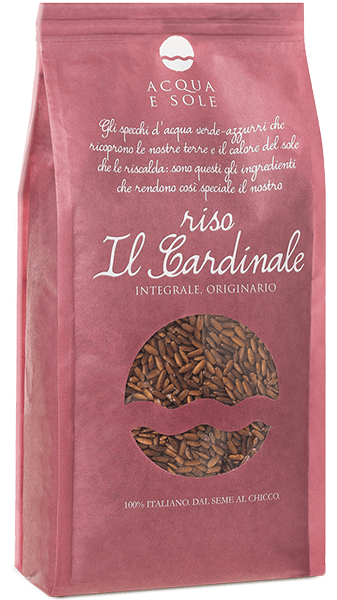
Il Cardinale (wholegrain red)
A naturally red rice, a sweet and spiced flavour. The choice for stuffed peppers, curries, dishes with warm spices, a side for white meats. Cook time 35-45 minutes.
More guides and recipes from our recipe book
For anyone who wants to go further: the guide to the methods for white rice, the recipes that use our wholegrain rices, and the traditional risotto that remains the dish of our city.
White Rice, a guide to the methods
Pilaf, boiled, risotto: three ways to cook Italian white rice, with times and quantities that always work.
See the guide ›Black rice salad with mango and prawns
Il Moro served cold with tropical fruit, avocado and shellfish. Summery, a strong colour contrast, hearty.
See recipe ›Red rice salad with pomegranate and feta
Il Cardinale served warm with crunchy pomegranate, crumbled feta and a citrus vinaigrette. Autumn balance.
See recipe ›Wholegrain risotto with leeks and pumpkin
Carnaroli Classico Integrale finished with softened leeks and roasted pumpkin. The wholegrain risotto for beginners.
See recipe ›Paniscia Novarese
The risotto of our city: borlotti beans, salame della duja, pork rind, Carnaroli finished off-heat. The full tradition.
See recipe ›Stuffed peppers with Il Cardinale
Roasted yellow peppers filled with wholegrain red rice, pine nuts, raisins and capers. Il Cardinale at its best.
See recipe ›Guide written by the Acqua e Sole editorial team, Lumellogno, Novara plain.