
Peppers Stuffed with Red Rice, Meat and Mozzarella
Baked peppers stuffed with Il Cardinale, a meat ragout deglazed with Barbera and mozzarella that pulls into strings. The Sunday recipe.
Red and yellow peppers baked and stuffed with Il Cardinale (wholegrain red rice), a ragout of mixed minced beef and pork, diced fior di latte mozzarella and tomato passata deglazed with Barbera. A Sunday dish from southern Italian cooking, reworked with our wholegrain red rice from Lumellogno that holds up to the double cooking without going to mush. Ready in ninety minutes, to serve with a glass of Piedmontese red.
Everyone has their own family version of stuffed peppers, and that is just as it should be: it is one of those dishes that gets handed down with a small detail changed each time, and where the two rules that matter are these. The first is that the pepper bakes for a long while, and the filling has to survive that cooking without falling apart or turning floury. The second is that the rice you choose counts for more than it seems: the wrong rice turns to pap, the right rice holds the cooking and gives structure to every mouthful.
For our classic version we use Il Cardinale, our wholegrain red rice from Lumellogno. It has the nutty flavour typical of wholegrain rice done properly and a tenacious structure that holds up beautifully in the oven: it does not go to mush, it keeps the grain, and it marries with the meat and the tomato without being crushed. The technique is simple if you respect two steps: the rice needs to be precooked al dente (with a slight bite at the heart) before it goes into the peppers, because it will finish its cooking in the oven, and the peppers should be hollowed out with care but not too much, because a thin layer of inner flesh holds the filling better.
Ingredients for 4 People
Ingredients
- 200 g Il Cardinale Acqua e Sole rice (wholegrain red rice)
- 4 large peppers (2 red and 2 yellow, about 250-300 g each)
- 350 g mixed minced beef and pork (70/30)
- 200 g fior di latte mozzarella (preferably from the day before)
- 400 g tomato passata
- 1 medium white onion
- 2 garlic cloves
- 1 small carrot
- 1 celery stick
- 100 ml Barbera or another light Piedmontese red
- 1 medium egg to bind
- 30 g grated parmesan
- to taste fresh parsley and basil
- to taste nutmeg, fine salt, black pepper
- 2 tbsp breadcrumbs
- to taste extra virgin olive oil
Notes from Our Kitchen
- Il Cardinale precooked strictly al dente, never beyond: it finishes its cooking in the oven, and if it goes in already cooked it turns floury
- Mozzarella from the day before is better: drier, in the oven it pulls into strings but does not water down the filling. If it is fresh that day, dice it and let it drain in a sieve for half an hour
- Brown the meat well over a lively heat until it has lost its pink colour: if it boils in its own juices it loses flavour
- Add the egg when the filling is lukewarm, never hot: otherwise it sets before going into the oven and no longer binds
- Hollow out the peppers with care but leave a thin layer of inner flesh: it helps hold the filling and gives more flavour
Method
Preparing the peppers
Wash the 4 peppers under cold water and dry them. Cut them in half lengthways, keeping the stalk attached to one of the two halves, as it helps the presentation. Carefully remove the seeds and white inner membranes, leaving the walls of the pepper intact. Lightly salt the inside and turn them upside down on a plate lined with kitchen paper for ten minutes, so they release a little of their vegetation water.
Cooking Il Cardinale al dente (35-40 min)
In a large pan bring two litres of salted water to the boil. Tip in the 200 g of Il Cardinale and cook over a lively heat for thirty-five to forty minutes, stirring now and then, until the grain is soft on the outside but with some resistance at the heart. Drain, rinse briefly under cold water to stop the cooking, and leave to drain well in a sieve. Transfer to a wide bowl, dress with a tablespoon of extra virgin olive oil and leave to cool to room temperature.
The soffritto and browning the meat (15 min)
In a wide, high-sided pan heat two tablespoons of extra virgin olive oil. Add the finely chopped onion, carrot and celery and sweat over a low heat for ten minutes until the vegetables are golden and soft, the soffritto (the slow-sweat aromatic base). Add the finely chopped garlic and cook for one minute. Raise the heat to medium-high, add the 350 g of minced meat and break it up with a wooden spoon: brown for five to six minutes until it has lost its pink colour and the juices have evaporated.
Deglazing with Barbera and the ragout (17 min)
Pour in the 100 ml of Barbera and let it evaporate for two minutes over a lively heat. Add the tomato passata, season with salt and pepper and a pinch of nutmeg. Lower the heat and simmer uncovered for fifteen minutes, stirring now and then, until the ragout is thick but still soft, not dry. Turn off the heat and add the finely chopped basil.
Bringing the filling together (5 min)
In a large bowl combine the al dente rice with the lukewarm ragout, not hot, and mix well so that every grain is coated in sauce. Taste and adjust the salt and pepper. Cut the mozzarella into small half-centimetre cubes. Add the mozzarella to the rice and ragout, along with the 30 g of grated parmesan, the lightly beaten egg and the chopped parsley. Mix well but without crushing: the filling should be soft but not wet.
Preparing the tray and filling
Preheat the oven to one hundred and eighty degrees, conventional setting. Grease a baking tray with a tablespoon of extra virgin olive oil, and if you have any tomato passata left over, dilute three or four tablespoons of it with two tablespoons of water and pour it over the base of the tray. Dry the inside of the peppers with kitchen paper. Arrange the half cups in the tray cut side up and fill them with the filling using a spoon, pressing gently up to the rim and slightly domed.
Breadcrumbs and oil
Scatter the surface of each pepper with a pinch of breadcrumbs, two tablespoons in total over the eight peppers. Drizzle with a thread of extra virgin olive oil, one tablespoon in total. In the oven this layer will turn golden and crisp, and it gives the mouthful the contrast that makes the difference between a good dish and a memorable one.
Baking in the oven (25 min)
Put the tray in the oven at one hundred and eighty degrees, conventional setting, for twenty-five minutes. Halfway through, after twelve or thirteen minutes, check: if the surface is colouring too much, cover with a sheet of foil laid loosely on top. In the last two or three minutes, if you want a deeper colour, raise the heat to two hundred degrees or switch to the grill for the final minutes only.
Resting and serving
Take the tray out of the oven and leave it to rest for five minutes covered with a sheet of foil laid loosely on top, not sealed: the filling settles and the heat spreads through. Place two pepper halves on each plate, ideally one red and one yellow for the colour. Add a fresh basil leaf on top of each, a thread of raw extra virgin olive oil and a spoonful of the sauce from the tray to the side. Serve at once while the mozzarella is still stringy.
Sunday at Lumellogno
Stuffed peppers at our house are the dish of the long lunch: you start early in the morning, because the ragout wants its time and the wholegrain rice even more. In August the peppers from the field are at their best, yellow and red with a real weight in the hand, the kitchen windows open onto the Novara plain and the smell of the soffritto drifting out into the courtyard. It is a dish from the tradition of the South that we like to make with Il Cardinale, because the wholegrain red rice holds up to the oven and gives the filling a substance that white rice cannot manage.
Lumellogno · The Novara plain
Why wholegrain red rice makes the difference
In stuffed peppers the choice of rice counts for far more than it seems, and it is the reason we use Il Cardinale here rather than a classic white rice. It is our wholegrain red rice, grown at Lumellogno and dried at low temperature in our own drying plant: a wholegrain done properly, a tenacious grain, a clean nutty flavour, a structure that holds up in the oven without being crushed.
«In peppers Il Cardinale gives the filling a substance that white rice cannot manage, and it draws out a toasted note that marries beautifully with the meat and the tomato. It is a rice that makes itself felt, and in the right dish it makes the difference.» From the kitchen of Acqua e Sole, Lumellogno
The supply chain is a closed one, from seed to grain, with ISO 9001 certified production. Three hundred and fifty hectares of paddy fields at Lumellogno, processing in our own rice mill, low-temperature drying to keep the surface starch intact. In stuffed peppers the difference is felt at once: a whole grain even after the double cooking, a structure that holds the meat and the mozzarella, a nutty flavour that converses with the tomato.
Questions about baked stuffed peppers
Which rice to use for baked stuffed peppers?
How long does wholegrain red rice Il Cardinale take to cook?
Can I make the stuffed peppers the day before?
Suggested Pairing
This classic version goes well with the medium-bodied reds of Piedmont, the ones that stand up to the fat of the meat and the mozzarella without covering the sweetness of the pepper. We happily open a Barbera del Monferrato, with the acidity that cuts through the ragout, or a Dolcetto di Dogliani with a medium body and clean red fruit.
For a choice close by but outside the region, a young, gently sparkling Bonarda dell’Oltrepò Pavese works very well. Avoid reds that are too structured, such as Barolo or Barbaresco: they cover the dish and leave no room for the pepper.
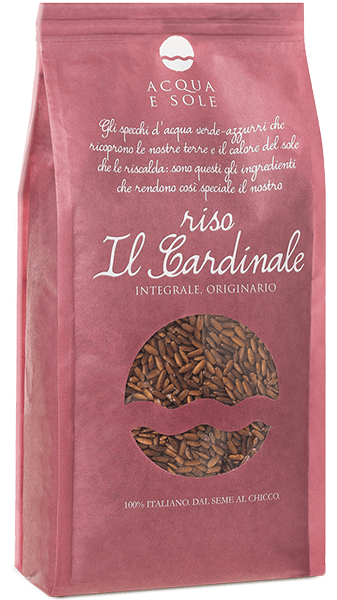
Riso Rosso Cardinale Acqua e Sole
Our wholegrain red rice, grown at Lumellogno and processed in our own rice mill. A tenacious grain, a clean nutty flavour, low-temperature drying to keep the surface starch intact. The right variety for baked dishes and for stuffing: it holds up to the double cooking without going to mush, it holds the sauce without falling apart, it converses with the meat and the tomato without being crushed.
Bring Il Cardinale homeOriginal Acqua e Sole recipe, from our kitchen at Lumellogno.