
White Chocolate Risotto
An elegant first course that plays on sweet and savoury, with our Arborio from Lumellogno.
An elegant first course for the Christmas holidays, in a sweet-savoury key: Acqua e Sole Arborio, patisserie white chocolate with at least 30% cocoa butter, shallot, light vegetable stock, dry white wine. No Parmesan and no classic butter to finish: the mantecatura, the off-heat creamy stir, is done off the heat with cold butter plus white chocolate, some finely grated and some in small shards, once the rice drops below seventy degrees, because cocoa butter splits over high heat. We serve it straight away in warm deep bowls, with a little orange or lemon zest grated at the last moment.
At home, when December comes round and we start thinking about the holiday menu, sometimes we experiment and feel like stepping away from the paniscia and the saffron risotto to try something that puts everyone around the table with a slightly curious smile. White chocolate risotto is one of those dishes that does exactly this: it looks like a pudding, and instead it is a first course in every respect, and when it arrives at the table the conversation pauses for a moment.
It works because good white chocolate, the kind with a high cocoa butter content, has a buttery, milky note that behaves like a creamy cheese, not like a sweet. It dismantles the whole idea of “savoury equals Parmesan” and replaces it with another mantecatura, the off-heat creamy stir, rounder and more elegant. The technical rule is all there: no live heat on the chocolate, mantecatura off the heat below seventy degrees, salt measured out drop by drop.
For this dish our Arborio is the variety that works best. The large grain and the generous surface starch give just the right creaminess to welcome the white chocolate without smothering its delicate flavour. We dry it at low temperature in the drying plant at Lumellogno, the western district of Novara, and this is the reason why, during the mantecatura, it holds the all’onda wave-like consistency even with such an unusual fat. A 500 g pack is enough for four people, with the round of citrus zest at serving.
Ingredients for 4 People
Ingredients
- 320 g Acqua e Sole Arborio rice (a 500 g pack, generous for 4)
- 100 g patisserie white chocolate, at least 30% cocoa butter (50 g finely grated, 50 g in small shards)
- 1 medium shallot, finely chopped
- 80 ml dry white wine (Erbaluce di Caluso, Arneis; never sweet, never Moscato)
- 800 ml light vegetable stock (celery, carrot, leek; no stock cube, no meat stock)
- 30 g butter (15 g in the soffritto, 15 g cold to finish)
- to taste fine salt, just a pinch
- to taste white pepper, freshly ground
- as desired orange or lemon zest, fine, at serving
Notes from Our Kitchen
- No Parmesan, no butter to finish in the classic sense: the mantecatura is cold butter plus white chocolate, always off the heat
- Patisserie white chocolate, never industrial chips: the quality of the cocoa butter makes the dish
- Light vegetable stock, never meat stock nor stock cube: they would cover the delicacy of the chocolate
- Dry white wine, never sweet nor sweet aromatic: the dish would slip into pudding territory
- White pepper, not black: an aesthetic and flavour choice, black pepper spoils the cream-white
- Arborio cooking: 16 minutes, all’onda (wave-like), slightly looser than usual
Method
Mise en place (5 min)
We finely chop the shallot. We finely grate fifty grams of white chocolate, put them in a small bowl and set them aside at room temperature. The other fifty grams we cut by knife into very small shards, also set aside. We keep the stock warm, eighty or eighty-five degrees, not boiling, in a small pan beside the hob. We prepare the citrus zest.
Light soffritto (2 min)
In a heavy-based saucepan (tin-lined copper or triple-bottomed steel) we melt fifteen grams of butter over low heat. We add the chopped shallot and sweat it gently without colouring, until it turns translucent. Never browned: the sweetness of the chocolate calls for a neutral base.
Toasting the rice (2 min)
We raise the heat to medium-high and pour our dry Arborio over the soffritto. We toast, stirring with a wooden spoon for two full minutes, until the grains are warm to the touch and slightly glossy, and you catch a light hazelnut aroma from the tostatura, the dry-toast of the rice.
Deglazing (1 min)
We pour in the eighty millilitres of dry white wine all at once. We let the alcohol evaporate over high heat, stirring just once. The base must become almost dry before adding the stock. Never with a sweet wine or a sweet aromatic Moscato: they would amplify the sweetness of the chocolate and make the dish slip into pudding territory.
Cooking with the stock (10 min)
We add a ladle of warm stock. We lower to medium heat. We stir little, every thirty or forty seconds, adding stock as the liquid is absorbed. The risotto rule still holds here too: warm stock, never cold. Never flood it: two ladles at a time, no more.
Continuous seasoning
At the eighth minute we taste the rice. We season lightly, just a pinch, and add white pepper. The rule of this dish: little salt, because the chocolate already balances with its lactose and its sugar. Normal salting would make the risotto cloying.
Second cooking phase (5 min)
We keep adding stock until the rice is al dente: sixteen minutes in total for our Arborio. The consistency should be all’onda (wave-like), slightly looser than usual: the mantecatura with the chocolate will pull up the creaminess and tend to dry out the dish.
Off the heat and waiting (30-40 sec)
We take the saucepan off the heat. This is the critical step: white chocolate must never be melted directly over live heat, because the cocoa butter splits and forms lumps that cannot be recovered. We let it rest thirty or forty seconds: the rice must drop below seventy degrees, the temperature at which the chocolate melts without separating.
Mantecatura with the chocolate (1 min)
We add the fifteen grams of cold butter left and the fifty grams of finely grated white chocolate. We stir vigorously with the wooden spoon, always off the heat. The chocolate melts into the warm mass of the rice without lumps. Once it is evenly incorporated, we also add the fifty grams of chocolate in shards: these stay partly whole, giving a little surprise of texture on the palate.
Serve straight away
A quick pirlatura, the swirl with the spoon, to bring back the wave. We serve straight away in warm deep bowls. Over each bowl a round of fresh citrus zest grated at the last moment: orange for a warmer, sweeter profile, lemon for a sharper, cleaner one. White pepper at serving. No Parmesan, no parsley, nothing else: the dish lives on the contrast between the cream-white of the rice and the citrus edge on top.
Lumellogno, the large grain, the Christmas mantecatura
For us who grow rice at Lumellogno, seeing our Arborio in a dish so different from the paniscia is a small satisfaction. It works here for two precise technical reasons worth knowing. The first: the large grain and the generous surface starch of the Arborio give a creamy mantecatura without covering the white chocolate. A drier variety like the Carnaroli would give a tidier result but a less enveloping one, and delicate white chocolate seeks precisely that cloud of creaminess. The second: we dry it at low temperature in the drying plant at Lumellogno, on the Novara plain, and this is why the surface starch stays intact. Industrial high-temperature drying “vitrifies” the grain and strips away exactly the creaminess we need here. The same plain as ever, the same closed supply chain, but with a technical care that you feel in the mantecatura. Sweet and savoury is nothing new in Piedmont: lemon risotto, strawberry risotto, fruit compotes on mountain cheeses are traditions of these valleys. White chocolate risotto belongs to that same family of gestures, brought to the end-of-year holiday table.
Lumellogno · Novara · Novara Plain
Why the Arborio for the sweet-savoury of Christmas
White chocolate risotto is the holiday dish we use to tell the story of the Arborio in all its personality. On meat and fish risottos the Carnaroli holds the structure better. But when the rice has to embrace an unusual fat like the cocoa butter of good white chocolate, and do it without covering a delicate note, the large grain of the Arborio and the generous surface starch make all the difference. We grow it here at Lumellogno, the western district of Novara, across our 350 hectares of paddy fields in a closed supply chain with ISO 9001 certified production, and we dry it on site at low temperature: that step keeps the surface starch intact, and it is the reason why, during the mantecatura, the dish becomes an enveloping cream, all’onda (wave-like) and slightly looser than usual, able to hold the chocolate without lumps and without separating.
«The secret of white chocolate risotto is just one: never melt the chocolate over live heat. You take the saucepan off, you count to forty, you finish the mantecatura when the rice drops below seventy degrees. Below that threshold the cocoa butter binds, above it splits. Forty seconds of patience, and the dish is done.» From the kitchen of Acqua e Sole, Lumellogno
A word of warning we feel we should give: the choice of white chocolate is not negotiable. You must use patisserie chocolate with at least 30% cocoa butter, never supermarket products with hydrogenated vegetable fats. In a dish this clean, the wrong ingredient shows at the first spoonful. The same care goes for the stock, which must be light vegetable and never meat, and for the white wine, which must be dry and never sweet aromatic: the dish lives on subtle balances, and every extra fat or sugar pushes it into pudding territory.
Questions about white chocolate risotto
Can I use cheap white chocolate for the risotto?
How do I serve white chocolate risotto on a menu?
Can I add prawns, asparagus or other variations?
Recommended Pairing
For the holidays we happily open a classic-method brut sparkling wine, nature or extra-brut dosage: the bubbles clean the mouth of the fat from the white chocolate and the acidity keeps the dish in balance. At home a favourite is an Alta Langa DOCG Brut Pas Dosé from Pinot Noir and Chardonnay grapes of Piedmont, perfect on the sweet-savoury of Christmas.
For those after a still white, a dry Riesling from Alto Adige works well: minerality and acidity hold the dish. The same goes for a Moscato d’Asti DOCG in its dry version (a minority vinification), which keeps the aromatic character while removing the sweetness. No structured reds, no sweet or sweet aromatic wines: they would amplify the sweetness of the dish.
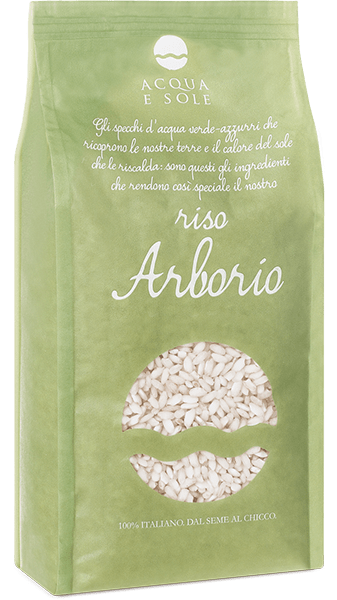
Acqua e Sole Arborio Rice
Our Arborio, grown at Lumellogno and processed in our rice mill. Large grain, generous surface starch, an enveloping creaminess that embraces even unusual fats like the cocoa butter of white chocolate without covering its delicacy. The right variety for the sweet-savoury risottos of the holidays and for the off-heat mantecatura. A closed supply chain with ISO 9001 certified production, low-temperature drying to preserve the surface starch.
Take the Arborio homeOriginal Acqua e Sole recipe, from our kitchen at Lumellogno.