
Arborio Rice Cake with Red Prawn from Mazara and Bisque
The fine-dining version of the rice cake on our Arborio, with raw Mazara red prawn fanned on top and a concentrated shellfish bisque served in a jug at the table.
A fine-dining rice cake made with our Arborio from Lumellogno, cooked for 16 minutes al dente, with raw Mazara del Vallo red prawn fanned on top, and a concentrated bisque of shellfish shells reduced to 200 ml and served in a small warm jug at the table. A structured mantecatura (the off-heat creamy stir) holds the shape in the 8 cm mould, a covered rest of 10 to 15 minutes, then plating with a glossy veil of bisque around it and lime zest. It is served at once, on warm plates, with chervil and tarragon and fleur de sel added to finish.
When we want to take the rice cake up to the level of a starred restaurant without stepping outside Italian tradition, we change the fish on top and the sauce around it. The raw langoustines become raw Mazara del Vallo red prawn, and the vegetable artichoke emulsion becomes a concentrated bisque made from the prawn shells, reduced to a glossy veil around the cake and also served on the side in a small warm jug at the table. Bringing the jug into the room is part of the dish: each guest adds the bisque as they please, and every spoonful changes the voice of the cake.
Underneath it stays our Arborio from Lumellogno, cooked for 16 minutes al dente as for the basic rice cake, because the grain must still have some resistance at its heart when it goes into the mould: the covered rest carries the cooking on through residual heat, and with a structured mantecatura using clarified butter and Parmigiano the shape holds right up to service. Arborio is the rice for shape: a large grain, generous surface starch, that creaminess that during mantecatura turns into glue. We grow it across the 350 hectares of the Novara plain and dry it at a low temperature in our own dryer, with a closed supply chain and ISO 9001 certified production. For the fine-dining version it is the variety that makes the difference between a cake that stands up firm and one that crumbles under the bisque.
Ingredients for 4
Ingredients
- 280 g Arborio Acqua e Sole rice
- 16 Mazara del Vallo red prawns, medium-large grade, blast-frozen
- 5 extra spare prawn shells for the bisque
- 1 small white onion for the bisque
- 1 small carrot for the bisque
- 1 stick of celery for the bisque
- 50 ml Cognac or Armagnac for flambéing
- 100 ml dry white wine
- 1 tablespoon tomato purée
- 1 teaspoon colatura di alici from Cetara (anchovy sauce)
- 1 teaspoon concentrated bisque paste for the mantecatura
- 80 ml dry white wine for the risotto (Erbaluce, Gavi, Soave)
- 600 ml light vegetable stock
- 1 shallot
- 30 g grated Parmigiano Reggiano, 24 months
- 20 g butter at room temperature
- 3 tablespoons extra virgin olive oil
- 1 unwaxed lime (zest)
- to taste chervil, tarragon, pink peppercorns, fleur de sel
Notes from Home
- Mazara red prawns must be blast-frozen for 96 hours at minus 20 degrees, or bought certified sashimi-grade from a trusted fishmonger
- The concentrated bisque is reduced to about 200 ml: it should be glossy, velvety, a deep coral-pink colour to make the veil on the plate
- The rice cooking is stopped at 16 minutes, not 18: the rest in the mould carries the cooking on through residual heat
- A structured mantecatura with butter, Parmigiano and a teaspoon of concentrated bisque paste to tie the cake to the flavour of the sauce
- The serving jug is warmed in the oven at 60 degrees before it goes to the table: the bisque must reach the guest hot, not lukewarm
- The red prawn marinates for only 5 minutes, never longer: the acid of the lime and the salt would cure it cold and it would lose its living texture
Method
Cleaning the blast-frozen red prawns (10 min)
With the 16 Mazara red prawns already blast-frozen for 96 hours at minus 20 degrees: we shell each one by pulling off the head, remove the shell from the body, and lift out the dark intestinal vein along the back with the tip of a small knife. We keep all the shells, heads and casings aside together with the 5 extra spare shells: they are the flavour of the bisque, nothing is thrown away. We keep the flesh covered in the fridge at 0 to 2 degrees until it is time to marinate.
Concentrated bisque (50 min, ahead of time)
In a large pan we heat a tablespoon of extra virgin olive oil. We toast the shells and heads for 5 minutes, crushing them with a wooden spoon to draw out the coral. We flambé with the 50 ml of Cognac off the heat, bring the flame back and let the alcohol burn off. We add the finely chopped white onion, carrot and celery, the tablespoon of tomato purée, the 100 ml of white wine and 500 ml of water. We simmer uncovered for 40 minutes, strain through a fine sieve pressing well, and reduce over a high heat to about 200 ml until it is glossy and thick. At the very end we stir in the teaspoon of colatura di alici from Cetara off the heat. We keep it covered and warm.
Marinating the red prawns (5 min, cold)
In a glass bowl we lay out the flesh of the red prawns. We grate the zest of half a lime over them, add 2 g of fine sea salt (reduced salt, because the sweetness of the red prawn is less masked), a tablespoon of light fruity oil, a drop of tamari if we have some at home for the umami note, and a turn of white pepper. We stir gently. We cover and keep them at 0 to 2 degrees for exactly 5 minutes, no longer: a longer marinade would cure them cold and they would lose their living texture.
Cooking the Arborio risotto (16 min)
We bring the 600 ml of vegetable stock to the boil in a small pan and keep it covered and boiling. In a heavy-based pan we heat two tablespoons of extra virgin olive oil and gently sweat the finely chopped shallot for 3 minutes over a low heat until translucent, never browned. We raise the heat to medium-high, pour in the 280 g of Arborio and toast it for 2 minutes until the grains are hot and glossy. We deglaze with the 80 ml of white wine all at once and let it evaporate over a high heat. We add the boiling stock two ladles at a time. To give the grain a sea note, we replace half the vegetable stock with a measure of diluted bisque. The total cooking is 16 minutes from the first addition of stock, not 18: at minute 16 the grain must still have a noticeable resistance at its heart. We take it off the heat.
Structured mantecatura (1 min)
Off the heat we add the 20 g of butter in small pieces, the 30 g of grated Parmigiano, a tablespoon of raw extra virgin olive oil and the teaspoon of concentrated bisque paste into the mantecatura oil: it ties the cake to the flavour of the sauce that arrives on the plate afterwards. A vigorous stir with a wooden spoon for 30 seconds, moving the pan with small circular shakes. The texture must be creamy but not runny: we want structure to hold the shape, not the loose flow of an all’onda (the wave-like loose risotto). A turn of white pepper, a covered rest of 1 minute.
Shaping and resting in the mould (15 min)
We transfer the risotto to a lightly oiled tray, spread it out in a layer of about 3 cm and let it cool uncovered for 5 minutes. We place a round 8 cm mould in the centre of each slightly warm serving plate (oven at 60 degrees for 5 minutes if the plates are cold), fill it with 130 to 140 g of risotto per portion, press gently with the back of a spoon to compact it, and smooth the surface. We let it rest in the mould for 10 to 15 minutes: that is the time the grain needs to tighten the shape and stand up at service.
Unmoulding the cakes (1 min)
We lift the mould gently straight up off the plate, never tilted. The cake must stand up, compact, with a glossy surface and clean edges. If a cake should crumble, it means the risotto was overcooked or the mantecatura too runny: we rescue it as a quenelle in the centre of the plate in free-form plating, without any drama.
Plating with a veil of bisque and a jug on the side (3 min)
On top of each cake we arrange 4 marinated red prawns in a fan, tails pointing to the centre. We trace a glossy veil of concentrated bisque around the cake, a teaspoon per plate, without drowning the base. We warm a small serving jug in the oven at 60 degrees and pour in the rest of the bisque: it will reach the table hot. A grating of lime zest over the prawns, pink peppercorns crushed at the last moment, and leaves of chervil and tarragon.
Immediate service with the jug gesture
We bring the plates to the table and right after them the warm jug with the rest of the bisque. It is the gesture that makes the dish: each guest adds as much as they like, and the cake changes its voice with every spoonful. A pinch of fleur de sel over the prawns as the plate is handed over. It is eaten at once, while the cake is still warm and the bisque is alive.
Lumellogno, Cetara, Mazara del Vallo
The three voices of the fine-dining version of the rice cake come from three distant points of the country, and each brings its own character. Our Arborio is born here in Lumellogno, a hamlet west of Novara, where we have the rice fields and the dryer. The colatura di alici we adjust the bisque with comes from Cetara, on the Amalfi coast, where the technique of the slow salting of oily fish is a long-established tradition. The red prawns come from the Strait of Sicily, from Mazara del Vallo, where the deep sweetness of the shellfish has made this variety a recognised Italian signature in starred restaurants. Putting the three products together on the same plate is our way of taking the rice cake from the home kitchen to a fine-dining dinner.
Lumellogno · Cetara · Mazara del Vallo
Arborio for the fine-dining version of the rice cake
On Arborio, this is the version of the rice cake we like most, when we find genuinely fresh Mazara red prawns and have the time to make the bisque properly. It is the variety that Italian tradition has always chosen for creamy risottos with a full structure: a large grain, generous surface starch that releases plenty of cream during mantecatura, and that cream, when it cools in the mould, sets and forms the shape. It is not the rice for a wave on the plate, it is the rice for shape. We grow it across the 350 hectares around Lumellogno and dry it at a low temperature in our own dryer, a closed supply chain and ISO 9001 certified production. That low temperature keeps the surface starch intact, and it is the reason it works so well in the pan even with a technically demanding mantecatura like this one, where we bind a teaspoon of bisque paste into the raw oil to give the grain the sea identity of the sauce.
«On the fine-dining rice cake our Arborio makes the shape and the bisque makes the voice. Cooking cut to 16 minutes, a structured mantecatura, a covered rest in the mould, and when we lift the ring the disc stands up firm. From there on it is all plating and the jug at the table.» From the kitchen of Acqua e Sole, Lumellogno
The one warning we feel like giving to anyone trying the fine-dining version for the first time: the red prawn is not handled like a langoustine. A marinade of exactly five minutes, never more, and lime zest not juice, because the harsh acid would cure it cold. The deep sweetness of raw Mazara is the signature of the dish, and it lasts the length of a short, timed marinade.
Questions about the fine-dining version
Are raw Mazara red prawns safe to eat?
Why the Mazara red prawn and not the langoustines of the basic version?
Why serve the bisque in a small jug on the side?
Suggested Pairing
For the fine-dining version we happily open a Franciacorta Satèn made by the classic method, a fine perlage and a creaminess that talks to the structure of the cake, or a Vermentino di Gallura DOCG Superiore from Sardinia, with the minerality and structure to stand up to the sweetness of raw Mazara and the toasted depth of the bisque.
For those who want to stay in Piedmont, an Alta Langa DOCG Pas Dosé works very well, and for anyone who prefers a still wine an Erbaluce di Caluso DOCG dry from our own parts. Avoid aromatic whites and tannic reds, both of which cover the dish.
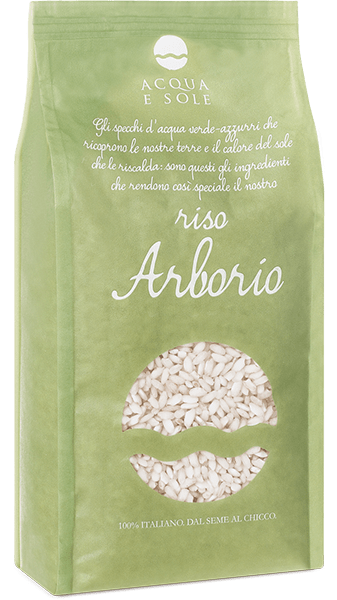
Arborio Acqua e Sole rice
Our Arborio, grown in Lumellogno across the 350 hectares of our closed supply chain and dried at a low temperature in our own dryer, with ISO 9001 certified production. A large grain, generous surface starch, a creaminess that during mantecatura becomes structure: the right variety for rice cakes, timballi, baked moulds and every shaped preparation, from the home kitchen to the fine-dining version with red prawn and bisque.
Bring Arborio homeOriginal Acqua e Sole recipe, the fine-dining version from our kitchen in Lumellogno.