
Saffron Risotto Cake with a Heart of Chicory
An Arborio tortino with whole saffron threads and a warm heart of chicory sautéed in oil, garlic and chilli. The orthodox Milanese version, without marrow.
A saffron risotto tortino made with whole saffron threads, with a warm heart of chicory sautéed in oil, garlic and chilli. The orthodox Milanese version, without marrow: whole threads infused in hot stock for 15-20 minutes, Arborio cooked for exactly 16 minutes, mantecatura (the off-heat creamy stir) with grana padano and cold butter. It is moulded inside a chef’s ring in two layers with the chicory heart in the centre, a short rest, a vertical release and immediate service with a thread of extra virgin olive oil and grana shavings on top. A vegetarian first course from our home table.
On saffron risotto we hold a clear position, because we have spent too many Sundays looking at faded yellow plates made with sachets of powder. Real saffron comes in threads, you infuse it in a little hot stock, and the colour arrives golden and deep the way only the real thing can be. The orthodox Milanese version calls for no beef marrow: we stand with the school of cleanliness, where the flavour of saffron comes through whole without being covered.
For our tortino we use our own Riso Arborio, and it is a precise technical choice. Arborio has the largest grain and the most generous surface starch among the varieties we grow: in cooking it releases a dense creaminess which, once it cools for a few minutes inside the ring, holds the shape of the tortino without falling apart. We grow it across the 350 hectares around Lumellogno, a hamlet west of Novara, and we dry it at low temperature in our own drying plant, so that surface starch reaches the pan intact. The heart is chicory sautéed in oil, garlic and chilli: the vegetable bitterness that cuts through the sweetness of the rice, the gesture of the Novara tradition when you want a first course that is more than just rice.
Ingredients for 4 People
Ingredients
- 320 g Arborio Acqua e Sole rice
- 0,2 g whole saffron threads (one sachet, never powder)
- 1 L light vegetable stock (celery, carrot, onion, parsley)
- 1 medium shallot
- 80 ml dry white wine (Lugana, Soave Classico, Erbaluce di Caluso)
- 3 tablespoons extra virgin olive oil for the risotto
- 30 g grated grana padano for the mantecatura
- 15 g very cold cubed butter for the mantecatura
- 400 g fresh trimmed chicory (white hearts and green leaves)
- 2 garlic cloves
- 1 small fresh chilli
- 3 tablespoons extra virgin olive oil for the chicory
- 30 g grana padano in shavings for serving
- 4 teaspoons extra virgin olive oil for serving
- q.b. fine salt, freshly ground white pepper
- 4 whole saffron threads to garnish (optional)
Notes from Home
- Always whole saffron threads, never powder: the powder is often cut with turmeric or safflower and the real flavour disappears
- Infuse the threads in half a ladle of hot stock for 15-20 minutes before adding them to the rice
- Arborio cooked for exactly 16 minutes, not twenty, not twelve: the grain wants this time to reach the right core
- A risotto wetter than the classic all’onda (loose and wave-like): the mantecatura and the rest in the ring dry it out by a good 20 per cent
- Steel chef’s rings 8-9 cm in diameter, 5-6 cm tall: standard portion tortini are enough. As an alternative, buttered silicone moulds or ramekins
- The orthodox Milanese version, without beef marrow: saffron wants the stage all to itself
Method
Saffron and stock infusion (15-20 min)
We start with the saffron, because the threads need their time to release their colour. We heat the vegetable stock in a pan, bring it to a gentle simmer and keep it covered. We take half a ladle of hot stock (about 80 ml) into a small cup and add the whole saffron threads (0,2 g). We leave it to infuse for at least 15-20 minutes, stirring once. The liquid should turn a deep orange.
Blanching the chicory (3 min)
The chicory is blanched first in salted water, so it loses its most aggressive bitterness and keeps its bright colour. We bring a pan of salted water to the boil (10 g salt per litre). We plunge in the trimmed chicory for 3 minutes from the moment the boil returns. We drain it and plunge it straight into iced water to fix the green. We squeeze it well and roughly chop it with a knife.
Chicory sautéed in the pan (7 min)
In a large frying pan we heat 3 tablespoons of extra virgin olive oil over medium heat. We add the garlic cloves crushed with the palm and the chilli in small pieces, frying for 2 minutes until the garlic is golden but not brown. We raise the heat, add the squeezed chicory, season lightly, and toss for 5 minutes, stirring often with tongs. We remove the garlic cloves. The chicory should be well flavoured but still with body, not a purée. We keep it warm and covered.
Soffritto and the dry-toast of the Arborio (5 min)
In a heavy-bottomed pan we heat 3 tablespoons of extra virgin olive oil. We add the finely chopped shallot and gently sweat it over low heat for 3 minutes until translucent, never coloured. This is the soffritto (the slow-sweat aromatic base). No garlic, no marrow: saffron wants the stage all to itself. We raise the heat to medium-high, pour the 320 g of Arborio onto the soffritto, and dry-toast the rice, stirring with a wooden spoon for 2 minutes until the grains are hot and slightly glossy. This is the tostatura (the dry-toast of the rice).
Deglazing with white wine (1 min)
We pour in the 80 ml of white wine all at once, decisively, and let the alcohol cook off before moving on to the stock. We let it evaporate over a lively heat until the base is dry, about 1 minute.
Cooking the risotto with the stock (16 min)
We add 2 ladles of boiling stock. We lower it to medium heat. We stir every 30-40 seconds and add stock as the liquid is absorbed. We season just lightly, because the stock and the final grana are already savoury. At minute 12 of cooking we pour in the saffron infusion (threads included, if you like the visual detail, or strained through a fine sieve), we stir, and we carry on cooking, adding stock only if needed. At minute 16 we check: the grain should be soft on the outside, with the very slightest resistance at the core, and the risotto should be wetter than a classic all’onda (loose and wave-like). We turn off the heat.
The mantecatura of the Milanese yellow (2 min)
We add the 30 g of grated grana padano and the 15 g of very cold cubed butter. An energetic pirlatura with a wooden spoon for 30 seconds: we move the pan with small circular shakes to draw all the starch to the surface. We cover and leave it to rest for 2 minutes.
Moulding the tortino in two layers (2 min)
We set a chef’s ring in the centre of the warm serving plate. We fill half the ring with saffron risotto, pressing lightly with the back of the spoon to compact it. We lay a generous spoonful of warm chicory in the centre (about 60 g). We cover with more risotto until the ring is full and smooth the surface with the back of the spoon. We leave it to rest for 30 seconds.
Releasing and serving immediately
We slide off the ring, lifting it straight up with a firm movement: the tortino holds its shape and shows the golden cylinder which, when cut with the fork, lets the steaming green heart of chicory escape. We pour over the tortino a teaspoon of raw extra virgin olive oil, a few shavings of grana padano made with the peeler, a grind of white pepper, and, if you like, a whole saffron thread on top to garnish. We bring it straight to the table.
Real saffron, chicory from the garden
The Milanese yellow is a dish at the heart of Lombardy’s identity, and the orthodox version calls for no beef marrow: the flavour of the saffron comes through whole without being covered. The thread, not the powder, infused in hot stock for 15-20 minutes, and the colour arrives golden and deep the way only the real thing can be. The chicory heart, here with us at Lumellogno, is the gesture of home cooking when you want a first course that is more than just rice. The vegetable bitterness cuts through the sweetness of the yellow and makes the dialogue the tortino asks for, evening after evening.
Lumellogno · Milan · The home garden
Arborio for the saffron tortino
The risotto tortino is the dish that lets us show best why Arborio is the right variety for certain uses. On traditional all’onda (loose and wave-like) risottos you can argue between Carnaroli, Arborio and Vialone Nano, and each has its own school. On tortini, on arancini, on rice timballi, the argument is closed: you need dense creaminess, and Arborio is the grain with the most generous surface starch there is. Our Arborio is grown across the 350 hectares around Lumellogno, a hamlet west of Novara, and dried at low temperature in our own drying plant, a closed supply chain and ISO 9001 certified production. That low temperature is the reason the grain reaches the pan with its surface starch intact: it melts in the mantecatura and makes the creaminess the ring wants.
«On the saffron tortino the Arborio makes the creaminess the ring asks for, the saffron threads make the real colour, the chicory makes the bitter dialogue. It is moulded in two layers, a short rest, a vertical release, and when you cut it with the fork the green heart is still steaming.» From the kitchen of Acqua e Sole, Lumellogno
On the chicory heart, when the plate reaches the table with the steam rising from the green centre, you understand why certain gestures stay the same in the cooking of the Novara plain. The saffron is there for the celebration, but the dish is this: chicory from the garden sautéed in oil, garlic and chilli, the vegetable bitterness that cuts through the sweetness of the yellow rice. The risotto should be left wetter than the classic all’onda, because the mantecatura and the two minutes of rest in the ring dry it out by a good twenty per cent.
Questions about the saffron tortino
Which rice should you use for a risotto tortino?
Should the saffron be in threads or in powder?
Can the tortino be prepared in advance?
Recommended Pairing
On the saffron tortino we like to stay in Piedmont. We happily open an Erbaluce di Caluso DOCG, dry and from our own parts, with that minerality that talks to the land the rice comes from, or a medium-bodied Roero Arneis DOCG, fresh on the palate, which balances the grana padano of the mantecatura and stands up to the bitter note of the chicory.
For those who prefer a red, a young Nebbiolo d’Alba DOC works well, with the right structure without covering the Milanese yellow. Avoid aromatic whites such as Gewürztraminer or grassy Sauvignon, and big tannic reds such as Barolo or Barbaresco, too large for the dish.
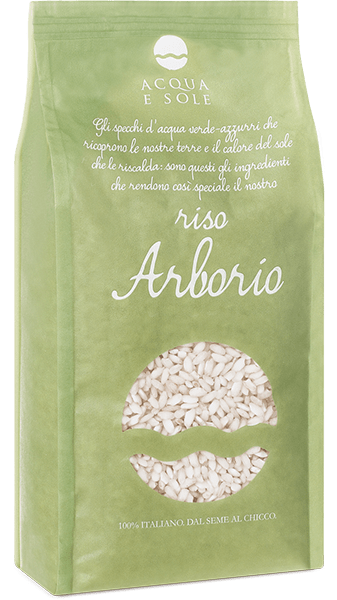
Riso Arborio Acqua e Sole
Our Arborio, grown at Lumellogno across 350 hectares of closed supply chain and dried at low temperature in our own drying plant, with ISO 9001 certified production. A large grain, generous surface starch, maximum creaminess in the mantecatura: the variety that on tortini, on arancini and on timballi holds its shape without falling apart and makes the structure the ring asks for.
Take Arborio homeOriginal Acqua e Sole recipe, from our kitchen in Lumellogno.