
Risotto alla Milanese with Clarified Butter
The dry, fragrant version of the Lombard tradition, made with clarified butter, beef marrow and saffron threads.
Risotto alla milanese in the traditional Lombard style: Carnaroli, saffron threads steeped in the hot broth, an onion soffritto (the slow-sweat aromatic base) cooked in clarified butter for a dry, clean finish, beef marrow worked in two stages (cubed into the risotto, in seared discs as a garnish), a final mantecatura (the off-heat creamy stir) with Grana from Lodi and cold butter. Cooking time 18 minutes, finished all’onda (wave-like and creamy). Four servings.
Around here, we know risotto alla milanese well. Lumellogno is a hamlet of Novara and Milan is less than an hour away by road, but above all the plain between the Sesia and the Ticino has always been the rice basin that supplied the great Lombard kitchens. When we make the traditional version at home, we choose our own Carnaroli Classico from our closed supply chain: it is the variety that best holds the long wave-like movement of the mantecatura (the off-heat creamy stir) without letting the grain give way.
Ours is the dry, golden version, with two technical touches that make the difference: clarified butter for the soffritto (the slow-sweat aromatic base), which has a higher smoke point than ordinary butter and lets you sweat the onion over the gentlest heat for a quarter of an hour without ever browning, and saffron threads steeped in the hot broth, so that they give up all their gold and fragrance to the liquid before they ever reach the pan.
The other touch we care about here is the way we treat the beef marrow. We don’t melt it into the soffritto: we work it in two stages. The cubes go into the risotto towards the end, when they release their richness into the grain; the whole discs are seared separately and set on each plate at the moment of serving, where they melt slowly on contact with the hot rice. It is the detail that turns a portion of risotto into something you remember.
The final mantecatura, made with freshly grated Grana from Lodi and cold butter straight from the fridge, finishes the dish. Choosing Grana from Lodi is a choice of place, of the Lombard plain: milk and rice that come from the same land speak to one another in a way Parmesan, here, could not manage.
Ingredients for 4 People
Ingredients
- 320 g Carnaroli Classico Acqua e Sole rice
- 60 g beef marrow + 4 marrow bone discs
- 1,5 L meat broth
- 80 g clarified butter
- 40 g butter for the mantecatura
- 60 g grated Grana from Lodi
- 0,4 g saffron threads
- 60 g onion
- 100 ml white wine
Notes from Our Kitchen
- Saffron always in threads and always steeped in the hot broth: the powder gives up less colour and less aroma
- Onion sweated for 15 minutes over the gentlest heat: it must stay translucent, never browning
- Clarified butter to cook the soffritto, ordinary cold butter from the fridge for the mantecatura: they are not interchangeable
- Grana from Lodi chosen for place: milk of the Lombard plain that speaks to the Novara rice
- Marrow in two stages: cubes into the rice at the end of cooking, whole discs seared separately for serving
Method
Steeping the Saffron
We put the broth on to heat in a roomy pan. Once it is good and hot, we take out a couple of ladlefuls and pour them into a small bowl together with the saffron threads. We let it rest: little by little, the threads give up to the broth their gold and that fragrance which, to us, recalls the Sunday dishes. It is a small act of patience that makes all the difference to the colour and the final taste, as we were taught by the tradition we keep here on the Novara plain.
The Soffritto with Clarified Butter
We chop the onion as finely as possible. We melt the clarified butter in a saucepan and sweat the onion in it over the gentlest heat for at least 15 minutes. No rush, ever: the onion must turn translucent, soft, almost creamy, without taking on even a veil of colour. Clarified butter has a higher smoke point than ordinary butter and lets us cook cleanly and gently, exactly the way we like it when we make risotto at home.
Toasting the Rice and Deglazing
At this point the Carnaroli rice comes in, from our Lumellogno harvest. We pour it over the soffritto and let it toast for 2-3 minutes, stirring constantly, until the grains turn translucent along their edges. It is the moment we like best: you can hear the dry sound of the grain sealing itself. We deglaze with the white wine and wait for it to dry off completely, letting all the alcohol go.
Cooking with Broth and Saffron
Straight after, we add the ladleful of broth in which we steeped the saffron threads: it is the golden heart of the dish, the moment when the colour comes alight. From here on we carry on as we do at home, one ladle of broth at a time, adding the next only when the previous one has been almost entirely absorbed. We stir steadily for 16-18 minutes, never leaving the saucepan.
Preparing the Marrow
We take the marrow bone discs. With the tip of a knife, gently, we ease out the marrow, trying not to spoil it: we get 4 whole discs from it. We pass them through a small dry pan, 1 minute each side, just to sear them. The rest of the marrow we cut into small cubes and add to the rice just before the end of cooking, so it releases all its flavour into the grain.
Mantecatura and Plating
We take the pan off the heat. Now comes the mantecatura, the gesture we value most in the family: a shower of freshly grated Grana from Lodi, and with it the butter just out of the fridge, good and cold. We stir with firm energy until the grain settles into the wave, all’onda. Twenty seconds of rest, then we plate up and set on each plate a disc of seared marrow. On contact with the hot rice it yields slowly, and whoever is sitting at the table gets a full, deep spoonful of real character.
Keeping the Tradition
Risotto alla milanese is a dish at the heart of Lombard identity, codified by the city’s cooking and by that of the great noble households of the nineteenth century. Three choices set the traditional dry version apart from the more modern one: clarified butter for the soffritto, beef marrow as the aromatic fat, saffron strictly in threads. Clarified butter, in particular, reached Lombard cooking from the French tradition of beurre clarifié, adopted in the high kitchens of northern Italy for its clean result and its high smoke point, which allows the long, very low-temperature sweating of the onion. Carnaroli, a variety from the Po plain, is the technical choice that makes this risotto possible: it holds its cooking, it stands up to the mantecatura, it gives back a distinct grain. We grow it here at Lumellogno and process it on site, in a closed, ISO 9001 certified supply chain, for those who seek the quality of the classic variety in the recipes of the Lombard tradition.
Lombardy · Po Plain · Traditional Cooking
Carnaroli Classico for the mantecatura all’onda
For risotto alla milanese, Carnaroli Classico is the variety we always keep in the pantry. Compared with Arborio it releases a more structured starch and stands up to the mantecatura without breaking down, giving back that wave-like movement, all’onda, which is the mark of a risotto made properly. The ideal cooking time is 16-18 minutes from the first ladle of broth, stirring steadily but without overdoing it: the grain must stay firm, never overcooked. We grow it here at Lumellogno and process it in our own rice mill, from paddy to packet, in a closed supply chain that lets us guarantee the same quality in every pack.
«In our home, risotto alla milanese is made with what the Lombard tradition has codified: Carnaroli, clarified butter, beef marrow, saffron threads, Grana from Lodi. No shortcuts, no simplified versions. What reaches the table is the dish that has always stood for Milan.» From the kitchen of Acqua e Sole, Lumellogno
One word of warning we feel we should give: don’t skip steeping the saffron. Those ten minutes in which the threads give up their colour and fragrance to the hot broth are the heart of the dish. If you tip the threads straight into the pan, the risotto stays pale and the aroma never fully develops.
Questions about traditional risotto alla milanese
Can I use powdered saffron instead of threads?
Why clarified butter for the soffritto and not ordinary butter?
Can risotto alla milanese be made without marrow?
Recommended Pairing
To go with risotto alla milanese we like Piedmontese reds with good body but not too much tannin, which can stand up to the richness of the marrow and the savour of the Grana from Lodi. We happily open a young Barbera d’Asti DOCG, fruity and with a fine acidity that cleans the palate, or a Dolcetto d’Alba ready to drink.
For those after a weightier pairing, a Nebbiolo delle Colline Novaresi from our parts, perhaps a young vintage: it brings structure without flattening the saffron. Steer clear of whites that are too light: they get lost in the richness of the dish.
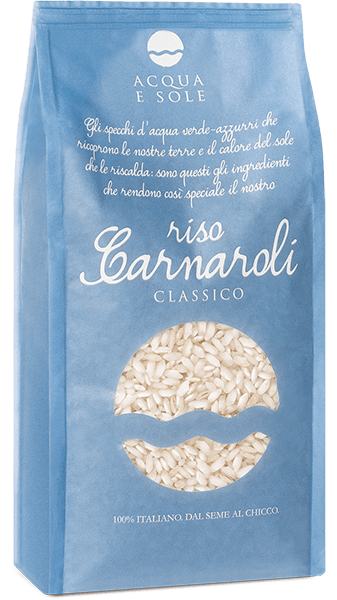
Carnaroli Classico Acqua e Sole Rice
Our Carnaroli Classico, the historic risotto rice variety, grown at Lumellogno and processed in our own rice mill. A large grain, a compact structure, an excellent starch yield. The variety that holds the mantecatura all’onda and stands up to long cooking times without giving way. For traditional risotto alla milanese, for paniscia, for all the risottos of the northern Italian tradition that ask for a grain with character.
Bring Carnaroli homeA recipe of the Lombard tradition, the technical code kept by our kitchen at Lumellogno.