
Risotto with Red Prawns from Mazara and White Asparagus from Bassano
A spring gourmet version on our Carnaroli, with red Mazara prawns, white Bassano asparagus and an iced mantecatura.
A gourmet spring risotto with our Carnaroli Classico, fresh red prawns from Mazara del Vallo, white asparagus from Bassano del Grappa DOP, a pink-amber bisque from the prawn shells and the asparagus stalk peelings, an iced mantecatura (the off-heat creamy stir) with clarified butter and fresh dill to serve. Total cooking time 25 minutes for the risotto, with the bisque made separately in 40 minutes. We serve it all’onda (in a soft, flowing wave) in warm plates, with one whole red prawn head, Maldon salt and freshly crushed pink pepper.
When we want to bring the prawn and asparagus risotto up to the standard of a starred restaurant without stepping outside Italian classicism, we change two ingredients and the mantecatura. The pink prawns become red prawns from Mazara, the green asparagus becomes white Bassano DOP, and the oil-based creamy stir becomes an iced mantecatura with clarified butter. The broth changes colour: no longer green-pink, but pink-amber, more elegant, because without the chlorophyll of green asparagus the note turns towards coral.
Underneath sits our Carnaroli Classico from Lumellogno, the variety Italian tradition has always chosen for delicate fish risottos. We grow it across the 350 hectares of the Novara plain and dry it at low temperature in our own drying plant, with a closed supply chain: the surface starch reaches the pan intact, and with a gentle broth like this one it makes all the difference between clean creaminess and a pasty one. Spring is the season in which this dish finds its point of balance.
Ingredients for 4 People
Ingredients
- 320 g Carnaroli Classico Acqua e Sole rice
- 500 g fresh red Mazara del Vallo prawns, in the shell
- 500 g white asparagus from Bassano del Grappa DOP
- 100 ml dry white wine (Vermentino, Falanghina or Lugana)
- 1 shallot, finely chopped
- 1 garlic clove, in its skin
- 3 tablespoons extra virgin olive oil
- 10 g cold clarified butter for the mantecatura
- 1 sprig fresh dill to serve
- 1 small carrot for the broth
- 1/2 white onion for the broth
- 1 bay leaf
- 1.2 L cold water for the broth
- to taste Maldon salt or fleur de sel to serve
- 1 pinch freshly crushed pink pepper to serve
Notes from Our Kitchen
- Red Mazara prawns go in during the last 60 seconds, not 90: the deep sweetness is lost if they cook too long
- White DOP asparagus needs the outer fibre carefully peeled from 3 cm below the tip down to the base, before anything else
- 4 whole prawn heads are kept for the final garnish, they do not go into the broth
- The prawn flesh is kept at 0-2 degrees until 5 minutes before use, not at room temperature
- A cube of frozen broth should be prepared in advance for the iced mantecatura: the thermal shock stops the cooking and stabilises the creaminess
- Cold clarified butter, not ordinary butter: clarified butter takes the thermal shock of the mantecatura better and does not cloud the dish
Method
Cleaning the red prawns (10 min)
We shell them carefully, keeping 4 whole heads for the garnish, remove the intestinal thread and keep the flesh at 0-2 degrees until 5 minutes before use. The shells, the remaining heads and the carapaces all go together into a bowl: they are the flavour of the dish, nothing is thrown away.
Peeling the white asparagus (10 min)
With the peeler we peel the outer fibre of the stalk from 3 cm below the tip down towards the base; the peeling goes into the broth, the tasty part. We cut the tips at 4 cm from the top and keep them whole, slice the middle part into 5 mm rounds for the soffritto (the slow-sweat aromatic base), and keep the lower stalks and the fibrous trimmings for the broth.
Bisque and white broth (40 min)
In a large pan we warm a tablespoon of extra virgin olive oil. We add all the red prawn trimmings and toast them over a high heat for 3 minutes, pressing the heads with a wooden spoon to draw out the coral. We deglaze with half a glass of white wine and let it evaporate for a minute. We add the lower asparagus stalks and the white asparagus peelings, half an onion, a small carrot and a bay leaf. We cover with 1.2 L of cold water. We simmer uncovered for 30 minutes. We strain through a fine sieve, pressing well. Same technique as the base version, but the final colour of the broth turns out pink-amber because there is no chlorophyll from green asparagus. We keep it hot, covered.
Soffritto and asparagus rounds (5 min)
In a heavy-based pan we warm two tablespoons of extra virgin olive oil. We add the finely chopped shallot and the garlic clove in its skin. We slow-sweat over a low heat for 3 minutes until the shallot is translucent. We remove the garlic. We add the rounds from the middle white asparagus stalk, brown them for 2 minutes over a medium heat, stirring, and season with just a little salt.
Toasting the Carnaroli and deglazing (3 min)
We raise the heat to medium-high and pour the 320 g of Carnaroli Classico over the soffritto. We carry out the tostatura (the dry-toast of the rice), stirring for 2 minutes until the grains are hot and slightly glossy. We deglaze with the 100 ml of white wine all at once and let it evaporate over a high heat until the base is dry.
Risotto and quick cooking of the prawns (18 min)
The tostatura, the deglazing and the broth as in the base version; the red prawns go in during the last 60 seconds, not 90, because the sweetness is lost if they cook too long. We add the hot pink-amber broth two ladles at a time, lower to a medium heat and stir every 30-40 seconds. At minute 14 we add the whole white asparagus tips. At minute 17, exactly 60 seconds before the end, we add the whole red Mazara prawn flesh straight from the fridge. We stir gently. We turn off the heat at a full 60 seconds.
Iced mantecatura (1 min)
Off the heat we add a cube of frozen broth kept aside: the thermal shock stops the cooking and stabilises the creaminess. We add the 10 g of cold clarified butter. We carry out an energetic mantecatura with a wooden spoon for 40 seconds, then cover and let it rest for a minute.
Plating with a whole head (2 min)
Risotto all’onda, one red prawn head in the centre as a garnish, Maldon salt, fresh pink pepper, a sprig of dill. We pour it into warm deep plates and tap the plate gently on the chopping board to spread the wave.
Serve immediately
We serve at once, while the dish is still hot and the wave is alive. A little grinding of pink pepper directly at the table as the plate is set down, a few fronds of dill pulled off by hand. Never hold the risotto in the pan after the mantecatura: the creaminess of the Carnaroli lives on heat, and after five minutes the grain keeps drawing in broth and the dish loses its wave.
Lumellogno, Bassano, Mazara
The three voices of this risotto come from three very distant points of Italy, and each one brings its own character. Our Carnaroli Classico is born here at Lumellogno, a hamlet west of Novara, where we have the paddies and the rice we dry in winter waits for spring. The white asparagus of the Veneto comes from Bassano del Grappa, where growing it sheltered from the light gives it that buttery sweetness which is its character. The red prawns come from the Sicilian channel, from Mazara del Vallo, and their deep sweetness is what has made this shellfish variety a recognised Italian signature. Bringing the three products together on the same plate is our way of celebrating the long spring of the country, from north to south.
Lumellogno · Bassano del Grappa · Mazara del Vallo
Carnaroli Classico with gourmet ingredients
On our Carnaroli Classico this is the version we like best, when we find red Mazara prawns that are truly fresh and white Bassano asparagus at the height of its season. It is the variety Italian tradition has always chosen for delicate risottos: a large grain, an inner structure rich in amylose, a surface starch that melts during the mantecatura and makes the creaminess without the need for heavy additions. We grow it across the 350 hectares around Lumellogno and dry it at low temperature in our own drying plant, with a closed supply chain and ISO 9001 certified production. That low temperature keeps the surface starch intact, and it is the reason why it works so well in the pan even with an elegant broth like this one, light, pink-amber, without forcing.
«With red Mazara prawns and white Bassano asparagus you cannot get the broth wrong: it changes colour, turns pink-amber, and the iced mantecatura is what stops the dish at just the right point. Our Carnaroli Classico holds up beautifully.» From the Acqua e Sole kitchen, Lumellogno
The word of warning we feel we should give anyone trying the gourmet version for the first time: red prawns are not treated like pink prawns. Sixty seconds, not ninety. And for those who want to go further, some kitchens even serve them partly raw, warmed only by the residual heat of the rice with the heat off. It works, if the prawns are caught that day and of certain provenance.
Questions about the gourmet version
How long should the red Mazara prawns cook?
How does the broth change with white Bassano DOP asparagus?
What is the iced mantecatura and why do we use it?
Suggested Pairing
For the gourmet version we like Piedmontese whites with structure, minerality and good acidity, which stand up to the deep sweetness of the red prawns and talk to the buttery sweetness of the white asparagus. We happily open a dry Erbaluce di Caluso DOCG from our own parts, or a young Roero Arneis DOCG.
For those who want a sparkling wine, a Piedmontese Alta Langa DOCG Pas Dosé, a dry classic method, stands up beautifully to the iodine of the prawn and to the iced mantecatura. Avoid tannic reds and overly aromatic whites: in both cases they cover the dish.
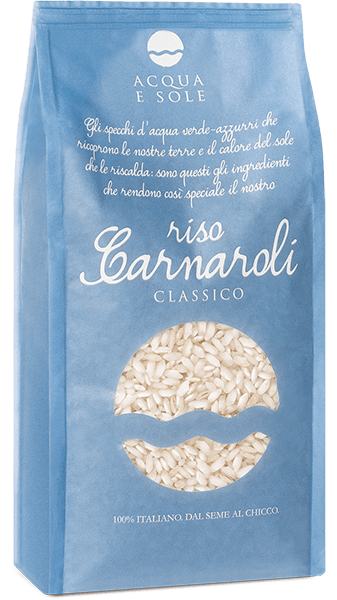
Carnaroli Classico Acqua e Sole Rice
Our Carnaroli Classico, grown at Lumellogno across the 350 hectares of our closed supply chain and dried at low temperature in our own drying plant, with ISO 9001 certified production. A large grain, intact surface starch, superior cooking hold: the right variety for delicate fish risottos and for gourmet versions with refined ingredients, from red Mazara prawns to white DOP asparagus.
Bring Carnaroli homeOriginal Acqua e Sole recipe, the gourmet version from our kitchen at Lumellogno.