
Risotto with Prawns, Asparagus and Saffron
The festive version of our spring risotto on our Carnaroli Classico, with king prawns, DOP saffron threads and asparagus from the Novara plain.
Festive spring risotto with our Carnaroli Classico, the freshest king prawns, DOP saffron threads from Aquila or Sardinia in a 30-minute cold infusion, a saffron bisque made from the shells, green asparagus from the Novara plain for colour contrast, and a yellow, creamy mantecatura (the off-heat creamy stir) with unsalted butter and Grana Padano DOP. Total cooking time 25 minutes for the risotto, with the bisque made separately in 40 minutes. We serve it all’onda (loose and wavy) in warm plates, a whole king prawn with its head in the centre, two green asparagus tips, whole saffron threads on the surface.
This is the festive version of the spring risotto, richer, more colourful. King prawns are larger and sweeter than standard pink prawns, and saffron threads add the deep yellow and the lingering aroma that turn the dish into something Milanese and seasonal. It is the risotto that opens Easter lunch and lights up the table on the occasions that matter.
On our Carnaroli Classico we allow ourselves a codified exception here: traditional saffron lives well with grana, and with the firm flesh of king prawns the combination holds. We say so openly. Anyone who wants to stay a purist of the seafood risotto rule can leave it out, the recipe works with just oil and butter too. The asparagus stays ordinary green, in season, because the saffron already does the strong colour work and two green tips for contrast in the centre of the plate are more than enough.
We grow the Carnaroli from Lumellogno across the 350 hectares of the Novara plain and dry it at low temperature in our own drying plant, with a closed supply chain certified to ISO 9001. For saffron risotto it is the reference variety of the Italian tradition: the generous surface starch takes on the yellow of the threads at once, the eighteen-minute cooking hold allows a rich and luminous mantecatura (the off-heat creamy stir), and the inner structure holds even with the king prawns added at the finish and the grana in the final stir.
Ingredients for 4 People
Ingredients
- 320 g Carnaroli Classico rice by Acqua e Sole
- 700 g the freshest king prawns, shell and head on
- 0,2 g DOP saffron threads from Aquila or Sardinia
- 1 tablespoon warm water for the infusion
- 500 g green asparagus (1 bunch, ideally from the Novara plain)
- 100 ml dry white wine
- 1 shallot, finely chopped
- 1 garlic clove, in its skin
- 3 tablespoons extra virgin olive oil
- 10 g unsalted butter for the mantecatura
- 30 g grated Grana Padano DOP
- 1 small carrot for the broth
- 1/2 white onion for the broth
- 1 bay leaf
- 1,2 L cold water for the broth
- to taste fine salt and freshly ground white pepper
- to taste raw extra virgin olive oil to serve
Notes from Home
- Always saffron threads, never powder: whole DOP threads from Aquila or Sardinia are the only true spice, the powder is almost always cut
- Cold infusion of the threads in a tablespoon of water below 60 degrees for at least 30 minutes, ideally an hour: it preserves safranal and crocin, no direct cooking
- Half the infusion goes into the bisque to simmer, the other half is kept aside for the final mantecatura
- The king prawns go in for the last 90 seconds, not 60: the firmer flesh holds even at 110-120 seconds, but the house rule stays at 90
- Codified exception: the grana in the mantecatura on seafood risotto is done here, and it is stated. Traditional saffron lives well with grana and the king prawns hold up
- Anyone who stays a purist of seafood risotto leaves out the grana and keeps only unsalted butter and oil: it works just the same
- Ordinary green asparagus, not white: the saffron already does the strong colour work, two green tips in the centre of the plate are enough
- Four whole prawn heads are kept for the plating, they do not go into the bisque
Method
Saffron infusion (30 min, in advance)
We put the threads in a tablespoon of water below 60 degrees for at least 30 minutes, ideally an hour; the cold infusion preserves safranal and crocin. The water takes on a deep golden yellow colour and the threads release all their aroma. We set it aside: half will go into the bisque, half into the final mantecatura.
Cleaning the king prawns (10 min)
We shell the body leaving the tail and the last segment of shell attached to the flesh, whole heads for the plating, shells into the bisque. We remove the dorsal intestinal thread with the tip of the knife. We keep the flesh at 0-2 degrees until 5 minutes before use, kept separate.
Preparing the green asparagus (5 min)
We remove the woody white part of the stalks by bending them with both hands until they snap naturally. We cut the tips 4 cm from the top and keep them whole aside for the plating. The middle part of the stalks goes into 5 mm rounds for the soffritto (the slow-sweat aromatic base). The lower stalks and the fibrous trimmings are kept for the bisque.
Saffron bisque (40 min)
In a large pan we heat a tablespoon of extra virgin olive oil. We add the remaining shells and heads of the king prawns and dry-toast them over high heat for 3 minutes, pressing with a wooden spoon to draw out the coral. We deglaze with half a glass of white wine. We add the lower asparagus stalks, half an onion, a small carrot, a bay leaf. We cover with 1,2 L of cold water. The base technique, but half the saffron infusion goes into the bisque to simmer. The other half we keep for the risotto. We simmer uncovered for 30 minutes. We strain through a fine sieve, pressing well. We keep it boiling, covered.
Soffritto and asparagus rounds (5 min)
In a heavy-bottomed pan we heat two tablespoons of extra virgin olive oil. We add the finely chopped shallot and the garlic clove in its skin. We sweat over low heat for 3 minutes until the shallot is translucent. We remove the garlic. We add the rounds of middle asparagus stalk, brown them for 2 minutes over medium heat while stirring, and season lightly with salt.
Toasting the Carnaroli and deglazing (3 min)
We raise the heat to medium-high and pour the 320 g of Carnaroli Classico over the soffritto. We toast, stirring, for 2 minutes until the grains are hot and slightly glossy. We deglaze with the 100 ml of white wine all at once and let it evaporate over high heat until the base is dry.
Risotto and king prawns (18 min)
Cooking as for the base, the king prawns in the last 90 seconds; with the firmer flesh there is margin even at 110-120 seconds, but the rule stays 90. We add the boiling saffron broth two ladles at a time, lower to medium heat, and stir every 30-40 seconds. At minute 14 we add the asparagus tips kept whole. At minute 16 and 30 seconds we add the king prawn flesh taken from the fridge. We stir gently. We turn off the heat at a full 90 seconds.
Yellow, creamy mantecatura (1 min)
Off the heat, the second half of the saffron infusion, butter, Grana Padano, a drizzle of oil. Vigorous pirlatura (the swirling final stir) for 30-40 seconds. The rice takes on a deep, fragrant golden yellow, the mantecatura is rich, velvety, fit for an important occasion. We cover and let it rest for a minute.
Golden starburst plating (2 min)
Yellow risotto all’onda (loose and wavy) in warm deep plates, we tap the plate on the board to spread the wave. One whole king prawn with its head in the centre, two green asparagus tips for contrast, a few whole saffron threads on the surface, a drizzle of raw oil. We serve at once, while the plate is still warm and the wave is alive. Never hold the risotto in the pan after the pirlatura: the grain keeps drawing in broth and the plate loses its wave.
Saffron Threads, Italy’s Precious Spice
Saffron is the spice obtained from the red stigmas of Crocus sativus, a bulbous plant that flowers in autumn for just a few days. The harvest takes place at dawn, flower by flower, and each flower offers only three threads, which must be separated by hand and then dried. To obtain one gram of saffron it takes around one hundred and fifty flowers. In Italy there are historic productions of the very highest quality recognised by the European Union with protected denominations: Zafferano dell’Aquila DOP grown on the Navelli plateau in Abruzzo, Zafferano di Sardegna DOP from the Medio Campidano, Zafferano di San Gimignano DOP from Tuscany. The organoleptic characteristics of threads of true Italian origin are an intense red colour, a clear aroma, a bitterish and lingering flavour. The powdered saffron sold in sachets is often cut with other plant ingredients that dilute its effect: for home cooking a little of the real threads goes a long way.
Crocus sativus · DOP Aquila · DOP Sardinia
Why Carnaroli Classico is the rice of saffron
On our Carnaroli Classico the saffron version is a natural choice: a long Milanese tradition of yellow risotto says as much. The generous surface starch takes on the colour of the threads at once and keeps the luminous golden yellow through the whole mantecatura, without paling. The eighteen-minute cooking hold, al dente at the core, lets us reach the end of cooking with the grain intact, able to take in the saffron infusion, the butter and the grana in the mantecatura without falling apart. The vitrified rice that comes out of our low-temperature drying in the Lumellogno plant keeps its pearl whole and behaves predictably in the pan, indispensable when the finish has to be measured to the minute on the king prawns.
«Traditional saffron lives well with grana, and with king prawns of firm flesh the combination holds. We say so openly: on seafood risotto the grana is done here, and this is the festive version, for an occasion. For those who stay purists, leaving out the grana and a drizzle of raw extra virgin olive oil stand in perfectly well.» From the kitchen of Acqua e Sole, Lumellogno
The technical word of warning for anyone trying this version for the first time concerns the infusion of the threads: it must be cold, below 60 degrees, for at least 30 minutes, ideally an hour. High heat destroys the safranal and the crocin, and the dish loses the intense yellow and the lingering aroma that define it. Never cook the threads over direct heat, never put them into the toasting of the rice.
Questions about the festive version
How long should you cook the king prawns in saffron risotto?
Why is grana added to seafood risotto with saffron?
How do you make the correct infusion of saffron threads?
Recommended Pairing
For this festive version we like Piedmontese whites with structure, minerality and good acidity, which carry the sweetness of the king prawn and converse with the lingering yellow of the saffron without being covered by the grana. We happily open an Erbaluce di Caluso DOCG, dry, from our parts, or a young, fragrant Roero Arneis DOCG with good backbone.
For anyone wanting a sparkling wine for an important occasion, a Piedmontese classic-method Alta Langa DOCG Pas Dosé stands up beautifully to the lingering aromatics of the saffron, the sweet flesh of the king prawns and the milky note of the mantecatura. Avoid tannic reds and overly aromatic whites: in both cases they cover the dish. Serve at 8-10 degrees.
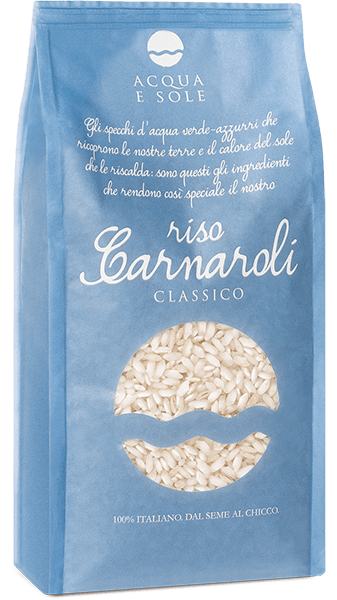
Carnaroli Classico Rice by Acqua e Sole
Our Carnaroli Classico, grown at Lumellogno across the 350 hectares of a closed supply chain and dried at low temperature in our own drying plant, with production certified to ISO 9001. A large grain, intact surface starch, superior cooking hold: the reference variety of the Milanese tradition of saffron risotto, perfect with king prawns and green asparagus of the Novara spring too.
Bring Carnaroli homeOriginal recipe by Acqua e Sole, the festive version from our kitchen in Lumellogno.