
Risotto with Leeks, Prawns and Saffron
Sweet leeks, pink prawns, saffron threads and our Carnaroli Classico from Lumellogno. The Sunday risotto.
A Sunday seafood risotto made with Carnaroli Classico Acqua e Sole from Lumellogno, leeks slowly braised in the white part and the tender green, pink prawns peeled and seared for ninety seconds in a separate pan, saffron threads steeped in boiling stock twenty minutes before use. The Carnaroli cooks for exactly eighteen minutes, saffron goes in at minute 8, the leeks at minute 13, the prawns laid on top at serving. The mantecatura (the off-heat creamy stir) always away from the heat, no cheese on seafood risottos. Served at once in warm deep bowls, all’onda (loose and wavelike).
When we want to turn the leek and prawn risotto into a dish for an occasion, at home we add the saffron. The golden colour that enters the pot and the pink of the prawns laid over the creaminess of the braised leeks make all the difference between the everyday dish and the Sunday one. The threads go into the boiling stock to steep twenty minutes before, never powdered straight into the rice: that is the rule which separates real saffron from any old colouring.
For our home version we choose the Carnaroli Classico from the closed supply chain of Lumellogno, the western hamlet of Novara. We grow it on our 350 hectares around the hamlet, we dry it at low temperature in our own drying plant, and this step leaves the surface starch intact: in the pot it releases just the right creaminess without turning gluey, even inside a stock as full as the saffron one. Eighteen minutes of cooking exactly, no more and no less.
The real trick, if there is one, is the temperature. The leeks braise over a low heat with a film of butter and a little water, until they become translucent and sweet without taking on colour. The prawns go into a separate pan in the last two minutes, ninety seconds in all, not one more. The stock, always boiling, never cold: on this there is no compromise. The mantecatura (the off-heat creamy stir), always away from the heat. On this, none either.
Ingredients for 4 People
Ingredients
- 320 g Carnaroli Classico Acqua e Sole rice
- 3 large leeks (white part and tender green, 400 g trimmed)
- 400 g peeled prawns (pink or Mediterranean red)
- 0,2 g saffron threads (one sachet)
- 1 medium shallot, finely chopped
- 100 ml dry white wine (Erbaluce di Caluso)
- 1 L light vegetable stock or prawn fumet
- 30 g cold butter (10 g for the leeks, 20 g for the mantecatura)
- 4 tablespoons extra virgin olive oil
- 1 sprig fresh chopped parsley
- to taste fine salt, white pepper freshly ground
Notes from Home
- Saffron always in threads, never powdered: more fragrance, a cleaner colour
- Steeping the threads in boiling stock: at least twenty minutes before cooking
- The leeks must never take on colour: braised slowly, covered, always white
- Carnaroli cooking time: exactly eighteen minutes from the first addition of stock
- The mantecatura always with the heat off, never over the flame
- No Parmesan on seafood risottos: it covers the delicacy of the prawns
- White pepper and not black: gentler, it does not overpower the dish
Method
Steeping the saffron (20 min before)
We take 100 ml of boiling stock and pour it into a small cup. We add the saffron threads, cover with a saucer and leave to steep for at least twenty minutes. The liquid should turn an intense yellow, almost orange. This step is done before everything else: the threads need time to release their colour and fragrance, and must never go straight into the rice.
Preparing the leeks
We cut away the root and the dark green part of the leeks. We keep only the white part and the tender green. We slice them finely into rounds of three or four millimetres. We wash them under cold water in a colander, because the soil always stays between the layers. We drain them well before putting them in the pan.
Braising the leeks
In a wide pan we heat 10 g of butter and a tablespoon of extra virgin olive oil over a low heat. We add the sliced leeks with a pinch of salt and two tablespoons of water. We cover with a lid and braise for seven or eight minutes, stirring now and then. The leeks should become soft and translucent but never golden. We turn off the heat and keep them aside, covered.
The base soffritto
In a thick-bottomed pan we heat two tablespoons of extra virgin olive oil over a medium heat. We add the finely chopped shallot and sweat it for two minutes without letting it colour. The shallot should only soften and become fragrant, not turn brown: it is the neutral base of the dish, it should be barely noticeable.
Toasting the rice
We raise the heat to medium-high. We pour the 320 g of dry Carnaroli into the pan and stir with a wooden spoon. We toast for two minutes, until the grains are glossy and warm to the touch: testing with the back of the hand, they should feel hot. The tostatura (the dry-toast of the rice) seals the grain and starts the cooking the right way.
Deglazing with white wine
We pour in the 100 ml of white wine all at once. We stir and let it evaporate over a lively heat for a minute or two, until the pan no longer smells of the sharp scent of the wine. The alcohol must all go off before moving on to the stock.
Cooking with the stock
We lower to a medium heat. We add two ladles of boiling stock. We stir little, every forty or fifty seconds. We add more stock when the previous liquid has almost been absorbed. From this moment the count of the eighteen minutes of Carnaroli cooking begins.
Adding the saffron (at minute 8)
At minute 8 of the rice cooking, we pour the saffron infusion with all the threads straight into the pan. We stir well to spread the colour. The rice immediately takes on a yellow tinge that grows more intense over the following minutes, up to the final deep yellow. The threads stay in the dish: they are part of the serving.
Adding the leeks (at minute 13)
At minute 13 of the rice cooking, we add the braised leeks set aside. We stir gently so as not to break the rounds. We carry on cooking, adding a little stock if needed: the final liquid should be just enough to keep the rice all’onda (loose and wavelike), never dry.
The prawn pan (last 3 minutes)
When three minutes are left to the end of the risotto, in a separate pan we heat a tablespoon of extra virgin olive oil over a high heat. We add the 400 g of peeled prawns, season with a little salt and pepper. We sauté for ninety seconds in all, turning the prawns halfway through. They should turn full pink but stay springy to the touch. We turn off the heat at once and keep them covered.
Checking the cooking (at minute 18)
At minute 18 the rice should be al dente: the grain soft on the outside with a light resistance at the core. We taste and adjust the salt. The right consistency is all’onda: moving the pan, the rice forms a slow wave. We turn off the heat.
The mantecatura away from the heat
With the heat off, we add the remaining 20 g of cold butter, in small pieces. We stir vigorously with the wooden spoon for thirty or forty seconds, until the butter is completely melted and the risotto is glossy and creamy. No Parmesan: the prawns want delicacy, the cheese would cover the saffron and the sweetness of the leeks.
Serving
We share the risotto out into four warm deep bowls. Over each bowl we lay the prawns, about one hundred grams per portion, dust with finely chopped parsley and a turn of white pepper. We serve at once: the risotto does not wait, the grain keeps cooking with the residual heat and loses its wave after a few minutes.
Lumellogno and the dish for special days
Here at Lumellogno, the leek and prawn risotto is an everyday dish, simple, made with a light fumet and the quick pan. When Sunday comes, though, and we want to bring out the good tablecloth, we add the saffron threads, we work the stock with more calm, we braise the leeks slowly until they turn silky, and everything changes voice. The same dish becomes a composition for special days, where the golden colour of the risotto and the pink of the prawns on top speak to each other within the same spoonful. Our Carnaroli Classico, grown here in a closed supply chain, holds the eighteen minutes without wearing out and in the mantecatura brings out the right creaminess that makes the dish.
Lumellogno · Novara · Rice Plain
Why Carnaroli Classico for this risotto
For the leek, prawn and saffron risotto we recommend our Carnaroli Classico, and the choice is no accident. The leek is sweet but fragile, the prawn is delicate and does not forgive the wrong cooking, the saffron is aromatic but must be left free to breathe: the rice has to provide the balance, hold the grain whole for the eighteen minutes, release the starch at the right moment in the mantecatura, and not lay its own personality over that of the other ingredients. Carnaroli Classico does exactly this: large grain, surface starch generous but not intrusive, perfect hold al dente.
Our Carnaroli is sown and harvested here at Lumellogno, on the 350 hectares of the Novara plain, and we dry it at low temperature in our own drying plant. This is the technical reason why, in the mantecatura, it releases its starch in an orderly way, without turning gluey, even inside a stock as full as the saffron one. Closed supply chain Acqua e Sole, from seed to grain, ISO 9001 certification on the production. A 500 g pack is enough for four people with room to spare, with the turn of white pepper at serving.
«On seafood risottos no cheese, not even a grating. The saffron and the sweetness of the leeks want to be tasted, the delicacy of the prawn too. Cold butter, the mantecatura away from the heat, parsley at the end of cooking. That is all.» From the kitchen of Acqua e Sole, Lumellogno
One word of warning we feel we should give: the saffron threads must never be powdered straight into the rice, and must never go in without steeping. Twenty minutes in the boiling stock are the minimum to draw out all the carotenoids and essential oils that give the golden colour and the true fragrance. The shortcut of the sachet dissolved cold leads nowhere.
Questions about leek, prawn and saffron risotto
Why does the saffron go in threads and not in powder?
Can I use another type of rice instead of Carnaroli Classico?
Which prawns are best for this recipe?
Recommended Pairing
With the leek, prawn and saffron risotto we gladly open an Erbaluce di Caluso DOCG still wine from the Canavese, the same wine as the deglazing: fresh minerality and structure that hold the sweetness of the leeks, accompany the prawns and let the saffron breathe. It is the wine of our parts, the local pairing from home.
As an alternative, a young Arneis Roero DOCG brings floral freshness and a note of pear that speaks well with the prawn, or a white from the Colline Novaresi of local production. For grand occasions, an Alta Langa DOCG Brut Pas Dosé from Pinot Nero and Chardonnay grapes supports the dish with elegance. No reds on this dish: the tannins clash with the delicacy of the shellfish and with the aromatic note of the saffron.
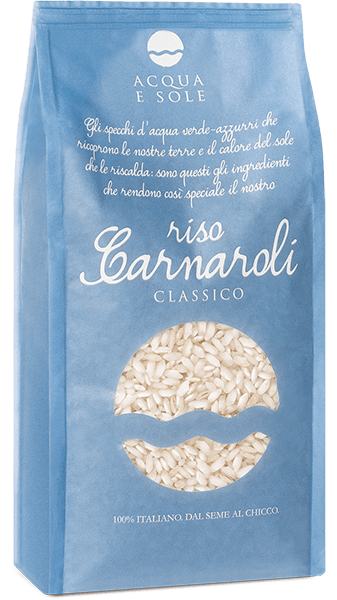
Carnaroli Classico Acqua e Sole Rice
Our Carnaroli Classico, grown at Lumellogno and processed in our own rice mill. Large grain, surface starch generous but not intrusive, perfect hold at eighteen minutes of cooking. The variety we always keep in the larder for seafood risottos and for delicate preparations, where you need a grain that binds without covering. Closed supply chain with ISO 9001 certified production, low-temperature drying in our own drying plant to preserve the surface starch.
Bring Carnaroli homeOriginal Acqua e Sole recipe, from our kitchen at Lumellogno.