
Tricolour Rice Stack with Tuna Tartare
Three of our rices layered, knife-cut Mediterranean red tuna tartare on top. Warm below, cold above: the summer version.
A tricolour rice stack in three bands, set in a chef’s ring: red wholegrain Cardinale at the base, black Il Moro in the middle, white Arborio on top. Above it, a tartare of Mediterranean red tuna, blast-frozen and fit for raw consumption, knife-cut into 5 mm cubes and dressed at the last moment with oil, lemon, chives, Maldon salt and black pepper. Four bands stacked, a warm and cold contrast at the first bite. Serves 4, in around one hour and twenty.
For the summer dinner under the wisteria, for an anniversary, for guests who love raw fish, the version of the tricolour rice stack we bring out is this one: the same layering of Arborio, Il Moro and Il Cardinale, but on top, instead of a whole fish baked in salt, a tartare of raw red tuna, cut by knife on the spot, dressed at the very last moment. The tuna resting on top of the rice stack becomes a fourth band of colour, dark red, above the white of the Arborio.
The dish changes character: the warmth of the freshly built rice stack below, the cold of the tartare on top. You feel the contrast of temperature straight away at the first bite, even before the flavours. The tuna must be very fresh, blast-frozen to minus twenty degrees for twenty-four hours, declared fit for raw consumption by the fishmonger (EU Regulation 1276/2011). Always knife-cut into regular five-millimetre cubes, never minced, never put through the blender: the grains must stay distinct, each one with its own bite. Three pieces of Piedmont inside the rice stack, a migratory Atlantic fish on top, a plain of rice at Lumellogno in conversation with the Mediterranean.
Ingredients for 4 People
For the tricolour rice stack
- 100 g Arborio Acqua e Sole rice (white band on top)
- 100 g Il Moro Acqua e Sole black wholegrain rice (black band in the middle)
- 100 g Il Cardinale Acqua e Sole red wholegrain rice (red band at the base)
- 6 tablespoons extra virgin olive oil (two per rice)
- 1 untreated lemon (grated zest)
- 1 teaspoon fresh thyme leaves (for Il Moro)
- to taste coarse salt for cooking, fine salt, black pepper
For the tuna tartare
- 400 g central fillet of Mediterranean red tuna FAO 37 (or MSC yellowfin tuna), blast-frozen and declared fit for raw consumption
- 3 tablespoons light, fruity extra virgin olive oil
- 2 tablespoons juice of untreated lemon
- zest of a quarter of an untreated lemon
- 1 tablespoon finely chopped fresh chives
- 1 pinch Maldon salt per portion (at the moment of serving)
- to taste freshly ground black pepper
- a few microgreens (turnip or radish shoots) for visual height
Notes from Home
- Three rices cooked in three parallel pots: different times (35-30-16 minutes), one shared finish. Same logic as the classic version
- No cold water after draining: the surface starch keeps the bands compact in the ring
- Tuna out of the fridge 15 minutes before serving, never at full room temperature: it must stay cold for cutting
- Cut with a sharp knife on a dry board, regular 5×5 millimetre cubes. Never a meat grinder, never a blender
- Maldon salt only at the moment of serving: if you add it earlier, the tuna draws out liquid and the bite is spoiled
- Four bands of colour stacked: red Cardinale below, black Moro, white Arborio, dark red tartare on top
- Optional for those who want to lean towards the East: a teaspoon of soy sauce in the dressing, half a diced avocado in the last stirs, a touch of fresh wasabi in the oil
Preparation
The red Cardinale goes first (35 min)
We bring a first pot of 2 litres of salted water to the boil (10 grams of coarse salt per litre). Scatter in 100 grams of Il Cardinale, stir once and cook over a lively heat without a lid for 35 minutes. The grain should stay soft on the outside and slightly firm at the core: for the rice stack we want a more pronounced bite than usual, because it holds up the structure of the base.
The black Il Moro goes in 5 minutes later (30 min)
Five minutes after putting in Il Cardinale, in a second pot of 2 litres of boiling salted water add 100 grams of Il Moro. Stir, cook for 30 minutes. Same logic: soft on the outside, firm at the core.
The white Arborio goes in 19 minutes after Il Moro (16 min)
When Il Moro has been in the pot for 19 minutes, bring the third pot of 2 litres of salted water to the boil. Add 100 grams of Arborio and cook for 16 minutes. If the timings are respected, all three rices finish in the same minute.
Draining and dressing separately (5 min)
Drain the three rices each in a different colander, without running them under the tap: the surface starch serves to keep the bands of the rice stack compact. Tip them into three separate bowls. Dress Il Cardinale with 2 tablespoons of oil and the zest of a quarter of a lemon. Dress Il Moro with 2 tablespoons of oil and the teaspoon of fresh thyme. Dress the Arborio with 2 tablespoons of oil and the zest of half a lemon. Fine salt and black pepper for each. Leave to cool to lukewarm.
Tuna out of the fridge (15 min)
Fifteen minutes before you start cutting the tartare, take the tuna fillet out of the fridge. It must lose the intense chill of the cold store but stay cool: you want a tuna that yields under the knife, not a tuna at room temperature. Keep it covered with cling film, on a plate, away from the sun.
Cleaning and knife-cutting the tuna (10 min)
Dry board, well-sharpened fish knife. Inspect the fillet and remove any visible sinews. First cut into thin 5-millimetre slices, turn, cut into strips, turn again, cut into regular 5 by 5 millimetre cubes. The grain must stay distinct, recognisable under the blade. Transfer the tartare to a steel or glass bowl kept in the fridge until the very last moment.
Dressing the tartare (3 min, at the last moment)
Just before serving, add to the tartare 3 tablespoons of light, fruity extra virgin olive oil, the juice of 2 tablespoons of untreated lemon, the grated zest of a quarter of a lemon, the finely chopped chives, a few grinds of black pepper. Stir gently with a wooden spoon so as not to break the cubes. The Maldon salt stays aside: you will put it on top of each portion only when plating. If added now, the tuna draws out liquid.
Building the tricolour rice stack (5 min)
Place a cylindrical ring of 7-8 centimetres in the centre of each flat plate. First layer: red Il Cardinale, about 4 heaped tablespoons per person, press down with the back of the spoon to form a band of 1.5-2 centimetres. Second layer: black Il Moro, same thickness, press down. Third layer: white Arborio, level the surface well. Lift the ring off vertically with a gentle movement. The rice stack is warm or lukewarm: that is just right, the contrast with the cold of the tartare is half the dish.
Final composition in four bands (3 min)
On top of each rice stack set a dome of tuna tartare about 1.5 centimetres high, shaped with two wet spoons or with a smaller 5-centimetre ring. The dome of tuna is the fourth visual band, dark red, above the white of the Arborio. Add the pinch of Maldon salt on top of the tuna, a few drops of raw extra virgin olive oil, a tuft of microgreens for height, two slices of lemon on the rim of the plate as a fifth note of colour.
Serve at once
It is served immediately, before the warmth of the rice stack and the cold of the tartare even out: the contrast of temperature at the first bite is the signature of the dish. Bottle of wine already chilling, cold glasses, guests already seated. The tricolour rice stack with tuna tartare waits for no one.
Lumellogno looks out to the sea
The red tuna of the Mediterranean, Thunnus thynnus, is the largest fish in the Mediterranean: an Atlantic migrant that comes in during spring to spawn and leaves again in autumn towards the ocean. Traditional fishing is done with the fixed tonnare, systems of nets cast from the coast that trap the tuna during migration. The tonnare of Favignana in Sicily and of Carloforte in Sardinia have been active for centuries. In the nineteen-nineties the species risked extinction through overfishing; today, thanks to strict quotas from ICCAT, the International Commission for the Conservation of Atlantic Tunas, it has recovered, and the certified catch is sustainable once more. For the tartare we always look for Mediterranean red tuna with a FAO 37 certificate of origin, never generic yellowfin tuna of unknown provenance. Our Novara plain looks to the Mediterranean of the tonnaroti as another half of the Italian table.
Thunnus thynnus · Mediterranean FAO 37 · Certified fishing
Four bands, two temperatures
The tricolour rice stack with tuna tartare is the summer version of our showpiece dish. The structure of the rice stack is the same: three rices cooked in parallel, three different times, one shared serving window. But on top, everything changes: no whole fish baked in salt, no convivial gesture at the table. In place of the parcel or the crust, a dome of raw tuna tartare cut on the spot, which becomes the fourth band of colour above the white of the Arborio.
«Warmth of the rice stack below, cold of the tartare on top. The contrast of temperature at the first bite is the signature of the dish: you feel it even before the flavours. That is why it is served at once, always, without keeping anyone waiting.» From the kitchen of Acqua e Sole, Lumellogno
On the tuna, a recommendation that holds as a household law: always ask the fishmonger for the declaration of fitness for raw consumption (EU Regulation 1276/2011), which certifies the blast-freezing to minus twenty degrees for at least twenty-four hours. It is the minimum guarantee against anisakis. Mediterranean red tuna FAO 37 or MSC yellowfin tuna: always a certified supply chain, never a catch of unclear provenance. Always knife-cut, never minced. Dress it at the last moment, Maldon salt only when plating.
Questions about the tricolour rice stack with tuna tartare
Can I use fresh tuna without blast-freezing?
Can I use another fish instead of tuna?
Why three separate cooking times for the rices?
Suggested Pairing
To accompany the raw tuna tartare we look for a white with character, with lively acidity, sharp minerality and aromatic finesse: it must clean the mouth between one band of rice and the next and hold up the warm and cold contrast of the dish. Our first choice from our part of the world is an Alta Langa DOCG metodo classico Brut Nature: the long bead, the savoury acidity and the dry dosage are the ideal companion to raw tuna.
As an alternative, an Erbaluce di Caluso DOCG metodo classico from the Canavese, or a young Roero Arneis DOCG from the Langhe, soft and floral but with good acidic backbone. Serve at 6-8 degrees, open 10 minutes beforehand.
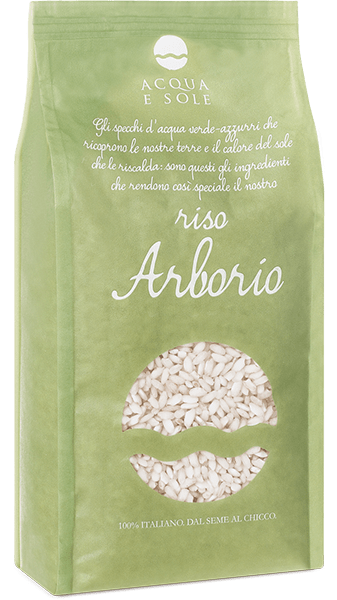
Arborio Acqua e Sole Rice
Our classic white Arborio, grown at Lumellogno and milled in our own rice mill. Large grain, rich in starch, delicate flavour. In the tricolour rice stack it is the white band on top, the most visible one, the one that contrasts with the dark red of the tuna tartare resting above it. For the bite of the rice stack, just 16 minutes in salted water are enough. Closed supply chain certified ISO 9001, from the paddy field to the bag.
Take the Arborio homeOriginal Acqua e Sole recipe, from our kitchen at Lumellogno.