
Red Rice Timbale with Duck in Myrtle
Wholegrain red rice “Il Cardinale” shaped into a timbale, pink duck breast with crisp skin, Cannonau sauce and Sardinian myrtle berries mirrored on the plate.
A contemporary Italian timbale made with wholegrain red rice “Il Cardinale” cooked al dente, shaped in a chef’s ring and served with slices of pink duck breast with crisp skin and a Sardinian Cannonau sauce with myrtle berries mirrored on the plate. A structured main course with a wild, Mediterranean profile, naturally gluten-free. Marinating 2 hours, active work 35 minutes, cooking 45 minutes. Serves four, 70 grams of rice per person.
The rice timbale is a dish we love because it asks for order. No rush, no improvising: we cook the rice on its own, let it cool to lukewarm, shape it in the chef’s ring, and only then do we plate up. On the table the result has the shape of a small building of red rice, and each person opens their own timbale with a spoon the way you open a surprise.
In this version the duck with myrtle sits somewhere between the inland cooking of Sardinia and the elegance of an Italian bistro. The pink duck breast at the centre, seared on the skin until it crackles, holds up well to the intense profile of our Riso Rosso Cardinale, a wholegrain red rice we grow at Lumellogno, on the Novara plain. The red bran of the Cardinale converses with the red of the Cannonau in the sauce, and the myrtle comes in as a third voice, aromatic and balsamic. It is a version we like to make when we want something more structured than the usual Sunday lunch.
Ingredients for 4 People
Ingredients
- 280 g Riso Rosso Cardinale Acqua e Sole (wholegrain)
- 500 g whole duck breast with skin (Mulard or Barbary, free-range)
- 2 tbsp crushed Sardinian myrtle berries (1 for the marinade, 1 for the sauce)
- 250 ml Cannonau di Sardegna DOC (100 ml marinade, 150 ml sauce)
- 2 leaves bay, torn
- 1 shallot, finely chopped
- 100 ml vegetable or chicken broth
- 1 garlic clove, in its skin (for the marinade)
- 1 bay leaf (for the rice water)
- 3 tbsp extra virgin olive oil
- 14 g coarse salt for the rice water
- to taste fine salt, freshly ground black pepper
- opt. 1 tsp Sardinian myrtle liqueur
Notes from Our Kitchen
- Duck breast pink at the core: internal temperature 56-58 degrees, never beyond, or the meat dries out and loses its quality
- Crisp skin in a cold steel pan, no oil: the fat melts on its own and cooks the skin from within
- Two-hour marinade with crushed myrtle, bay and Cannonau: no salt in the marinade, the salt goes in during the pan-frying
- Sardinian myrtle berries: the signature of this version, not to be swapped for juniper or other balsamic berries
- The Cardinale needs a full 35 minutes of cooking: do not drain before 33 or the grain stays grainy at the core
- Rest the breast for five minutes under foil before slicing: without resting the juices run out when you cut
- Cannonau sauce reduced until it coats the spoon: uncovered, eight to ten minutes, a syrupy rather than liquid profile
- Plating with the sauce mirrored around the timbale, never over it: the timbale rises whole like a building of red rice
Method
Marinating the duck breast (2 hours, in advance)
Lay the whole duck breast in a deep dish or a marinating bag. Add a tablespoon of crushed myrtle berries, the two torn bay leaves, 100 ml of Cannonau, a drizzle of extra virgin olive oil and the crushed garlic clove. No salt: the salt goes in during the pan-frying. Cover and keep in the fridge for two hours, turning the breast halfway through. Thirty minutes before cooking, take it out of the fridge and bring it to room temperature.
Boiling and cooking the rice “Il Cardinale” (40 min)
In a large pot bring 1.4 litres of water to the boil with 14 g of coarse salt and the bay leaf. Pour in the 280 g of Cardinale, stir once only. Cook over medium heat for 35 minutes, uncovered, without stirring again. Taste from minute 30: the grain should be soft on the outside with the very lightest resistance at the core. Drain, remove the bay, dress with a drizzle of oil in a wide bowl and leave to cool to lukewarm for ten minutes, covered with a clean tea towel.
Searing the skin (7 min)
Pat the duck breast dry with kitchen paper, keeping the strained marinade for the sauce. With a sharp knife, score the skin in a crosshatch, down to the fat but without cutting the meat beneath. Lay the breast skin side down in a cold steel pan, with no oil: the fat melts on its own. Turn the heat to medium and cook until the skin is golden and crisp, seven to eight minutes, pressing lightly with a spatula. Salt the skin.
Cooking the meat side and resting (8 min)
Turn the breast onto the meat side, raise the heat to medium-high, cook for 3-4 minutes for a pink centre: internal temperature at the core 56-58 degrees measured with a thermometer. Transfer the breast to a board, salt the meat side, cover with foil and leave to rest for five minutes. Without resting, the juices run out when you cut and the meat dries. Then slice at 5 mm against the grain.
Cannonau and Sardinian myrtle sauce (15 min)
Keep three tablespoons of the released duck fat in the pan, discard the rest. Add the very finely chopped shallot and let it sweat for two minutes over medium heat. Deglaze with the 150 ml of Cannonau, add the strained marinade and the tablespoon of fresh myrtle berries, pour in the 100 ml of broth. Leave to reduce over medium heat for eight to ten minutes until the sauce coats the back of the spoon. Adjust the salt and freshly ground black pepper. If you like, flambé at the end with a teaspoon of Sardinian myrtle liqueur.
Shaping the timbale with a chef’s ring (3 min)
Place a steel chef’s ring (8-10 cm in diameter, 4-5 cm tall) in the centre of the plate. Fill it with the lukewarm rice to a height of 3-4 cm. Press gently with the back of a spoon to compact without crushing. Slide the ring off vertically in one clean movement, not in fits and starts. Repeat for the other three plates.
Mirroring the sauce around the timbale (1 min)
Pour 3-4 tablespoons of the Cannonau and myrtle sauce around the timbale, forming a glossy circular mirror. Never over the timbale: it should rise whole like a small building of red rice. Scatter five or six whole myrtle berries in the sauce too, clearly visible on the surface.
Laying the duck slices (1 min)
Arrange five or six slices of pink duck breast in a fan over the timbale, with the crisp skin on top in view, lightly overlapping. The pink at the core of the meat should stay visible on the cut: it is the sign that the cooking held to the right measure.
Final assembly and serving (1 min)
Finish with a few small leaves of fresh myrtle for a green contrast on the red of the sauce, a grind of black pepper at the last, a drizzle of raw extra virgin olive oil. Serve immediately, still hot: the Cannonau sauce is best just made, and the duck skin loses its crispness if it waits.
The Cardinale of Lumellogno and the myrtle of Sardinia
We make this version of the timbale when we want something more structured than the usual Sunday lunch. The pink duck breast with its crisp skin holds up well to the profile of our Cardinale, which we grow here at Lumellogno, on the Novara plain, within the closed Acqua e Sole supply chain. The red bran of the rice converses with the red of the Cannonau in the sauce, and the myrtle comes in as a third voice, aromatic and balsamic: it is the signature of this version, a Sardinian berry that nothing can replace. A dish from inland Sardinia that meets our rice from the Po Valley plain.
Lumellogno · Closed Acqua e Sole supply chain
Wholegrain red rice for structured timbales
Wholegrain red rice is the variety we keep in the pantry when we want a one-dish meal that holds the shaping of the timbale and that knows how to converse with flavourful meats. Compared with white rice it keeps the grain compact even after draining, gives back a note of toasted hazelnut that plays off the duck breast, and brings complex carbohydrates and fibre that make the dish substantial without weighing it down. Our Riso Rosso Cardinale is one we grow at Lumellogno and work in our own rice mill within the closed Acqua e Sole supply chain, from seed to grain: drying at low temperature lets us keep the fibre intact and the nutty flavour we are after.
«For the timbale we want a rice that asks for order: the Cardinale gives it, because it keeps the grain al dente, holds the ring, and brings to the table a red that speaks with the Cannonau and with the myrtle. That is how it is made.» From our kitchen at Lumellogno
A word of caution we feel we should give: the duck breast wants time and attention, no rush. Marinate two hours ahead, sear on the cold skin, short cooking on the meat side, rest under foil. The difference between a breast pink at the centre and a stringy one lies entirely in the final minutes. Thermometer in hand, 58 degrees at the core and off the heat it comes.
Questions about the red rice timbale with duck and myrtle
Which rice do you use for a red rice timbale with duck?
How do you cook duck breast so it stays pink in the centre?
Which wine goes with the red rice timbale with duck and myrtle?
Recommended Pairing
To go with the timbale we gladly open the same Cannonau di Sardegna DOC that goes into the sauce: the choice closes an aromatic circle between dish and glass, brings the myrtle berries to the table in both and holds up well to the pink duck breast.
As an alternative, for those who prefer a structured white, a Vermentino di Gallura DOCG supports the duck breast and the balsamic notes of the myrtle. Staying in Piedmont, a young Nebbiolo d’Alba DOC is a consistent alternative: measured tannin, red fruit and a light balsamic note. Avoid aromatic whites and light reds such as Dolcetto, too weak for the structure of the duck breast.
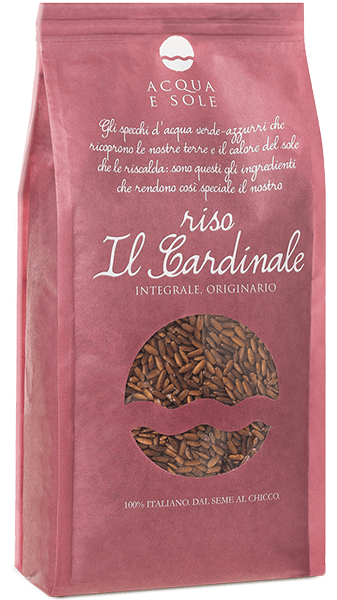
Riso Rosso Cardinale Acqua e Sole
Our wholegrain red rice, grown at Lumellogno and worked in our own rice mill within the closed Acqua e Sole supply chain. Red bran kept intact thanks to anthocyanins, a firm grain that stays separate even after the timbale is shaped, a note of toasted hazelnut that the wholegrain processing develops naturally. The right variety for timbales, composed salads and structured dishes with flavourful meats such as duck breast.
Bring the Cardinale homeOriginal Acqua e Sole recipe, from our kitchen at Lumellogno.