
Wholegrain Rice Boat with Radicchio, Guanciale and Williams Pears
Our wholegrain Carnaroli tossed with crisp guanciale and caramelised Williams pears, served on half a leaf of raw red radicchio.
A boat of Carnaroli Classico Integrale cooked by absorption (40 minutes, grain al dente), tossed in the pan with crisp guanciale and Williams pears caramelised in its fat, deglazed with semi-aromatic white wine. Served inside half a leaf of raw red radicchio that acts as a bowl, with a few slices of raw Williams pear on top: raw and cooked contrast on both the radicchio and the fruit. A rustic first course for September to November, made with our wholegrain Carnaroli from Lumellogno and our closed supply chain.
This is the September version, for when the Williams pears are ripe at just the right point and the radicchio starts to appear in the markets. In place of pancetta we use guanciale, which has a sweeter, more marbled fat, and we add a few cubes of pear caramelised in the same base. We deglaze it with semi-aromatic white wine, not red: the fruity note of the pear wants an ally on the white side, and the boat changes register at the table.
The technique of our Carnaroli Classico Integrale does not change from the basic version: cooking by absorption, forty minutes, grain al dente with the bran film intact. Only the dressing of the final toss and the presentation change. On top of the half leaf of raw radicchio we add a few thin slices of raw Williams pear, so the raw and cooked contrast carries over to the fruit side too. The hazelnut crumble of the basic version is not needed here: the pear is already the note of sweet contrast.
Ingredients for 4 People
Ingredients
- 320 g Carnaroli Classico Integrale Acqua e Sole rice
- 800 ml water or light vegetable stock
- 1 level teaspoon coarse salt
- 1 bay leaf
- 150 g diced guanciale (cured pork jowl from central Italy)
- 2 Williams pears, ripe but firm (1 diced, 1 thinly sliced)
- 1 teaspoon brown sugar for caramelising
- 1 head red radicchio di Treviso (about 400 g trimmed)
- 2 large outer radicchio leaves for the boat
- 1 medium shallot
- 50 ml semi-aromatic white wine (Sauvignon, Müller Thurgau, Friulano)
- ½ teaspoon traditional balsamic vinegar
- 3 tablespoons extra virgin olive oil
- to taste freshly ground black pepper
Notes from Home
- Guanciale into a cold pan, with no added oil: the fat of the guanciale is enough on its own and scents the whole base
- Williams pears ripe but still firm: if they are too soft they melt into caramel, with no clean cubes
- Semi-aromatic white wine, not red: the pear wants an ally on the white side, the red covers the fruity note
- Balsamic vinegar only half a teaspoon, no more: the caramelised pear already brings its own sweetness, the vinegar is only there to give the acidity that cuts the fat
- Slices of raw pear on top at serving, never before: in contact with the hot rice they oxidise and lose their fresh note
- No hazelnut crumble, no parsley: the pear is already the note of sweet contrast, nothing else is needed
Method
Rinsing the wholegrain Carnaroli
We put the 320 g of wholegrain Carnaroli in a bowl, cover it with cold water, stir with the hand and drain it. We repeat a second time. This step removes the surface bran dust without touching the properties of the grain.
Cooking by absorption (40 min)
In a heavy-based pot we pour 800 ml of cold water, 1 level teaspoon of coarse salt, 1 bay leaf and 1 tablespoon of oil. We add the drained rice. We bring it to the boil over a high heat, lower it to the minimum and cover. We cook for 40 minutes without ever stirring. At the end of cooking the rice has absorbed all the water and the grain is al dente: soft outside, firm inside, with the bran film intact. We turn off the heat, leave it to rest for 5 minutes covered, remove the bay leaf and loosen the grains with a fork.
Preparing the radicchio
We separate the leaves of the radicchio. We set aside 2 large, sound outer leaves of an elongated shape: we wash them, dry them well, cut them in half lengthways. These are the 4 boats for the presentation. The rest of the head (about 400 g trimmed) we cut into strips a finger wide.
Crisp guanciale (5 min)
We put the 150 g of diced guanciale into a large non-stick pan, cold, without adding oil. We turn the heat to medium. We brown it for 4 to 5 minutes, stirring now and then, until the guanciale is golden and crisp and has released its fat. With a slotted spoon we transfer the guanciale onto kitchen paper, leaving the fat in the pan.
Caramelised Williams pears (2 min)
In the guanciale fat, still hot, we add the cubes of Williams pear and 1 teaspoon of brown sugar. High heat for 2 minutes, stirring, until the cubes are golden and lightly glazed. We lift them out with the slotted spoon and set them aside on a small plate.
Shallot, radicchio and deglazing (5 min)
Into the fat left in the pan we add 1 tablespoon of extra virgin olive oil and the finely chopped shallot. Medium heat, we sweat it for 2 minutes until translucent. We add the strips of radicchio, raise the heat and toss for 2 minutes. We pour in the 50 ml of semi-aromatic white wine and the half teaspoon of balsamic vinegar, and let it evaporate over a high heat for 1 minute. The base should stay slightly moist, not dry.
Tossing the rice (2 to 3 min)
We add the cooked rice to the pan with the radicchio and shallot. We stir with a movement from the bottom upwards, as for a warm rice salad, letting the rice work into the dressing. We toss over a medium-high heat for 2 to 3 minutes. A grinding of black pepper. We taste and adjust the salt only if needed, as the guanciale is already savoury.
Folding back the guanciale and caramelised pears
We turn off the heat. We add the crisp guanciale and the cubes of caramelised pear we set aside. We stir gently to combine, just 10 seconds. We cover the pan and leave it to rest for 2 minutes, so the guanciale and pears warm through without softening in the moisture.
Assembling the boat and serving (3 min)
On each soup plate we lay a half leaf of raw radicchio, concave side up, slightly on the diagonal. With a large spoon we lift about 200 g of tossed rice per plate and settle it inside the boat, leaving the edge of the leaf visible. On top of each boat we arrange 4 to 5 thin slices of raw Williams pear, a drizzle of extra virgin olive oil, a grinding of black pepper. We serve at once: the raw boat welcomes the warmth of the rice, and the raw and cooked contrast comes through at the first mouthful.
A September boat in Lumellogno
September in Lumellogno is the month when the Novara plain catches its breath. The rice is still in the fields, the Williams pears arrive ripe from the nearby orchards, and the first radicchio begins to appear in the markets. From this meeting comes the seasonal version of our boat: the guanciale in place of pancetta brings a sweeter fat, the pears caramelised in its base tie the sweetness to the hazelnut flavour of the wholegrain Carnaroli, and the semi-aromatic white wine in the deglazing opens the dish up instead of closing it the way red would. The boat of raw radicchio stays the same, but on top come slices of raw pear in place of the hazelnut crumble. A dish for the September table, for when it is still warm inside the house and outside the sun begins to set early.
Lumellogno · Novara plain
Why wholegrain Carnaroli holds the September boat
Wholegrain rice is the rice we work the least: a single pass in the mill, we take off the outer husk and that is all. The bran and the germ stay on the grain, and that is where the fibre, the minerals and the hazelnut flavour live, the flavour that makes the difference in rustic dishes like this boat with guanciale and Williams pears. Our Carnaroli Classico Integrale comes from the same paddies as the white Carnaroli, around Lumellogno on the Novara plain to the west of Novara. Same seed, same closed supply chain, same low-temperature drying: only the final degree of processing changes.
«For the September version, with the guanciale and the Williams pears, wholegrain Carnaroli is the perfect variety: the hazelnut note of the grain talks to the sweetness of the caramelised pear, the structure holds the toss in the pan without breaking down, and the flavour is not covered by the guanciale. It is a rice that should be in everyone’s larder, for dishes like this where every ingredient brings something.» From our kitchen in Lumellogno
We work it in our own mill at home, with low-temperature drying and ISO 9001 certified production. The bran film acts as a shield during the forty minutes of cooking by absorption: the grain stays al dente, the surface starch does not disperse, and in the pan during the final toss it takes up the fat of the guanciale and the caramel of the pears without falling apart. It is the difference you feel at the first mouthful.
Questions about the wholegrain rice boat with guanciale and pears
Which rice should I use for the wholegrain rice boat with guanciale and pears?
How do you cook wholegrain rice by absorption?
Why guanciale and Williams pears in place of pancetta?
Suggested Pairing
To go with this September boat we like structured semi-aromatic whites, which hold up to the guanciale and talk to the caramelised pear. We happily open a Sauvignon Blanc from Collio, with its mineral freshness, or a Müller Thurgau from Alto Adige, with its floral and fruity notes that lift the Williams pear.
As an alternative, a young Friulano works very well, with its almond note that rounds off the dish. Avoid important reds and whites that are too rich, such as oaked Chardonnay: the first covers the pear, the second weighs the dish down.
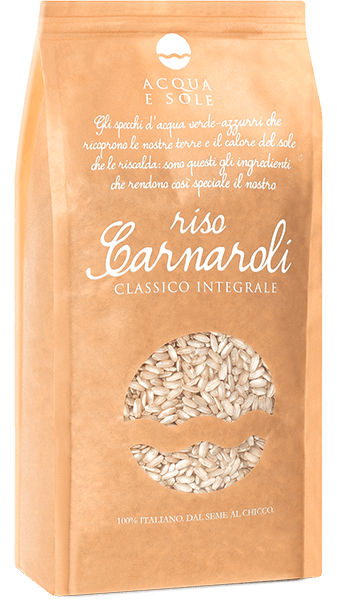
Carnaroli Classico Integrale Acqua e Sole Rice
The Carnaroli with the bran film intact, grown in Lumellogno and worked in our own mill. A single pass in the mill, bran and germ on the grain: fibre, minerals and a natural hazelnut note. A superior cooking hold thanks to low-temperature drying. The right variety for rustic dishes like this boat with guanciale and Williams pears: it holds the forty minutes by absorption, takes up the dressing in the pan toss without falling apart, and brings to the table the true flavour of wholegrain Carnaroli.
Bring wholegrain Carnaroli homeOriginal Acqua e Sole recipe, from our kitchen in Lumellogno.