
Tricolour Rice Timbale with Sea Bream in a Salt Crust
Three of our rices in layers and a whole sea bream in a salt crust, to crack open at the table in front of your guests.
A tricolour rice timbale in three bands, built in a ring mould: red wholegrain Cardinale at the base, black wholegrain Il Moro in the middle, white Arborio on top. Alongside, a whole sea bream of 1.2-1.5 kg cooked in a salt crust, scented with rosemary, thyme, bay and lemon, which you crack open at the table with a tap of the spoon in front of your guests. A convivial, theatrical gesture, with very firm, moist flesh. Serves 4, in about an hour and a quarter.
For the extended-family lunch, for the birthday with the children gathered round the table, for the summer dinner under the wisteria, the version of the tricolour timbale we bring out at home is this one: the same layering of Arborio, Il Moro and Il Cardinale, but with a whole sea bream in a salt crust alongside that you crack open at the table. The gesture of tapping the spoon on the crust and the scented steam that rises is half the pleasure of the dish.
Sea bream from responsible Italian farming or from Mediterranean wild fishing works beautifully here: its flesh is very close to sea bass, and in a salt crust, shielded from direct heat, it comes out very firm, moist and scented with Mediterranean herbs. A higher oven (200 degrees) and longer times than for an en papillote, because the salt acts as a shield. The timbale in the centre of the plate, the fillet of sea bream pulled off the bone at the last moment alongside. Three Piedmonts and a whole Mediterranean fish, on the same table.
Ingredients for 4 People
For the tricolour timbale
- 100 g Arborio Acqua e Sole rice (white band on top)
- 100 g Il Moro Acqua e Sole black wholegrain rice (black band in the middle)
- 100 g Il Cardinale Acqua e Sole red wholegrain rice (red band at the base)
- 6 tablespoons extra virgin olive oil (two per rice)
- 1 untreated lemon (grated zest)
- 1 teaspoon fresh thyme leaves (for Il Moro)
- to taste coarse salt for cooking, fine salt, black pepper
For the sea bream in a salt crust
- 1 sea bream of 1.2-1.5 kg, whole and gutted, with scales and skin (Italian ASC farming or FAO 37 wild fishing)
- 2.5-3 kg Italian coarse sea salt
- 2-3 egg whites (to bind the salt)
- 3-4 sprigs fresh rosemary
- 3-4 sprigs fresh thyme
- 2 leaves fresh bay
- 1 untreated lemon, thinly sliced
- a handful black peppercorns
- 3 tablespoons extra virgin olive oil, raw, for serving
Notes from Our Kitchen
- Three rices cooked in three parallel pans: different times (35-30-16 minutes), one single shared finish
- No cold water after draining: the surface starch is what keeps the bands compact in the ring mould
- Egg whites beaten roughly with the salt: you want the texture of wet sand, not a cream
- No fin should stick out of the salt crust: press well with your hands so it sticks fast
- Rest for 5 minutes out of the oven before breaking the crust: it completes the residual cooking
- The tap of the spoon on the crust goes at the table, never in the kitchen: it is half the dish
Method
Red Il Cardinale goes in first (35 min)
We bring a first pan with 2 litres of salted water to a gentle boil (10 grams of coarse salt per litre). Scatter in 100 grams of Il Cardinale, stir once and cook over a lively heat without a lid for 35 minutes. The grain should stay soft on the outside and slightly firm at the heart: for the timbale you want a more pronounced bite than usual, because it holds the structure.
Black Il Moro goes in 5 minutes later (30 min)
Five minutes after dropping in Il Cardinale, in a second pan with 2 litres of boiling salted water add 100 grams of Il Moro. Stir, cook for 30 minutes. Same logic: soft on the outside, firm at the heart.
White Arborio goes in 19 minutes after Il Moro (16 min)
When Il Moro has been in the pan for 19 minutes, bring the third pan with 2 litres of salted water to the boil. Add 100 grams of Arborio and cook for 16 minutes. If the timings are respected, all three rices finish within the same minute.
Separate draining and dressing (5 min)
Drain the three rices each in a different colander, without rinsing them under running water: the surface starch helps keep the bands of the timbale compact. Tip into three separate bowls. Dress Il Cardinale with 2 tablespoons of oil and the zest of a quarter of a lemon. Dress Il Moro with 2 tablespoons of oil and the teaspoon of fresh thyme. Dress the Arborio with 2 tablespoons of oil and the zest of half a lemon. Fine salt and black pepper for each. Leave to cool to lukewarm.
Preparing the sea bream (5 min)
While the rices cool, heat the oven to 200 degrees, conventional. Rinse the sea bream under cold water and dry it well. Lightly salt the inside of the belly cavity, fill it with 2-3 lemon slices, a few sprigs of rosemary and thyme, the two bay leaves, a few black peppercorns.
Salt bed (5 min)
In a large bowl mix the coarse salt with the egg whites, roughly beaten with a fork, until the mixture reaches the texture of wet sand. Add the remaining rosemary and thyme sprigs, broken up with your hands: during cooking they will release their scent through the crust.
Encasing the fish in the crust (3 min)
On a tray lined with baking paper, spread half the salt into a rectangular bed, 3-4 centimetres larger than the fish on each side. Lay the sea bream on the salt bed and cover it completely with the remaining salt, pressing well with your hands so it sticks to the body of the fish. No fin should stick out: there the salt insulates the cooking and everything must stay sealed.
Cooking and resting (35-40 min)
Bake at 200 degrees, conventional. For a 1.2 kilo sea bream allow 30 minutes, for a 1.5 kilo one 35 minutes. At the end of cooking the crust should be lightly golden and hard to the touch. Take it out and leave to rest for 5 minutes out of the oven: the residual cooking completes the fish without drying it.
Building the tricolour timbale (5 min)
While the sea bream rests, build the timbales. Place a cylindrical ring mould 7-8 centimetres wide in the centre of each flat plate. First layer: red Il Cardinale, about 4 heaped tablespoons per person, press with the back of the spoon to form a band 1.5-2 centimetres deep. Second layer: black Il Moro, the same thickness, press down. Third layer: white Arborio, level the surface well. Lift the ring mould straight up with a gentle movement.
Breaking the crust at the table and final assembly (5 min)
Bring the tray with the sea bream in its crust to the table in front of your guests. Give a firm tap with the back of a sturdy spoon on the top of the crust: it cracks and releases the scented steam. Move the salt aside, lift off the skin of the fish, fillet the sea bream into 4 portions with a spoon and a fork. Assemble: the tricolour timbale in the centre of the plate, the fillet of sea bream alongside, a drizzle of raw extra virgin olive oil, a squeeze of lemon if you like. Serve at once.
Lumellogno and the Mediterranean
We build the timbales in the kitchen, calmly, while the fish finishes cooking and then rests. But we always break the salt crust at the table, in front of whoever is seated. It is a gesture that costs nothing and that changes the dinner: the tap of the spoon, the crack that opens, the warm steam that rises scented with rosemary and thyme. The children come closer, the adults stop talking. Three Piedmonts inside the timbale, a whole sea bream from the Mediterranean alongside, a plain of rice at Lumellogno pausing for a few minutes to look at the other half of Italy.
Lumellogno · Mediterranean · The convivial table
Three of our rices in a single dish
The tricolour timbale is the showcase recipe of our rice mill: three varieties that come out of the same farm, the same low-temperature drying, the same Novara plain. White Arborio is the risotto rice of Italian tradition, a large grain rich in starch, used here at a short cooking time for the band on top. Black wholegrain Il Moro brings the natural dark colour and the toasted, hazelnut note, in the middle as a contrasting band. Red wholegrain Il Cardinale closes at the bottom with its warm colour and slightly spiced savouriness; it is the most structured rice and carries the weight of the other two.
«We always break the salt crust at the table, never in the kitchen. The tap of the spoon, the crack, the steam that rises: the children come closer, the adults stop talking. It is half the dish.» From the Acqua e Sole kitchen, Lumellogno
On the sea bream, a recommendation that holds for sea bass too: choose responsible Italian farming (ASC chain, Liguria, Tuscany, Sardinia, Sicily) or certified FAO 37 Mediterranean wild fishing. Always ask the fishmonger where it comes from. Avoid imported Asian fish of unclear origin: the short Italian supply chain is also a question of flavour, not only ethics.
Questions about the timbale and the sea bream in a salt crust
Can I use sea bass instead of sea bream?
Why three separate cookings for the rices?
Should I cook the fish in a fan oven or a conventional one?
Suggested Pairing
To go with this dish we like a white with character, good acidity and minerality, that cleans the palate between one band of rice and the next and converses with the sea bream in its salt crust. Our first choice is a Vermentino di Sardegna DOC served chilled, savoury and marine, which marries well with the Mediterranean fish and holds its own against the timbale.
As an alternative, from our part of the world, a dry, mineral Erbaluce di Caluso DOCG, or a softer, more floral Roero Arneis DOCG. Serve at 8-10 degrees, open 15 minutes beforehand.
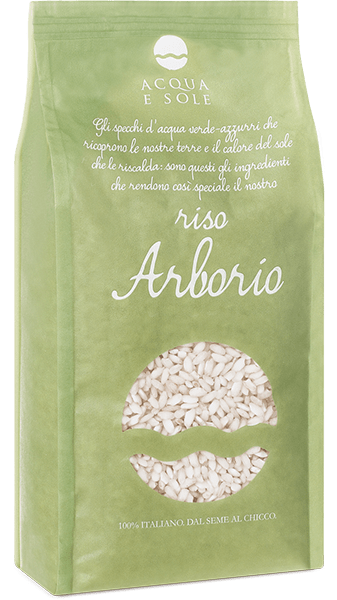
Arborio Acqua e Sole Rice
Our classic white Arborio, grown at Lumellogno and milled in our own rice mill. A large grain, rich in starch, with a delicate flavour. In the tricolour timbale it is the white band on top, the most visible one, the one that contrasts with the red of Il Cardinale and the black of Il Moro. For the timbale’s bite, 16 minutes in salted water is enough. A closed supply chain certified to ISO 9001, from the paddy field to the bag.
Bring Arborio homeOriginal Acqua e Sole recipe, from our kitchen at Lumellogno.