
Black Rice Timbale with Home-cured Salmon Gravlax
Salmon cured raw for 48 hours in salt, sugar and dill, sliced thin over a bed of our Il Moro black rice. A formal dinner.
A formal-dinner black rice timbale, with salmon cured at home raw in salt, sugar, dill and lemon zest for 36-48 hours. It is cleaned, sliced at 3-4 millimetres, and laid over a ring mould of warm Il Moro wholegrain black rice dressed with shallot, oil and lemon. Alongside, two commas of sweet dill mustard, micro herbs and flaked salt. Two days of calm, twenty-five minutes of active work, four people.
Gravlax is the Nordic method of curing salmon raw in salt, sugar and dill. It is simpler than it seems: you cover the salmon fillet with the cure, leave it for 36-48 hours in the fridge under a weight, clean it, and slice it very thin. The result is a firm, fragrant flesh with a refined flavour that makes all the difference compared with industrial smoked salmon.
For the base we use our Il Moro wholegrain black rice, grown on the Novara plain at Lumellogno and dried at low temperature in our drying house. The whole grain that comes out of our processing holds the shape of the ring mould and makes a perfect bed for the cured fish: deep black below, translucent pink above, a comma of sweet dill mustard to finish the plate. A recipe to prepare two days ahead, to plate at the last moment.
Ingredients for 4 People
Ingredients
- 280 g Il Moro Wholegrain Black Rice Acqua e Sole
- 400 g very fresh salmon, centre cut with skin, blast-frozen and declared fit for raw consumption
- 60 g coarse sea salt
- 60 g caster sugar
- 1 bunch fresh dill
- 1 teaspoon black peppercorns, crushed
- 1 unwaxed lemon (zest)
- 2 tablespoons vodka or gin (optional)
- 3 tablespoons mild sweet mustard
- 1 tablespoon white vinegar
- 1 tablespoon chopped dill (for the sauce)
- 1 small shallot, very finely chopped
- 3 tablespoons mild extra virgin olive oil
- to taste micro herbs (cress sprouts, fresh dill), Maldon salt, white pepper
Notes from Home
- Equipment: 4 round ring moulds of 7-8 cm, a sharp fish knife, a plate with a weight (a plate topped with 500 g jars)
- The salmon must be blast-frozen at minus twenty degrees for twenty-four hours before curing (Anisakis safety): ask the fishmonger or use the home blast chiller
- Centre cut with skin, always: the skin protects the flesh during curing and holds the slice when carving
- Fresh dill is irreplaceable: dried dill does not have the same aromatic intensity
- The vodka or gin are optional, they lightly disinfect the surface and bring a herbaceous note: the more traditional Swedish versions do not use them
- The rice is cooked on the day of serving, never well in advance: it needs to be warm under the cold gravlax
- Slice at 3-4 mm with the blade almost parallel to the board, from the tail towards the head, always perpendicular to the skin
Method
Day minus two: preparing the fillet (10 min)
Check that the salmon has been blast-frozen at minus twenty degrees for at least twenty-four hours. Bone the fillet with fish tweezers, running your fingers against the grain to locate the bones. Pat the flesh dry with kitchen paper, leaving the skin whole underneath.
Day minus two: dry curing (5 min)
In a bowl combine 60 g of coarse salt, 60 g of caster sugar, the grated zest of a lemon and the crushed black pepper. Mix well. In a baking dish spread half of the salt-sugar mixture, lay the fillet on top skin side down. Cover the flesh with half of the bunch of chopped dill, and if you decide to use them, brush with two tablespoons of vodka or gin. Spread the rest of the salt-sugar mixture over the whole surface of the fillet, then the other half of the dill.
Day minus two: weight and fridge (36-48 hours)
Cover the baking dish with cling film. Rest a flat plate on top and then two 500 g jars full of water as a weight: the pressure helps the cure penetrate evenly. Transfer to the fridge for 36-48 hours. Every 12 hours open it, turn the fillet over and redistribute the cure that has dissolved at the bottom. The fillet releases liquid, and that is the right thing.
Day zero: cleaning the gravlax (5 min)
Take the salmon out of the baking dish. Rinse it quickly under cold running water to remove the residual salt and the dissolved dill. Dry it very well with kitchen paper, above and below. Remove any dill left on the surface with the knife. The gravlax is ready: the flesh has become firmer, darker, fragrant.
Day zero: cooking the rice (30 min)
Bring a generous pot of salted water to the boil. Pour in the 280 g of our Il Moro, stir once only, and cook over a moderate heat for 30 minutes. Drain. Transfer to a bowl and dress while warm with the very finely chopped shallot, two tablespoons of extra virgin olive oil, the grated zest of half a lemon, fine salt and white pepper. Let it cool for 5 minutes, it should stay warm under the cold gravlax.
Sweet dill mustard (3 min)
In a small bowl mix 3 tablespoons of mild sweet mustard with 1 tablespoon of white vinegar, a tablespoon of extra virgin olive oil, a tablespoon of fresh chopped dill and a pinch of fine salt. Work with a small whisk until you have a smooth, fluid sauce. Taste it: it should be sweet and tangy, fragrant with dill. Adjust with a drop of honey if it needs more sweetness.
Slicing the gravlax (5 min)
Rest the gravlax on the board skin side down. With a sharp, long-bladed fish knife, slice at 3-4 mm perpendicular to the skin, starting from the tail towards the head, holding the blade almost parallel to the board. The slices should come out long, thin, translucent, pale pink in colour. Arrange them on a covered plate and keep at room temperature until serving.
Shaping the timbale (3 min)
Rest a ring mould in the centre of each flat serving plate. Fill it with the warm dressed rice, pressing lightly with the back of the spoon to level the layer without crushing it. Slide the ring mould upwards with a straight, decisive movement. The timbale should stand up, compact, two or three fingers tall.
Arranging the gravlax (3 min)
Lay three or four slices of gravlax over the timbale, letting them fall naturally so they spill a finger’s width over the edge of the rice, slightly overlapping. The pink of the salmon should cover the surface of the timbale and drape down the sides with grace. Do not overload it: the slice needs to breathe.
Finishing and serving (2 min)
With a teaspoon let a comma of sweet dill mustard fall beside the timbale and a smaller cloud on the opposite side. Scatter a few micro herbs over the gravlax (cress sprouts, sprigs of fresh dill), a pinch of Maldon salt at the very end and a light grind of white pepper. Serve at once, while the rice is still warm under the cold fish.
The buried salmon that becomes a home dinner
Gravlax in Swedish means buried salmon. It was born in the Nordic countries as a method of preserving fish before industrial refrigeration: fishermen covered the salmon with salt, sugar and aromatic herbs, and left it under a weight for days so that the dehydration and the pressure would concentrate the flavour without cooking. Today it is one of the most elegant preparations of fish, and it is made at home with little work: salt, sugar, dill, a weight, two days of calm in the fridge. For our timbale the whole grain of Il Moro does what dark bread does in Sweden: a firm bed that brings the pink of the cured fish to the table without covering it. Our kitchen in Lumellogno looks north from behind a rice field.
Lumellogno · the Novara plain · Nordic home cooking
Il Moro as a firm bed for cured salmon
Gravlax is a fragile preparation: the flesh is soft, cured, thin. Underneath it you need a base that does not steal the scene, that brings colour without covering the flavour. Our Il Moro works here for two precise reasons. First, the whole grain that comes out of low-temperature drying holds the shape of the ring mould without going to mush, takes the weight of the salmon slices, and leaves a clean black base beneath the pink of the fish. Second, the slightly herbaceous note that the wholegrain pericarp keeps speaks to the dill of the cure and to the juniper without having to add other spices.
«A formal dinner is not a question of rare ingredients. It is a question of time: two days of calm under a weight, a precise cleaning, a patient slicing. The rice we have grown plays its part without calling for attention.» From the kitchen of Acqua e Sole, Lumellogno
On the salmon, one single recommendation, which matters more than all the others. The fish must be blast-frozen at minus twenty degrees for at least twenty-four hours before curing, always, even if the supplier reassures you. Curing in salt and sugar does not kill Anisakis: you need the cold. Ask the fishmonger for a centre cut already blast-frozen and with a declaration of fitness for raw consumption, or put it yourself in the home freezer at full power for 24 hours before proceeding. It is a non-negotiable step.
Questions about home-cured gravlax
Do I really have to blast-freeze the salmon before curing?
Can I shorten the curing time below 36 hours?
What is the difference between home-made gravlax and supermarket smoked salmon?
Suggested Pairing
To accompany a formal-dinner dish like the black rice timbale with gravlax we stay among the Piedmontese whites and the Alta Langa sparkling wines, which speak by territory to our kitchen in Lumellogno. Our first choice is an Alta Langa DOCG Brut Pas Dose, a metodo classico made from Pinot Noir and Chardonnay with at least thirty months on the lees: the fine mousse cuts through the cured flesh, the notes of bread crust and hazelnut accompany the herbaceous note of the wholegrain black rice.
As an alternative, a still Erbaluce di Caluso DOCG, a native white wine of the Canavese made from erbaluce grapes: marked acidity, saline minerality, structure enough to stand up to the savouriness of the gravlax without covering its aroma of dill and lemon. Avoid soft whites, too aromatic or of full barrel-aged maturity: they work against the cure and against the sweet mustard sauce.
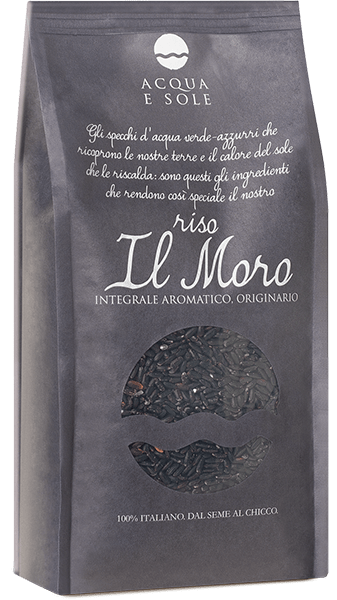
Il Moro Wholegrain Black Rice Acqua e Sole
Our wholegrain black rice, grown at Lumellogno on the Novara plain and dried at low temperature in our drying house. A whole grain that holds the shape of the ring mould under the weight of the gravlax slices, a herbaceous note that speaks to the dill of the cure without covering the natural sweetness of the salmon. The right variety for cured fish timbales, formal starters, dishes where you need structure and colour without dominance.
Take Il Moro homeOriginal Acqua e Sole recipe, from our kitchen in Lumellogno.